KATHMANDU: Nepal’s devastating flood and debris disaster has claimed more than 1000 lives, while over 4,300 people remain missing, even as rescuers race against time to reach workers trapped inside the Upper Trishuli 3 ‘A’ Hydropower Project tunnel.
The rescue operation has entered a critical phase, but there has been no response from the trapped workers despite repeated attempts by Nepali Army personnel to establish contact from inside the tunnel.
A 90-member joint rescue team is working continuously at the hydropower project, comprising 66 Nepali Army personnel, including a specially trained search-and-rescue team with sniffer dogs, 18 Armed Police Force personnel and six Nepal Police personnel.
Army engineers have resorted to drilling, heavy machinery and controlled blasting to penetrate the blocked section of the tunnel and widen the access point.
The rescue team reached the tunnel’s main section, or crown head, at around 2 pm and created a 2-by-3-foot opening. Personnel then descended by ropes into the tunnel and called out to the workers.
There was no response.
The silence from inside has intensified fears for the workers, whose condition remains unknown. Rescuers are nevertheless continuing operations round the clock, carefully widening the opening while confronting unstable rock, debris and the continuing risk of further collapse.
The desperate tunnel operation is unfolding against the backdrop of one of the worst Himalayan disasters in recent years.
Nepal’s death toll has crossed 900, according to the latest figures attributed to the National Disaster Risk Reduction and Management Authority, while more than 4,300 people remain missing.
The numbers are expected to change as rescue teams reach areas that have remained cut off since the catastrophic surge of water, mud, rocks and debris swept through the border region.
On the Chinese side of the affected Tibetan territory, Chinese reports have put the death toll at 16, with more than 4,500 people reported missing. A comprehensive updated assessment has yet to come from both Chinese and Nepalese authorities so.
The enormous number of missing people has turned the disaster into a race against time across both sides of the border.
Chitwan: As many as 272 bodies have been retrieved in Chitwan following the devastating floods, but only 10 have so far been identified and claimed by their relatives, according to reports.
Chitwan Chief District Officer said the remaining 262 unidentified bodies have been subjected to “underground disposal” as authorities struggle to manage the large number of casualties.
The grim development highlights the scale of the disaster and the continuing challenge of identifying victims, with families still searching for missing relatives.
Rescue teams are gradually reaching communities previously cut off after roads, bridges and communication links were destroyed along the Bhotekoshi-Trishuli corridor.
The devastation extends for more than 200 kilometres downstream, with entire stretches of the river valley buried beneath mud and debris.
Villages, temporary camps, tourist settlements, houses, roads, vehicles and bridges have been swept away or submerged.
The scale of the flood is evident from the debris marks mapped by rescue teams, with the flood level reportedly reaching nearly 60 metres, or around 190 feet, at some locations.
The exact trigger of the catastrophe remains unclear. Chinese authorities and agencies have attributed the disaster to a glacier collapse in the Langtang Lirung region, while earlier reports pointed to a sudden release of enormous quantities of water, ice, rocks and debris upstream.
Neither Nepal nor China has yet issued a definitive joint scientific assessment establishing the precise sequence of events.
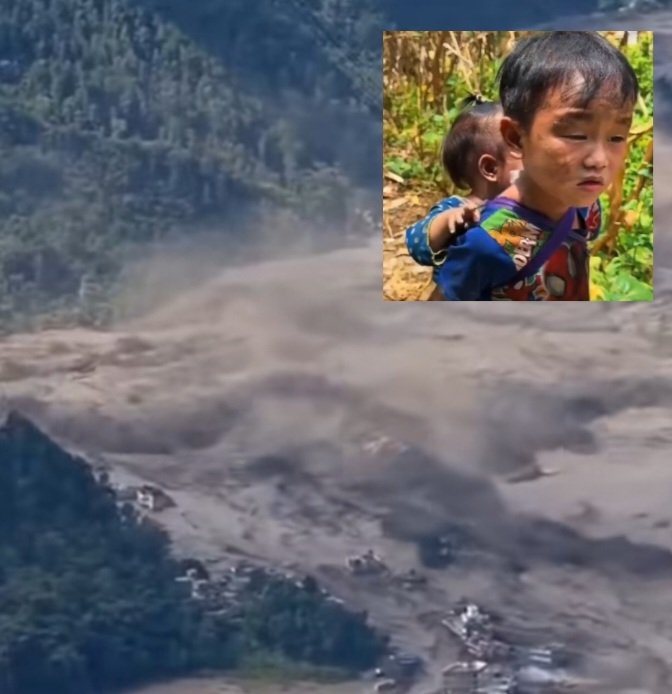
Satellite imagery and videos emerging from the affected region, however, show the extraordinary destructive force of the surge as it travelled downstream.
The Bhotekoshi and Trishuli river systems have been left choked with mud, boulders and debris, while riverbanks have been dramatically altered.
The destruction has also severely damaged roads and border infrastructure, making the movement of rescue personnel and heavy equipment extremely difficult.
About 261 foreigners are reportedly among those missing, including nationals from India, Latvia and the United States.
The Indian nationals reported missing have added to the urgency, with families waiting anxiously for information as rescue teams push into previously inaccessible areas.
On the Chinese side, restoration work is also continuing, but around 1.15 kilometres of road reportedly remains to be cleared before rescuers can fully reach the affected border area.
The weather could further complicate the operation.
Forecasts of continuing rain over parts of the affected Tibetan region and the Nepalese side of the border have raised fears of fresh landslides, flooding and renewed debris movement.
In the Trishuli and Nuwakot valleys, rescue teams are therefore working under intense pressure to reach isolated settlements and locate survivors before conditions deteriorate again.
But at the Upper Trishuli 3 ‘A’ tunnel, the immediate priority remains the same — finding the trapped workers.
Drilling and Blasting continue the access point is being widened. Rescuers continue to call into the darkness.
But there is still no response from inside.
For the families waiting outside, the silence has become the most agonising part of a disaster already measured in hundreds of deaths and thousands of missing people.
And for the rescue teams, every passing hour is now critical.