CHANDIGARH/NEW DELHI: The controversy surrounding actor-singer Diljit Dosanjh's upcoming film Satluj has evolved into a wider national debate over Punjab's violent insurgency, historical memory, human rights, and the relationship between Sikh and Hindu communities.
Politicians, retired military officers, journalists, academics, activists and social media users have sharply divided over whether the film presents a balanced account of one of India's most traumatic chapters.
At the centre of the debate is the portrayal of human rights activist Jaswant Singh Khalra, who documented alleged illegal cremations and custodial killings during Punjab's counter-insurgency operations in the 1990s. Supporters of the film argue that Khalra's work exposed serious human rights violations that deserved public attention.
Critics, however, contend that the film isolates those abuses from the broader context of Pakistan-backed Khalistani terrorism, thereby presenting what they describe as an incomplete and politically loaded narrative.
Khalra's Human Rights Campaign
Jaswant Singh Khalra disappeared in September 1995 after campaigning to document alleged illegal cremations of unidentified bodies in Amritsar, Tarn Taran and Majitha.
His investigations later became the subject of judicial scrutiny and National Human Rights Commission proceedings. Several police officials were eventually convicted in connection with his abduction and murder.
Human rights groups regard Khalra as a whistleblower who paid with his life for exposing custodial abuses. His supporters argue that democratic societies must acknowledge excesses committed by state agencies even while combating terrorism.
Critics Demand Complete Historical Context
Opponents of the film argue that while police excesses should never be denied, any portrayal of the period must also acknowledge the scale of violence unleashed by Khalistani militant organisations during the 1980s and early 1990s.
They point to numerous attacks, including bus massacres, targeted killings of civilians, assassinations of public officials, bombings and extortion campaigns that claimed thousands of lives.
Victims included Hindus, Sikhs, journalists, teachers, police personnel, village defence volunteers and government employees.
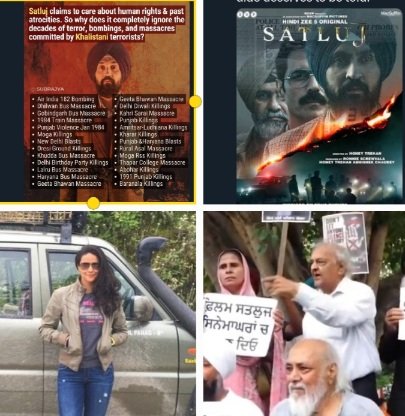
Several commentators cited incidents such as the Dhilwan bus killings (1983), Lalru bus massacre (1987), Fatehabad killings (1987), the 1991 train massacres, and the bombing of Air India Flight 182 in 1985 as examples of violence they believe has been omitted or downplayed in the film's narrative.
Divided Public Voices
The controversy has generated diverse reactions. Former Army Chief General Ved Malik has reportedly said that films dealing with such sensitive subjects should be factual, objective and unbiased.
Actor Gul Panag, who grew up in Punjab during the insurgency, has argued that difficult periods of history should continue to be examined rather than avoided.
She recalled both militant violence and allegations of innocent youths being illegally detained and tortured, stressing that uncomfortable histories deserve to be told.
Former journalists and investigators who worked in Punjab during the insurgency have also entered the debate, saying that they witnessed both terrorist atrocities and instances of alleged excesses by security forces.
According to them, an honest account must acknowledge both realities rather than presenting only one.
KPS Gill's Legacy Again Under Spotlight
The film has also revived debate over former Punjab Police chief K.P.S. Gill.
Supporters describe Gill as the officer who led Punjab's successful campaign against terrorism and restored normalcy after years of insurgency.
Critics maintain that serious allegations of fake encounters, enforced disappearances and custodial killings during the counter-insurgency cannot be ignored while assessing his legacy.
This debate has persisted for decades and remains deeply polarising.
Hindu-Sikh Relationship Becomes Part of Debate
Parallel to the film controversy, social media has witnessed renewed discussion over the historical relationship between Hindus and Sikhs.
Many users emphasised that Sikhism emerged in Punjab within a broader Indian civilisational context and highlighted the close familial ties historically shared by Hindu and Sikh families.
Several cited the long-standing tradition in parts of Punjab where families had both keshdhari (unshorn hair) and clean-shaven members, while others referred to traditions of dedicating one son to the Sikh faith.
Some commentators argued that attempts to create divisions between Hindus and Sikhs ignore centuries of shared history and common resistance to oppression.
However, historians caution that many viral claims circulating online—including assertions about the origins of Sikhism, practices of dedicating eldest sons, or broad generalisations regarding communities—remain subjects of scholarly debate and should not be treated as universally established historical facts without documentary evidence.
Political Overtones
The controversy has also acquired political dimensions, with criticism directed at leaders over statements regarding Sikh history and the protection of Hindus during the Mughal period.
Several social media posts accused separatist organisations of attempting to rewrite Punjab's history, while others alleged that state institutions have historically suppressed uncomfortable truths regarding human rights violations.
Historians Call for Nuance
Scholars studying Punjab generally agree that the insurgency was one of independent India's bloodiest internal conflicts. The period witnessed:
Pakistan-backed Khalistani militancy and terrorist violence.
Large-scale counter-insurgency operations by security forces.
Documented human rights violations.
Thousands of civilian casualties across communities.
Deep social and psychological trauma that continues to influence Punjab's politics and public memory.
Many historians argue that reducing this complex period to either "state repression alone" or "terrorism alone" oversimplifies history.
The Larger Question
Beyond the fate of Satluj, the controversy has reopened enduring questions about how societies remember violent conflicts.
While one section insists that victims of alleged state excesses deserve recognition, another argues that the sacrifices of civilians, police personnel and security forces who confronted Khalistani terrorism should receive equal attention.
As the debate intensifies, the central issue remains whether historical cinema should focus on one individual's story or bear the responsibility of presenting the broader context of one of India's most painful and contested periods.
(Many of the claims circulating on social media regarding Sikh history, community traditions, political organisations and individual roles remain contested and are not universally accepted by historians. Distinguishing verified historical facts from opinion, interpretation and political rhetoric is essential when evaluating such narratives).