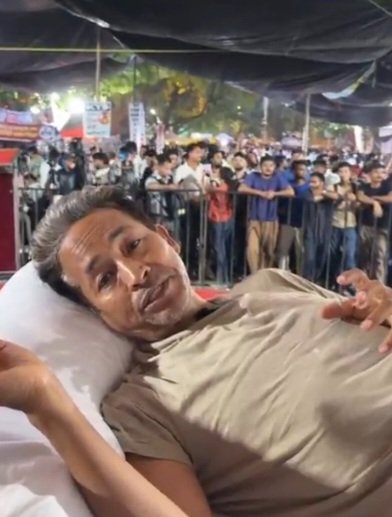
New Delhi/Leh: Anxiety is growing over the health of renowned education reformer and environmentalist Sonam Wangchuk, whose indefinite hunger strike entered its 19th day on Thursday. Medical updates from those attending to him indicate that he has lost around nine kilograms, while his blood pressure has fallen, raising concerns that prolonged fasting could soon lead to serious health complications.
Wangchuk launched the fast demanding the resignation of Union Education Minister Dharmendra Pradhan, holding him morally accountable for the NEET-UG examination paper leak and alleged irregularities that sparked nationwide protests.
Supporters of the campaign say the examination controversy pushed several students into despair and has been linked to the reported suicides of more than 25 aspirants, making the demand for accountability even more urgent.
Despite his weakening condition, Wangchuk has refused to call off his protest. In a message to supporters, he said, "I'm not in good shape but not so bad either. Rather than asking me to break my fast, join me on July 20 for the Peaceful March to Parliament." He maintained that the movement should continue through peaceful democratic means.
His deteriorating health has triggered concern across Ladakh and the Himalayan states, with citizens, student groups, environmental activists and civil society organisations urging the Centre to engage with the protesters before the situation worsens. Many believe Wangchuk's life should not be put at further risk and have appealed for meaningful dialogue to resolve the impasse.
Political support for Wangchuk has also grown. J&K Chief Minister Omar Abdullah says, "Politics has its place, but there must also be a room for humanity and compassion. Recall the time at Ramlila Maidan during Dr. Manmohan Singh’s government, when Anna Hazare and his associates were staging a hunger strike in a similar manner.
The government sent ministers to engage with them and tried to persuade them to call off the strike and come to the negotiating table. But no attempt has been made so far to initiate a dialogue with Sonam Wangchuk. We do not know what stance the government will take ahead, but we are certainly concerned about Sonam Wangchuk’s health.
Many people have visited him. His demand is not wrong. It is a legitimate demand but the government does not seem to pay attention to these matters."
Samajwadi Party president Akhilesh Yadav said he spoke with Wangchuk over the phone, inquired about his health and urged him to end his fast while assuring him of support for his campaign. Yadav said the country needs Wangchuk's moral leadership and appealed to him to regain his health before continuing the movement.
At the same time, some public voices have appealed to activist Abhijit Dipte and other organisers to persuade Wangchuk to accept medical treatment, arguing that while the demand for justice over the NEET controversy is legitimate, no democratic movement should come at the cost of a human life.
As Wangchuk prepares for the proposed Peaceful March to Parliament on July 20, pressure is mounting on both the government and protest organisers to find a peaceful resolution. With his health reportedly deteriorating by the day, concern continues to spread across the Himalayan region that any further delay in resolving the issue could have irreversible consequences.