Dehradun district records 20.22% decline; women voters see higher percentage reduction in 36 constituencies
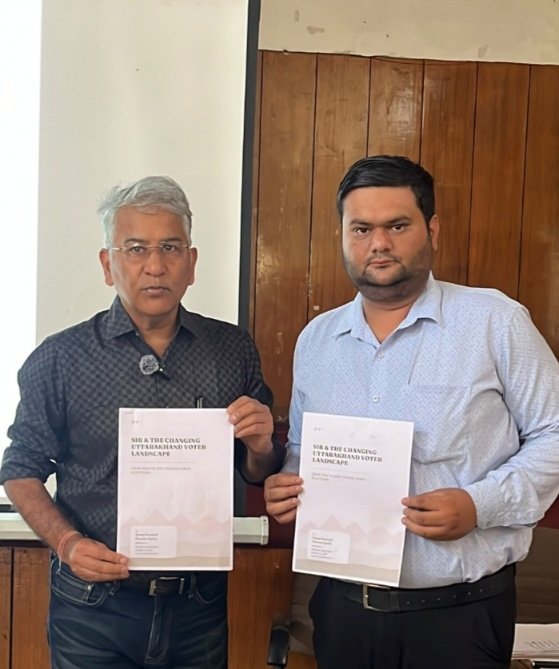
Dehradun, October 17: Uttarakhand’s electoral roll has shrunk by 11,07,695 voters, or 13.40%, since the 2022 Assembly elections, according to a report released in Dehradun on Saturday, raising questions over the scale of deletions under the Special Intensive Revision (SIR) as the controversy over the exercise intensifies nationally.
The report, titled *SIR and the Changing Uttarakhand Voter Landscape: From 2022 to 2027 Vidhan Sabha Elections*, was released by social worker Anoop Nautiyal and Praveen Upreti at the Dehradun Press Club. Its findings come against the backdrop of protests in Delhi against the SIR exercise and demands for the removal of Chief Election Commissioner Gyanesh Kumar, with opposition to the revision centred on transparency, voter deletions and the protection of voting rights.
According to the report, Uttarakhand’s electorate declined from 82,66,644 voters in 2022 to approximately 71.59 lakh in the final electoral roll published on October 3, 2026. The reduction comes after the state added approximately 18.89 lakh electors between the 2012 and 2022 Assembly elections.
The report calls for a constituency-wise and polling-station-wise explanation of the reduction, including deletions due to deaths, migration, duplicate entries and other corrections. It argues that the Election Commission of India (ECI) should disclose the reasons for the deletions and reconcile the latest figures with previous electoral rolls.
The report places Uttarakhand’s 13.40% decline above the reductions it cites for other states. Uttar Pradesh recorded an approximately 11.4% reduction, Tamil Nadu 8.79%, West Bengal 6.88%, Goa 9.18%, Manipur 5.28% and Punjab 0.7%. Kerala recorded a decline of 1.12%, while Bihar and Assam registered increases in their respective comparisons.
However, the report cautions that these figures relate to different reference years, publication dates and revision exercises and do not constitute a definitive like-for-like ranking. It has called for a standardised comparison to establish the reasons behind Uttarakhand’s sharp reduction.
The decline is particularly pronounced in Dehradun district, which recorded a reduction of approximately 3.03 lakh electors, or 20.22%, the highest district-level percentage decline identified in the report. Pauri Garhwal recorded a 14.89% reduction, Pithoragarh 13.61% and Tehri Garhwal 13.14%.
At the Assembly constituency level, Dehradun Cantt recorded a 34.19% decline, Rajpur Road 32.64% and Dharampur 27.59%. The report has sought a detailed review of these constituencies and disclosure of the reasons for the exceptional reductions.
Anoop Nautiyal said the findings raised questions about transparency, accountability and public confidence in the electoral process. He said voters should not have to struggle to establish whether their names remain on the electoral rolls and urged the Election Commission to proactively reach out to eligible electors.
Maintaining accurate electoral rolls was not merely an administrative exercise but fundamental to the credibility of elections, he said, calling for transparent data disclosure, timely reporting and accessible grievance-redressal mechanisms.
The report also flags gender-wise disparities in the reductions. In 36 of Uttarakhand’s 70 Assembly constituencies, the percentage decline in women electors was higher than that among men. The pattern was also identified in Udham Singh Nagar, Haridwar, Tehri Garhwal, Uttarkashi and Almora districts.
According to the report, Dwarahat was the only constituency in the 2022 Assembly elections where women voters outnumbered men. In the 2027 electoral-roll figures examined, no constituency has more women electors than men.
The report does not establish why women’s electoral numbers have declined at a higher rate in these constituencies. It calls on the ECI to publish constituency-wise and polling-station-wise gender-disaggregated figures before and after revision, along with the reasons recorded for deletions. It has also sought accessible enrolment and correction facilities for women whose names may be missing from the rolls.
A comparison between Rajpur Road and the Himalayan constituencies of Badrinath and Kedarnath illustrates the scale of the changes.
In 2022, Rajpur Road had 1,19,615 electors, compared with 1,04,795 in Badrinath and 93,016 in Kedarnath. In the final roll published on October 3, 2026, Rajpur Road had 80,569 electors, while Badrinath had 91,555 and Kedarnath 85,924.
Rajpur Road’s electorate has thus fallen by 39,046 since 2022, compared with a reduction of 13,240 in Badrinath and 7,092 in Kedarnath. Rajpur Road now has fewer registered electors than either of the two Himalayan constituencies.
The report has also sought reconciliation of the ASDD and “no mapping” figures for Rajpur Road, Badrinath and Kedarnath, as well as other constituencies showing significant changes.
Its recommendations include a complete account of the 11.07 lakh reduction, categorised by reason for deletion; a standardised state-wise comparison; a gender-wise review of all 70 constituencies; and a detailed examination of Dehradun Cantt, Rajpur Road and Dharampur.
It has further called for the ongoing Special Summary Revision to provide eligible voters with accessible opportunities to verify their names, file claims and corrections, and track applications and grievances through timely public reporting.
The findings come as the SIR exercise has become a major political and institutional controversy, with protests in Delhi seeking the ouster of Chief Election Commissioner Gyanesh Kumar. The Uttarakhand report adds state-specific figures to the wider debate over how electoral rolls are revised and how the Election Commission accounts for large-scale changes in voter numbers.
The report’s figures, however, do not by themselves establish that the deletions were wrongful or politically motivated. The reasons for the decline, the status of eligible voters whose names have been removed and the extent to which the figures reflect deaths, migration, duplicate entries or other corrections remain matters requiring detailed verification.
Nautiyal said the report aimed to strengthen electoral transparency, public confidence and the fundamental right of every eligible citizen to be registered as a voter.
#Uttarakhand #SIR #ElectionCommission #GyaneshKumar