New Delhi, July 23: In the Gandhian philosophy of Satyagraha, peaceful protest is not a sign of weakness but of moral strength.
It seeks justice through non-violence, dialogue and self-sacrifice rather than force, believing that truth ultimately prevails over coercion.
As student protests spread across the country over alleged paper leaks and demands for accountability in the education system, social reformer Sonam Wangchuk on Thursday reminded protesters to remain steadfast on the path of peace.
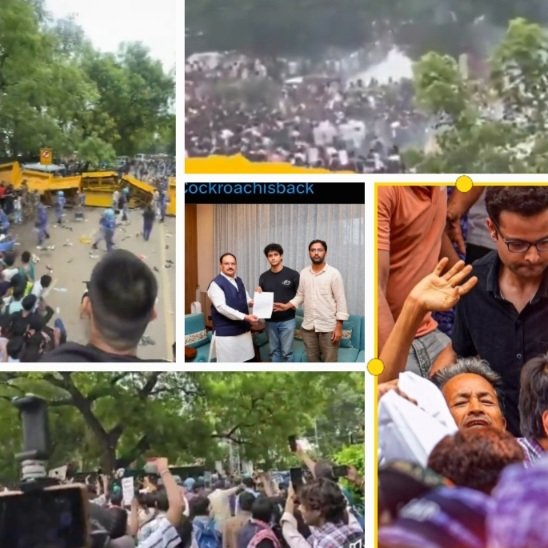
Speaking from his hospital bed on the 26th day of his hunger strike, Wangchuk said he was deeply pained to learn that while demonstrations at Jantar Mantar had remained peaceful, some anti-social elements elsewhere were allegedly trying to exploit the movement to provoke violence.
"Peace and only peace is my way. No matter what the other side does, our response must only be flowers. Please keep this tradition at all costs," he appealed, urging protesters not to allow provocations to derail the movement.
His appeal came as the agitation appeared to be expanding beyond student organisations. What began as a movement led by students is increasingly drawing support from parents, teachers, professionals, social activists and sections of the general public, reflecting wider concerns over repeated examination controversies and the future of the country's education system.
At the centre of the movement, the Cockroach Janta Party (CJP) hardened its stand, rejecting the Centre's latest outreach for talks. CJP leader Das said negotiations would be held only at Jantar Mantar or another mutually agreed neutral venue and not at the residences or offices of Union ministers.
He reiterated that the resignation of Union Education Minister Dharmendra Pradhan remained non-negotiable, maintaining that meaningful dialogue could begin only after political accountability was fixed.
The government's conciliatory outreach continued through Union Minister Dr. Jitendra Singh, who said the Centre had sent formal proposals for discussions with student representatives four times in the last 24 hours.
"We do not stand on prestige. Union Health Minister J.P. Nadda and I are ready for discussions. Talks can take place at Shri Nadda's office or residence. The government is prepared to discuss all issues at any convenient time and place," he said, describing the invitation as part of the government's continuing efforts to resolve the crisis through dialogue.
Despite the repeated offers, the impasse remained, with protesting groups insisting that talks without concrete action, including the removal of the Education Minister, would not address the core grievances.
The political confrontation intensified as Congress leaders attempted to march in solidarity with students, first towards India Gate and later to the site where Mahatma Gandhi was assassinated. Police prevented the march by erecting barricades.
Congress general secretary Priyanka Gandhi Vadra accused the Modi government of betraying Gandhi's democratic legacy.
She said that in the country where Mahatma Gandhi led peaceful movements with farmers and ordinary people without raising a hand against anyone, students were now allegedly being beaten simply for demanding their rights and accountability over repeated paper leaks.
Opposition leaders alleged that the government was "murdering democracy" by suppressing peaceful dissent, refusing to listen to students and declining to remove Education Minister Dharmendra Pradhan despite sustained nationwide protests. They argued that if students were on the streets demanding justice, elected representatives had a democratic obligation to stand with them.
Veteran social activist Anna Hazare also joined the chorus by staging a silent protest in Delhi in solidarity with students and was seen becoming emotional while expressing concern over the future of the country's youth.
Meanwhile, authorities ordered the suspension of internet services for eight hours within a 1.5-kilometre radius of Jantar Mantar, drawing criticism from opposition parties and civil society groups, who questioned the need for such restrictions during predominantly peaceful demonstrations.
Amid the escalating standoff, there was also growing speculation in political and security circles that the Centre could invoke provisions under the National Security Act (NSA) and authorise the Delhi Lieutenant Governor with additional powers to deal with the unfolding situation.
While there was no official confirmation of any such move, the possibility itself sparked concern among several observers and civil society voices, who warned that introducing extraordinary security measures against a predominantly student-led movement could add fuel to the fire, deepen mistrust and further inflame public sentiment at a time when dialogue remained possible.
Delhi Police, meanwhile, said it had identified and blocked several social media handles allegedly involved in coordinated misinformation campaigns and appealed to students and young people to remain cautious of rumours and misleading content being circulated from foreign accounts.
Former senior police officer Julio Ribeiro suggested an alternative approach to handling student demonstrations. He proposed that trained Civil Defence and Home Guards should form the first line of response during protests instead of riot police.
Equipped with protective gear but not lathis, they could reduce direct confrontation, while armed police should intervene only if there was a genuine threat to life or property. He argued that such a model would minimise allegations of excessive force and preserve public trust.
As the movement entered another decisive day, two sharply contrasting narratives dominated the national discourse.
The government maintained that its doors remained open for dialogue and claimed to have repeatedly invited student representatives for talks. Protest leaders, however, insisted that accountability must precede negotiations and maintained that Dharmendra Pradhan's resignation was indispensable.
The movement now stands at a critical juncture. Whether the crisis is resolved through dialogue or deepens into a wider political confrontation may depend on how quickly both sides bridge the growing trust deficit without abandoning the Gandhian principles of peaceful democratic protest. But one thing is clear Pradhan has to go.