Sacred Forests Axed, Cracks Appear, Locals Warn of Impending Ecological Catastrophe
KULLU/SHIMLA – The serene hilltop of Bijli Mahadev, one of Himachal’s most revered shrines, is today at the centre of a growing storm.
Citing clues from Seraj where ecological mayhem this season, is more than visible, the nature lovers warn the HP tourism department and state government on what is slowlyand surely shaping up as a ma made disaster in the making.
What began as a ropeway dream project—touted to boost tourism and provide easier access to the shrine—is fast turning into a nightmare.
Cracks are now visible not just on the sacred slopes, but in the very idea of development without accountability.
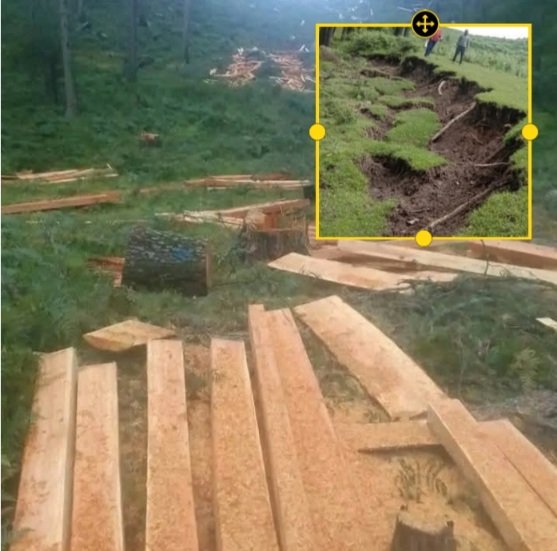
In the name of progress, tens or hundreds of ancient deodar and kail trees have been axed, leaving behind a trail of stumps where once sacred forest thrived.
Official records list around 80 trees cut and 7 hectares of land diverted, but ground reports suggest the ecological loss is far greater.
The slope—long considered fragile—is now riddled with visible fissures, raising fears of a man-made disaster waiting to unfold.
Locals, priests, and environmentalists have repeatedly opposed the project, citing spiritual, ecological, and geological reasons.
The deity’s own 'oracle' had warned against construction, but their voices have been drowned out by a powerful nexus of construction lobbies and local political backers determined to push the project through.
The ₹270–₹284 crore ropeway aims to carry pilgrims in just seven minutes to the hilltop temple located at an altitude of 2,460 metres.
But the environmental cost of this convenience could be irreversible.
The project received a major push when the Union Environment Ministry exempted ropeways from forest clearance norms, waiving off key safeguards such as compensatory afforestation and mandatory NPV (Net Present Value) payments.
Documents accessed from the Himachal Pradesh Tourism Department show that the original proposal under the Forest Conservation Act accounted for just 2.1 hectares and ₹10 crore forest-related costs—drastically downplaying the true impact.
On the ground, however, the damage runs deeper: the land is scarred, tree roots lie exposed, and greenery has vanished.
The situation has triggered alarm across the Kullu Valley.
Residents fear the cutting of forests and heavy construction in such a geologically sensitive area could lead to massive landslides, especially during the monsoon. With Kullu town lying directly below Bijli Mahadev, the stakes couldn't be higher.
“This isn’t tourism. It’s ecological terrorism,” said a local forest rights activist. “What good is a ropeway if it destabilizes the very mountain it climbs?”
Several delegations, including temple priests, conservationists, and villagers, had in the past urged the district administration and even filed petitions against the project. Despite temporary halts, the axe returned with more force—and so did the machines.
The spiritual sanctity of Bijli Mahadev, often referred to as the “Lightning God,” is also being overlooked.
"If the deity says no, who are we to say yes?" asked an elderly villager, echoing a belief held strongly by many in the region.
Meanwhile, construction continues. The mountain groans under the weight of ambition, and the cracks deepen—both literally and figuratively.
The question now hangs heavy in the Kullu air: Will authorities listen before it’s too late—or will this shrine be sacrificed at the altar of unchecked development?
#SaveBijliMahadev #DevelopmentOrDestruction #SacredNotForSale #EcologyMatters