Himalayan States, Downstream Regions Must Unite to Fight Climate Crisis: Experts Urge NITI Aayog to Create National Mountain Coalition
 SHIMLA/NEW DELHI: In a major policy intervention that could redefine India's approach towards the fragile Himalayan region, experts from across the Indian Himalayan Region (IHR) have called upon the Centre and NITI Aayog to establish a national coalition of Himalayan and downstream states to jointly address climate change, water security, ecological degradation, floods and unsustainable development.
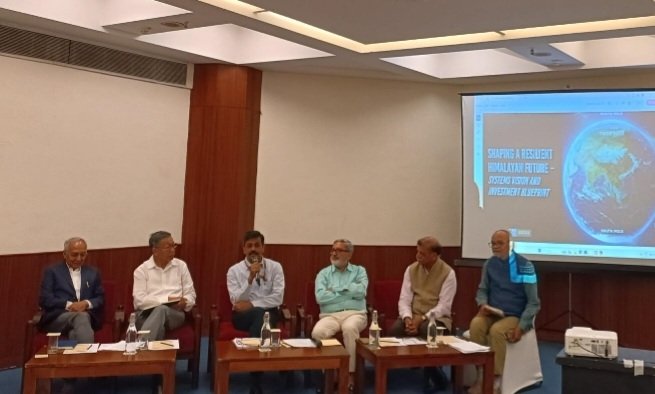
The call emerged from a high-level consultation jointly organised by the Integrated Mountain Initiative (IMI) and SYSTEMIQ, a London-based organisation working globally on climate change and sustainable development.
Experts expressed deep concern over the growing impact of climate change on Himalayan ecosystems and communities, blaming a directionless, unscientific and community-insensitive model of development for worsening environmental degradation across the mountains.
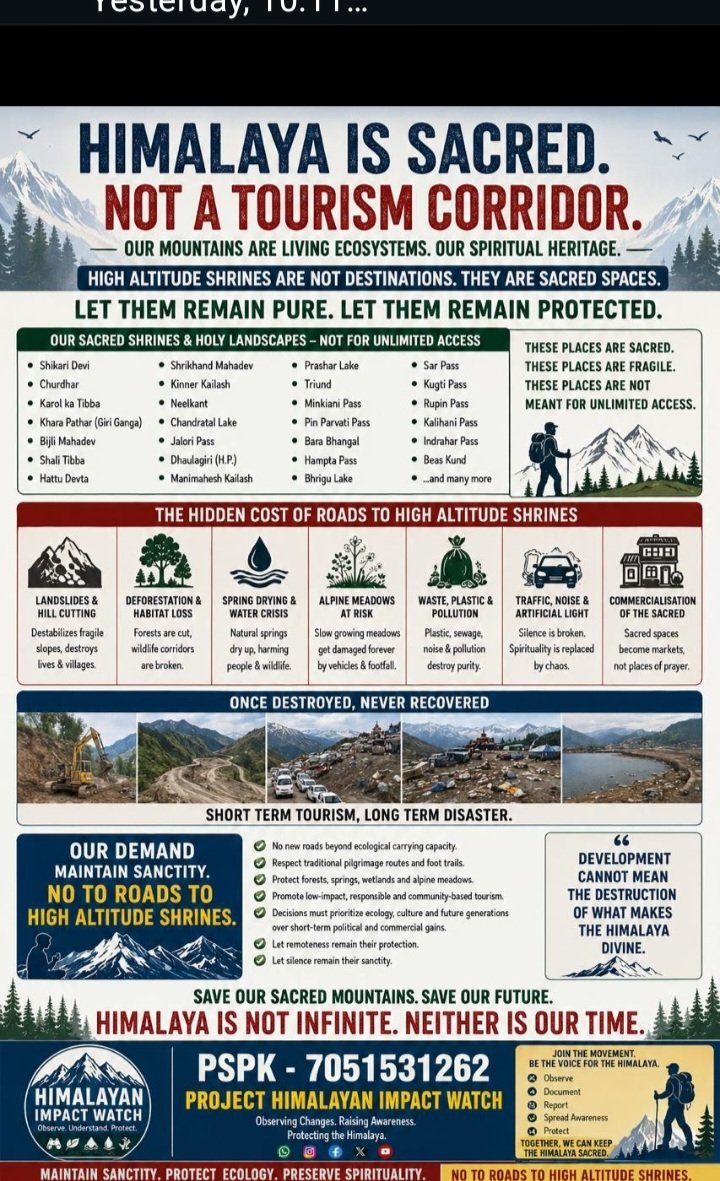
Participants warned that uncontrolled and unregulated tourism is eroding local culture, overwhelming fragile ecosystems and turning rivers, forests and pilgrimage centres into garbage dumps.
The traditional spiritual sanctity of many Himalayan shrines, they observed, is increasingly being drowned in the din of loud music, reckless commercialisation and behaviour that disregards local customs and traditions.
Opening the consultation, former IMI President Sushil Ralola urged NITI Aayog to formulate a dedicated National Himalayan Tourism Policy rooted in local traditions, ecological carrying capacity and community sensitivities.
Former NITI Aayog Advisor V.K. Jain advocated the creation of a distinct "Himalayan Narrative" that redefines development and economics through a mountain lens.
He argued that conservation, ecology and community well-being must take precedence over short-term profits and conventional growth indicators.
Former Sikkim MP P.D. Rai highlighted the demographic challenges confronting the Himalayan region, warning that declining populations in mountain districts and increasing dependence on migrant labour could lead to social tensions and cultural disruption in the future.
IMI President Ramesh Negi called for the immediate revival of the Council of Himalayan States, established in 2018 but lying dormant since then.
He said the platform was envisioned to bring all Himalayan states and Union Territories onto a common policy framework for addressing climate change, disaster management, ecological conservation and sustainable development.
Negi also stressed the need for a dedicated Himalayan Construction Code, arguing that infrastructure and engineering standards designed for the plains are often unsuitable for the fragile geology and seismic vulnerability of mountain regions.
Representing Nagaland, Amba Zamir lamented the disconnect between development agencies and local communities.
He said traditional ecological knowledge and time-tested sustainable practices are routinely ignored in policy planning.
He also called for a review of large-scale plantation drives involving rubber and palm oil, warning that they could have adverse ecological consequences.
Arushi Chopra, Team Leader at SYSTEMIQ, presented a blueprint for sustainable and investible projects that integrate private sector participation with community ownership while remaining firmly anchored in conservation, sustainability and social consensus.
One of the strongest recommendations to emerge from the consultation was the creation of a formal alliance between Himalayan and downstream states.
Experts emphasized that such a coalition should bring together all Himalayan states and Union Territories — Jammu & Kashmir, Ladakh, Himachal Pradesh, Uttarakhand, Sikkim, Arunachal Pradesh, Nagaland, Manipur, Mizoram, Meghalaya and Tripura, along with the hill regions of Assam — and the downstream states that depend heavily on Himalayan rivers for water, agriculture, energy and livelihoods.
In the western Himalayas, the proposed coalition would cover the Indus, Chenab, Ravi, Beas and Sutlej river basins, linking mountain regions with downstream beneficiaries in Punjab, Haryana, Rajasthan and other parts of northwestern India.
In the central Himalayas, it would connect the upper catchments of the Ganga and Yamuna with downstream states including Delhi, Uttar Pradesh, Haryana, Bihar, Jharkhand and West Bengal.
In the eastern Himalayas, the coalition would encompass the Brahmaputra basin, bringing together mountain states such as Arunachal Pradesh, Sikkim and the Northeast with downstream regions in Assam and Bangladesh.
Participants noted that while Himalayan states bear the burden of conserving forests, glaciers, rivers and biodiversity, the benefits flow far beyond the mountains.
Water, fertile soil, hydropower potential and vital ecosystem services generated in the Himalayas sustain hundreds of millions of people living in the plains.
"The Himalayas cannot be protected by mountain states alone. Those who benefit from Himalayan rivers must also share responsibility for safeguarding the source ecosystems," was a sentiment echoed by many participants.
Experts argued that a National Coalition of Himalayan and Downstream States could become a powerful institutional platform for coordinated action on water management, flood mitigation, disaster preparedness, climate adaptation, ecosystem restoration and long-term ecological security.
Representatives from Himalayan states, NITI Aayog, ICIMOD, UNDP, the Indian Meteorological Society and independent environmental practitioners participated in the consultation.
The experts asserted that the policymakers in New Delhi must think and understand that India's water security, food security, energy security and climate resilience are inseparable from the health of the Himalayas.
Unless mountain communities, ecological wisdom and scientific understanding are placed at the heart of national planning, the country risks undermining one of its most critical natural life-support systems.
The consultation also underscored the need for a "Himalayan Way of Life" framework that recognizes the mountains not merely as resources to be exploited but as living ecological and cultural spaces whose protection is fundamental to India's sustainable future.
#SaveHimalayas #HimalayanNarrative #ClimateResilientIndia #MountainToPlainsPartnership