
Science Speaks: Chander Shekhar’s Fast Becomes a Call for Rationality
DHARAMPUR/DHARAMSHALA: Himachal Pradesh is currently reeling under devastating natural calamities.
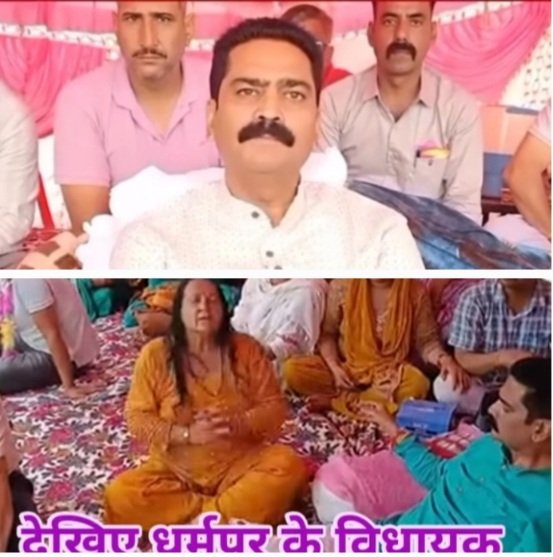
Torrential rains have thrown daily life out of gear. Amid this chaos, Chander Shekhar, the young MLA from Dharampur, has emerged as a rallying point.
His indefinite hunger strike against unscientific mining, reckless four-lane construction, and the irreparable damage these practices are causing to Himachal’s ecology and people has become the talk of the state — and even beyond.
He has demanded immediate intervention of Nitin Gadkari to initiate action against the erring Company wreaking massive damage in the road project. There is no accountability fixed in the ruthless destruction of ecology, MLA has charged.
As I write this, his fast has entered its sixth day.
His health is fragile. He suffers from mild diabetes and other ailments, and to see him go without food and water for six straight days worries me deeply.
Such strain could trigger complications that may haunt him for the rest of his life.
I am now 50 years old. For the past 30 years, I have devoted myself to the popularization of science.
Frankly, my only interest in politics, governments, and decision-making agencies lies in seeing who genuinely supports science, rational thinking, and scientific methods.
Chander Shekhar’s speech in the Monsoon Session on 18th August deserves to be heard widely. It was filled with reason and scientific clarity — a milestone in itself.
In his speech, he rightly pointed out:
“Across the country, the race to exploit natural resources, rapid industrialization, and so-called development have raised Himachal’s temperature by 1.5 to 2 degrees in just a decade. Pollution, carbon emissions, and greenhouse gases from Delhi, Punjab, Haryana, and elsewhere have worsened rainfall patterns, turning them into floods.
France has released ₹70 crore to study Himachal’s changing climate, while here we do little beyond political speeches.
Relief and rehabilitation are important, but will they stop these disasters?
Certainly not. This is the time to bring the country’s leading scientists, meteorologists, and geologists to Himachal, study the real causes, and frame a concrete policy.”
This speech is worth listening to, because it underlines the acute lack of scientific consciousness across our system.
From top to bottom, we suffer from a shortage of experts and scientific minds at the policy-making level. Typically, study teams comprise politicians or IAS officers.
Even our education system is increasingly under the control of administrators — not educators or scientists.
This is something the nation’s intelligentsia and political class must reflect upon: why shouldn’t departments be run by specialists?
Why shouldn’t education be led by educators? Chander Shekhar’s speech indirectly raised these questions too, along with his sharp remarks against the Secretary of the Central Rural Development Department.
It is no surprise — he himself is a science graduate. His scientifically grounded speech deserves appreciation.
And today, he sits on satyagraha against “unscientific and substandard construction.”
Satyagraha, pioneered by Mahatma Gandhi, has always been a powerful weapon against injustice.
Yet, I wonder — in today’s world, where capitalism dominates governance with its ruthless stranglehold, will there be space for the voice of a common citizen, let alone an elected legislator?
Especially when massive construction companies with turnovers in billions are involved?
Still, I remain hopeful. I believe that the common people, the enlightened class, civil society, and the scientific community will rise above party lines and stand with this satyagraha.
That support is not just for Chander Shekhar — it is for science, for rationality, and for the very future of Himachal.
(Writer: Sachin Thakur, Physics Lecturer, Government School Education Department, Himachal Pradesh)
#ChanderShekhar #HimachalDisaster #Satyagraha #ScienceForPolicy #SaveHimalayas #RationalVoice #StopUnscientificConstruction