Himachal pays homage to its founder, but Himbumail asks: will Parmar’s legacy remain a ritual—or become a living model of governance?
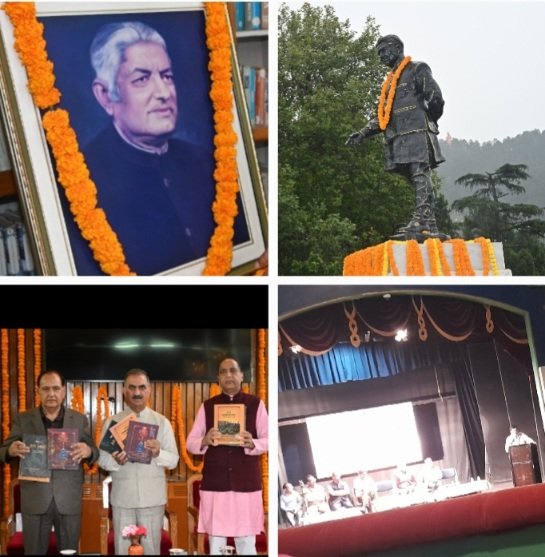
SHIMLA, AUGUST 4: The 120th birth anniversary of Himachal Pradesh’s founder and first Chief Minister, Dr Yashwant Singh Parmar, was marked through a series of programmes across the state, recalling his extraordinary contribution as a statesman, scholar, social reformer and visionary who laid the foundations of a distinct Himalayan development model.
A function organised by the Department of Language, Art and Culture brought together historians, administrators, academics and environmental and urban-planning experts to revisit Parmar’s legacy through archival research and contemporary perspectives.
The discussion around a newly compiled work by Dr Lakshman S. Thakur, historian, drew attention to Parmar’s political journey, his understanding of Himalayan society, his governance philosophy and his vision of a self-reliant hill state.
The panel included Tikender Singh Panwar, environmental activist and urban planning commentator; Rakesh Kunwar, IAS, Principal Secretary, Education; Prof. Chetan Singh, former Director, IIAS, Shimla; and Dr Sudesh Mokhta, IAS, Secretary, Art, Language and Culture.
They examined Parmar’s contribution from different perspectives, including his understanding of hill development, decentralisation, social reform, environment, culture, education and the economic empowerment of ordinary people.
Prof. Chetan Singh recalled his personal interaction with Parmar and his remarkable commitment to Himachal’s development even during his final days. He highlighted Parmar’s simplicity, sensitivity towards the last person and his ability to understand Himalayan society from within.
Having been a judge, Parmar could have chosen a comfortable professional life, but instead joined the Praja Mandal movement and took the struggle for people’s rights and Himachal’s political identity to its logical conclusion.
Dr Parmar’s scholarly approach to Himalayan society was also highlighted, including his work on social practices such as polyandry prevailing in Transgiri and Kinnaur district.
Rather than imposing plains-based models on the hills, he sought to understand the social, geographical and cultural realities of mountain communities and evolve policies accordingly.
The discussion also brought out the importance Parmar attached to art, language, culture, history and the distinctive identity of the Himalayan people, arguing that modernisation could not mean abandoning the soul of the mountains.
Tikender Singh Panwar placed Parmar’s legacy in the contemporary context of environmental degradation, unplanned urbanisation, climate change and the growing pressure of commercialisation on Himalayan settlements.
The challenge today, he suggested, is to reinterpret Parmar’s philosophy through green technologies, climate-resilient infrastructure, sustainable urban planning and protection of the ecological foundations of the state.
Rakesh Kunwar referred to historical material showing how Parmar encouraged ministers, departments and directorates to articulate their own development strategies and accept responsibility for implementing them.
This represented an unusual model of institutional decentralisation and intellectual ownership, in which government departments were expected not merely to execute instructions but to think, plan and take responsibility.
Dr Sudesh Mokhta placed Parmar’s political journey in its historical context, tracing his emergence from the movement for statehood to the leadership of Himachal and his efforts to build institutions suited to the state’s geographical and social conditions.
The proceedings also recalled Parmar’s emphasis on horticulture, agriculture, education, connectivity, tourism, forestry and scientific utilisation of natural resources. His approach was to convert Himachal’s natural advantages into sustainable economic opportunities for its people.
Vidhan Sabha pays homage
On the other hand, Himachal Pradesh Vidhan Sabha marked the occasion with a formal tribute to Dr Parmar. Chief Minister Sukhvinder Singh Sukhu, Speaker Kuldeep Singh Pathania, Leader of Opposition Jai Ram Thakur and other leaders paid floral tributes and recalled his contribution to the making of Himachal Pradesh.
The Chief Minister highlighted Parmar’s emphasis on roads, connectivity, schools, colleges, universities and institutions designed to strengthen the economic capacity of ordinary people.
Jai Ram Thakur called for a united effort to make Himachal self-reliant, modern and capable of providing opportunities for every citizen to fulfil their aspirations.
A book published by the Vidhan Sabha on Dr Parmar’s life, achievements and legacy was also released, while a photographic exhibition traced the journey from the formation of Himachal to its emergence as a full-fledged state on January 25, 1971, with Parmar becoming its first Chief Minister.
The celebrations therefore brought together two important dimensions of Parmar’s legacy—the historical and cultural understanding of his contribution, and the political establishment’s formal homage to him.
But it is here that the real question begins. Parmar’s real legacy was devolution of power
HimBumail believes that Dr Parmar deserves much more than bouquets, garlands, speeches and annual commemorative functions.
His greatest lesson was not merely that Himachal should be self-reliant. It was how government should function to achieve that objective.
Parmar believed in giving responsibility to ministers, departments and directorates. He expected them to think, plan and deliver. The Chief Minister was the political leader of the government—not the government itself.
That philosophy has gradually weakened.
Successive governments, irrespective of political party, have increasingly witnessed the concentration of decision-making around the Chief Minister’s office. Matters that should ordinarily be handled by departments and competent authorities often reach the highest political level.
The Chief Minister can end up spending disproportionate time dealing with transfers, postings and routine administrative matters instead of concentrating on long-term policy, institutional reform and development strategy.
This is perhaps the sharpest contrast between Parmar’s governance model and the contemporary political system.
The present government has repeatedly spoken of Vyavastha Parivartan. But the true measure of such a transformation would be whether power is actually devolved, whether ministers exercise meaningful authority and whether departments are given responsibility along with accountability.
From Section 118 to the apple economy
Parmar’s vision of self-reliance also found practical expression in land reforms and the restrictions embodied in Section 118 of the Himachal Pradesh Tenancy and Land Reforms Act.
The objective was to protect the land base of the hill people and prevent uncontrolled transfer of agricultural land to non-agriculturists, subject to statutory provisions and permissions.
The policy helped preserve the distinctive ownership structure of Himachal and provided a protective framework within which the state’s rural economy could develop.
His emphasis on horticulture subsequently contributed to the evolution of the state’s globally recognised apple economy and a broader high-value agriculture and horticulture sector. Alongside tourism, homestays and other rural enterprises, these sectors have become important sources of livelihood and employment.
The underlying philosophy was clear: use technology, knowledge and institutions to make the local population economically stronger while protecting the resources on which their livelihood depends.
The Parmar question in an age of climate change
Today, Himachal faces a radically different set of challenges—warming temperatures, erratic rainfall, flash floods, landslides, shrinking water security, waste, plastic pollution, unplanned construction, tourism pressure and ecological degradation.
The answer cannot be to mechanically reproduce the development policies of the 1960s.
The answer lies in reproducing Parmar’s method of thinking.
A modern Parmar model would mean climate-resilient roads, green buildings, electric public transport, scientific water management, sustainable hydropower, climate-smart horticulture, responsible tourism, decentralised renewable energy, waste-to-resource systems and Himalayan towns planned according to ecological carrying capacity.
It would mean modernisation without destroying the mountain.
Teach Parmar, don't merely garland him There is also a need to bring Parmar’s ideas into classrooms.
His legacy should not remain confined to a paragraph in a history textbook or an annual speech. Students should be encouraged to study his ideas on statehood, land, forests, horticulture, education, decentralisation, social reform, culture and hill development, and then compare them with the challenges facing Himachal and the wider Himalayas today.
The next generation should be able to ask what Parmar would have done in an era of climate change, artificial intelligence, green technology, mass tourism, urbanisation and globalised agriculture.
That would transform Parmar from a historical personality into a living intellectual resource.
Chanhalag should become a heritage of Himalayan thought.
We at Himbumail also believe that Chanhalag, Dr Parmar’s birthplace, should be developed and declared a heritage and learning destination, preserving not merely his memory but his intellectual legacy.
It could become a centre for research, exhibitions and education on Himalayan governance, culture, development and sustainability, allowing students, administrators, researchers and visitors to understand how the state was built and what lessons remain relevant.
The demand for conferring the Bharat Ratna on Dr Parmar also deserves to be pursued with seriousness. The Himachal Pradesh Assembly has already unanimously recommended the honour to the Union Government.
The real tribute begins after the flowers fade
Dr Y.S. Parmar was a statesman, scholar and visionary deeply rooted in the geography, geology, culture and aspirations of the Himalayan people. He carries a political grace in his style of governance that is rarely found in today's top politicians across the nation.
It would be a mistake and injudtice to his stature to confine him to Himachal’s past.
His ideas have relevance for the entire Western Himalayan region, where development, ecology, culture and human survival are inseparably linked.
Himachal has remembered Parmar for 120 years of history. The challenge now is to give his ideas another 120 years of relevance.
The Chief Minister, Council of Ministers and the entire political class must therefore move beyond the annual ritual of homage.
Parmar’s legacy must become a karma and Raj dharma of governance—devolution of power, institutional responsibility, ecological prudence, economic self-reliance and development rooted in the Himalayan reality.
Otherwise, the bouquets will fade, the speeches will disappear from social media and Parmar will once again be reduced to a photograph.
The time has come to stop merely talking about Dr Y.S. Parmar and start governing in the spirit of his legacy.
#YSParmar120 #HimachalNirmata #HimachalPradesh #SustainableHimalaya