
Women Beat the Flames, Systems Still Sleep: Uttarakhand’s Pine Needle Revolution Shows the Way, Will Himachal Wake Up? Will it end up as one time mission or sustained conservation mission?
DEHRADUN/SHIMLA: As forest fires rage with clockwork precision every summer across the Himalayan belt, it is not policy papers or high-decibel announcements and NGOs making noises in workshops or seminars that are making the real difference on the ground—it is village women.
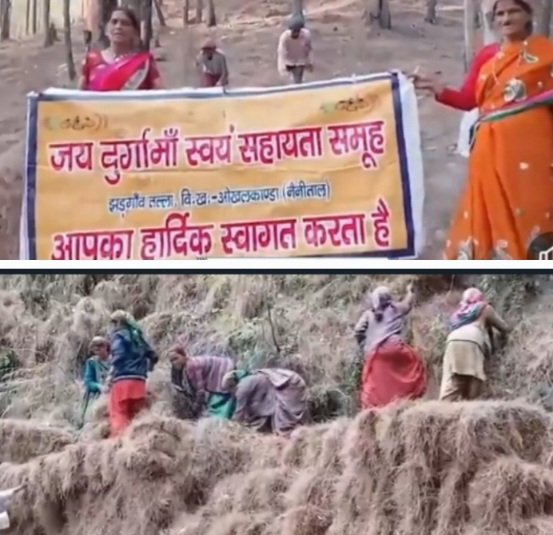
In Uttarakhand, under the National Rural Livelihood Mission (NRLM), over 76 self-help groups of women in Nainital Janpad have quietly built a frontline defence against the annual inferno.
Their weapon? The highly inflammable dry pine needles—pirul, chiyaan in Shimla hills—that carpet forest floors and turn vast stretches into tinderboxes during heatwaves and dry months every year.
The women initiative under mission tell a story governments can’t ignore. These women have collectively collected and removed over 2,300 quintals of dry pine needles, converting what was once a fire hazard into a livelihood stream.
In dozens of villages like Okhal Kanda, Jhargaon Talla, Ramgarh Dhari, Kota Pari, Bhimtal and other villages in Nainital janpad, village women have collected dry pin material worth 2357 kwintle. This material is being channelled into biofuel, briquettes, handicrafts, baskets and utility products, creating income while cutting fire risk at its root.
This is not tokenism or not a bland show to gain publicity. It is a working model. The logic is simple: remove the fuel, reduce the fire. But there is another layer—often left unsaid.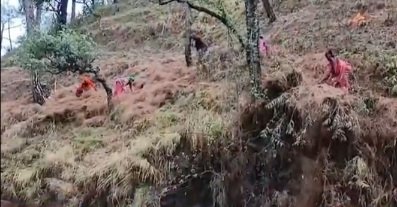
Every pine needle lifted is not just fire averted, it is also a blow to the shadow economy that thrives on burnt forests.
In too many stretches across the hills, fires don’t just “happen”—they serve a purpose. Once the green cover is gone, land suddenly becomes “available”, and the slow creep of hotels and multi-storey structures begins. The mountains are being quietly traded, one burnt slope at a time.
Uttarakhand’s women are disrupting that cycle. They are turning forest floors from liability into asset. From danger into dignity and green assets. And they are earning from it.
While exact earnings vary, field reports indicate that women are being paid per quintal collected and also earning through value addition—meaning a steady seasonal income that supplements fragile rural economies.
It may not be windfall money, but it is reliable, local, and tied directly to conservation—a rare combination in mountain livelihoods where poor nutrion and lack of sustainable sources are facts of life.
Now shift the lens to Himachal Pradesh. Same pine forests. Same summer fires. Same vulnerability. But different response.
In pockets of Solan, Sirmaur, lower Shimla and Kangra, pine needles—pillu, baidolu or chayaan —lie scattered in thick layers, waiting for a spark or a live bidi butt.
There have been small, almost forgotten attempts where local women turned them into baskets or fuel pellets, sold in melas, praised in speeches—and then quietly abandoned.
But it was long time ago. These efforts were not scaled up and there is no system and no sustained support in place mainly in the sensitive Shiwalik belt for women groups.
And certainly the government and NGOs have shown any urgency. The result? Year after year, flames return, Forests burn killing lakhs of undergrowth, tree saplings and biodiversity.
The questions pile up: Why is there no state-backed procurement mechanism for pine needles? Why aren’t self-help groups mobilised across fire-prone belts? Why is there no clear price signal to make collection worthwhile at scale?
And most importantly—who benefits when forests keep burning?
Because the ground reality is uncomfortable. In belts like Solan, Kasauli, Koti Chail-Kufri, and stretches across Renuka Dam of Sirmaur, locals speak—often in hushed tones—about how burnt land changes hands faster through the influential politicians. From forest to file, from file to foundation. Concrete follows ash with suspicious speed.
If even a fraction of this is true, then forest fires are not just an ecological crisis—they are a governance failure. And that is where Uttarakhand’s model hits hardest.
But there as well, forests continue to burn or being taken over by the highway projects, contractors and politicians.
If CM Pushkar Singh Dhami is serious about replicating this model in other districts, then it will make a real impact and save the forests from fire as the dry needles drop and pile up every year. This can be a sustainable source of livelihoods for village women. Only political will is needed.
It places the forest in the hands of the community.
It gives women both agency and income.
It creates a system where prevention is profitable.
Himachal doesn’t need to reinvent the wheel. It needs to replicate and scale:
A mission-mode drive across pine belts
Assured procurement at fair, even incentivised rates
Linking collected needles to bioenergy plants and rural enterprises
Direct involvement of panchayats and women’s groups
And strict vigilance in fire-prone, land-sensitive zones
Because let’s not pretend anymore—forest protection cannot survive on slogans. It needs skin in the game.
And right now, the only people showing that commitment are the women on the forest floor, gathering every dry needle like it matters—because it does.
The Himalayas are not burning in isolation. They are warning us. The question is—will Himachal listen, or keep counting losses after every fire season?
#ForestFires
#HimalayanCrisis
#WomenLeadChange
#SaveTheHills
#ActNow