
Himalayan Roads in Ruins: Time to Scrap Old Engineering, Hold PWD–NHAI–BRO Accountable
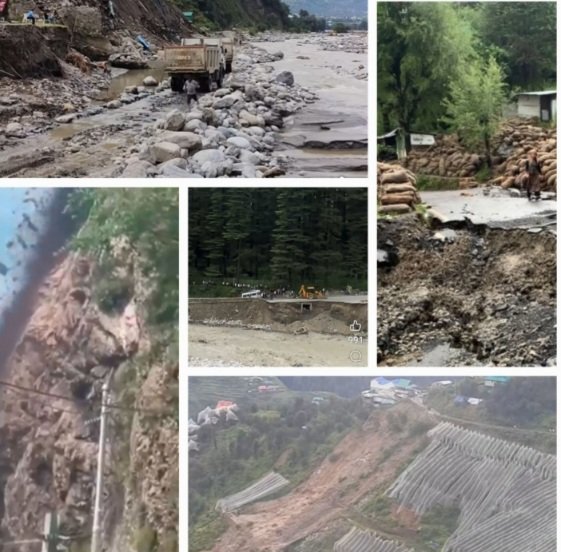
SHIMLA: From Shimla-Kalka to Mandi-Kullu, from Seraj valley to Bharmour, Himachal’s mountain roads lie battered, cut open like raw wounds after this monsoon.
Nallahs flooded, slopes collapsed, drains choked — all because the so-called road “engineering” in our fragile hills has been nothing short of reckless, no thought spent on how to guide the monsoon water into the nallah, streams, and rivers through the natural drainage mapping.
The collapse of these lifelines has not just broken highways, it has broken livelihoods.
In apple country, entire truckloads of fruit rotted as growers waited helplessly on blocked highways.
Vegetables lay unsold in the fields, left to decay because no road remained to carry them to mandis.
Farmers who had invested their year’s sweat and savings now face staggering losses, their produce stranded for over a week.
Trucks loaded with apples and peas, vegetables stood in serpentine queues on half-broken roads, while families watched their hard-earned harvest perish in front of their eyes.
Behind this crisis lies a rot deeper than landslides — corruption and negligence.
Debris from JCB-cut slopes was dumped straight into nallahs, rivers and streams, blocking natural water courses.
No culverts, no slope protection, no proper drains to channel the fierce mountain runoff.
Contractors cut corners, officials signed off, and commissions exchanged hands.
Seraj is now a textbook example of how unscientific roads can destroy an entire valley’s ecological balance. Forest carry broken salvage, timber.
The heavy rains triggered landslides carring dumped debris including trees and logs that snowballed into a deluge downstream, carrying logs and broken trees flowing freely into the Satluj, Beas, Ravi and and smaller rivers like Giri, Shalvi, Sainj, Tirthan, Jiuni in different parts of the state.
In ancient times, these logs which litter the flood plains when river receded, were used by downstream villagers for both fuel wood and timber.
The carrying of logs in rivers is no new. It has been happening over the years, decades and centuries during monsoons.
It will be wrong to attribute it to rampant felling alone. There could be some cases.
But the logs and broken trees come all the way from the uphill where you can see the uprooted trees, pine which have shallow root system falling on the roads, into the nallahs and quite many ending up into the river system.
But main culprits are the vast networks of roads.
Even Union Road Transport Minister Nitin Gadkari has admitted that faulty DPRs (Detailed Project Reports) are to blame for the crumbling Mandi–Kullu–Manali highway.
When the country’s top road boss says the very planning is wrong, it exposes the casual, copy-paste approach with which NHAI and its consultants design Himalayan highways.
Instead of studying fragile geology, seismic risks and cloudburst patterns, DPRs are rushed through on paper — and the mountains pay the price.
PWD engineers pass bills without even checking the ground reality, NHAI pushes four-lane projects as if the Himalayas were plains, and BRO carries on with its outdated war-time road methods. Private contractors collude in this game, chasing quick profits while hills bleed.
Jal Shakti schemes too have been torn apart as waterlines snapped and pumping stations buried under slides, yet no one is held responsible.
Experts warn that unless we overhaul the system, the Himalayas will keep collapsing every monsoon. But accountability is missing — no engineer suspended, no contractor blacklisted, no department answering for crores lost.
The way forward is clear:
New hill-friendly technology must replace the old road-cutting practices — bio-engineering for slopes, avalanche and slide protection, retaining walls that breathe, and culverts designed for cloudburst-scale rainfall.
Debris management must be non-negotiable — no more dumping muck in rivers and nallahs.
Natural drainage mapping must precede every road, bridge, or culvert project. Ignoring water’s natural path is what turns a highway into a death trap.
Strict accountability: PWD, NHAI, BRO, and their contractors must be held liable for shoddy work. Without naming and shaming guilty officers and firms, reform will remain lip service.
The Himalayas are not the plains. They demand respect, sensitivity, and science. If the present nexus of engineers, contractors, and politicians continues, Himachal will keep paying the price in landslides, washed-out roads, and ruined lives.
This monsoon has already shown the cost — rotting apples, wasted vegetables, and shattered farmers.
The message is loud and clear: build roads that belong to the mountains, or don’t build them at all.