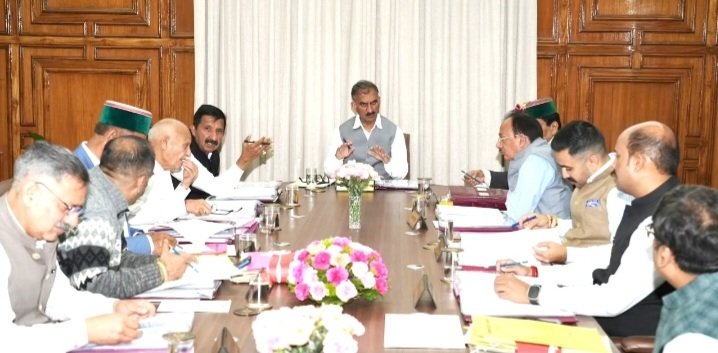
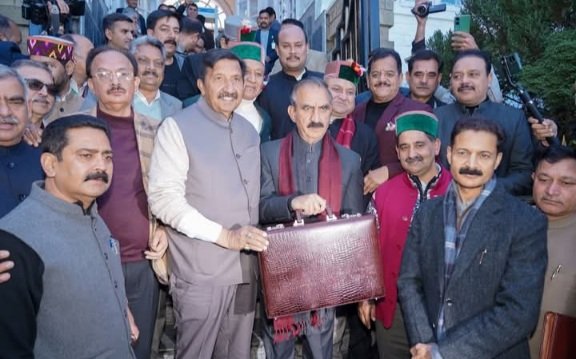
Shimla: The 134-page budget speech presented by Chief Minister Sukhvinder Singh Sukhu in the Vidhan Sabha read more like a political katha than a hard fiscal document, and in doing so, it revealed as much by omission as by intent.
While Sukhu spoke at length about the financial stress gripping Himachal Pradesh — citing the stoppage of Revenue Deficit Grants, the end of GST compensation and pending dues from neighbouring states.
He stopped short of addressing perhaps the most structural burden on the state exchequer: its ballooning salary and pension bill and non-planned expenditure.
Himachal Pradesh continues to have one of the highest employee-to-population ratios in the country, a legacy of decades of expansion in government services by what economists call "politics of Sarkari Naukri".
Himachal Pradesh’s 2026–27 Budget lays bare a fragile fiscal reality—shrinking resources, rising debt obligations, and "freebies commitment to welfare promises" to stay on in power.
The speech blends hard economic data with political messaging, but beneath it lies a deeper question: can the state sustain its expanding commitments without structural financial reform?
At the heart of the crisis is the complete withdrawal of the Revenue Deficit Grant (RDG), a crucial support mechanism for hill states.
Between 2020–21 and 2025–26, Himachal received ₹48,630 crore under RDG, but the latest Finance Commission has discontinued it, resulting in an average annual loss of ₹8,105 crore.
This single decision has forced the government to compress the budget size from ₹58,514 crore in 2025–26 to ₹54,928 crore in 2026–27. This downsizing signals a tightening fiscal space even as expenditure commitments continue to expand.
A Structural Deficit Economy
Sukhu argues that Himachal’s financial stress is not incidental but structural. As a hill state, it faces 2–3 times higher costs in delivering basic services like roads, health, and education as compared to the states in the plains.
With limited industrial base and a small consumption market, revenue generation remains constrained.
At the same time, the Chief Minister underlined how GST has weakened the state’s fiscal autonomy, estimating a cumulative loss of ₹25,000 crore over eight years, compounded by the end of GST compensation in 2022.
The speech also highlights pending financial claims, including ₹7,000 crore in BBMB arrears and the absence of compensation for ecological services, which a government-backed study values at ₹90,000 crore annually.
The state has not tapped this as a revenue source by banning green felling.
Yet, while these arguments establish external pressures, they do not fully explain the state’s internal fiscal imbalance.
Debt Trap, But Not Addressed
In one of the most candid admissions, Sukhu conceded that Himachal is now in a “debt trap”, where annual borrowings are overtaken by repayment and interest liabilities.
This reflects a classic case of fiscal stress: rising committed expenditure—particularly salaries, pensions, and interest payments—crowding out developmental spending.
The situation is further aggravated by the nature of central assistance such as SASCI, which comes as long-term loans rather than grants, adding to the state’s liabilities.
However, the Budget stops short of outlining any clear roadmap to reduce this burden. There is no mention of rationalising government expenditure at scale, particularly the large workforce and mounting pension liabilities, which remain central to Himachal’s fiscal stress.
Legacy vs Current Policy Choices
The Chief Minister attributes part of the crisis to the previous government, noting that despite receiving ₹47,000 crore RDG and ₹13,000 crore GST compensation, it also accumulated ₹30,000 crore in loans, worsening the debt profile.
But the present government’s own policy choices—especially the restoration of the Old Pension Scheme (OPS) and expansion of welfare guarantees, deployment of AAGs, Deputies —are likely to increase long-term liabilities.
While Sukhu defended OPS as a “sensitive and employee-friendly decision,” its fiscal implications remain significant and largely unaddressed in the Budget framework.
Welfare Commitments Continue Unabated
Despite fiscal constraints, the government has chosen to stay firmly on its welfare path. The Budget reiterates its commitment to:
₹1,500 monthly assistance to women (phased expansion)
300 units of free electricity for poor families
Expansion of social security schemes
Continued implementation of election guarantees
In addition, the government has increased Minimum Support Prices for key crops—wheat to ₹80/kg, maize to ₹50/kg, turmeric to ₹150/kg—and announced higher milk procurement prices at ₹61/litre for cow milk and ₹71/litre for buffalo milk, among the highest in the country.
These measures aim to strengthen the rural economy but also expand the state’s subsidy burden.
Growth Story: Strong Numbers, Uncertain Sustainability
On the macroeconomic front, the government projects a relatively strong outlook: GSDP growth at 8.3%
Per capita income at ₹2,83,626, higher than the national average.
State GDP estimated at ₹2.54 lakh crore
Tourism continues to be a major driver, contributing 7.78% to GSDP, with 3.11 crore tourist arrivals in 2025.
However, these growth indicators coexist with a shrinking fiscal envelope and rising debt servicing, raising concerns about sustainability.
Capital Spending vs Fiscal Constraints
The Budget attempts to strike a balance by prioritizing capital expenditure:
₹500 crore allocated to complete 300 stalled projects.
Major investments, old projects, in dairy, horticulture, tourism, and infrastructure
Large-scale schemes like the ₹1,292 crore HPSHIVA project and ₹300 crore PEHEL initiative
The focus on completing partially built assets reflects a shift towards efficiency. Yet, financing these initiatives without expanding debt remains a challenge.
Rural Economy at the Core
A significant portion of the Budget is devoted to rural transformation—natural farming, dairy expansion, fisheries, and self-employment schemes.
The government also plans to identify one lakh “poorest of the poor” families for targeted welfare under the Mukhya Mantri Apna Sukhi Parivar Yojana.
While this targeted approach may improve delivery efficiency, it also indicates the scale of economic vulnerability within the state.
The Unanswered Question
The Budget successfully builds a case around external constraints—central policies, GST design, and hill-state disadvantages. It also outlines an ambitious roadmap for rural development and social welfare.
But it remains less convincing on internal fiscal correction.
There is no clear strategy to reduce committed expenditure, no roadmap for fiscal consolidation, and limited discussion on enhancing revenue beyond traditional sectors.
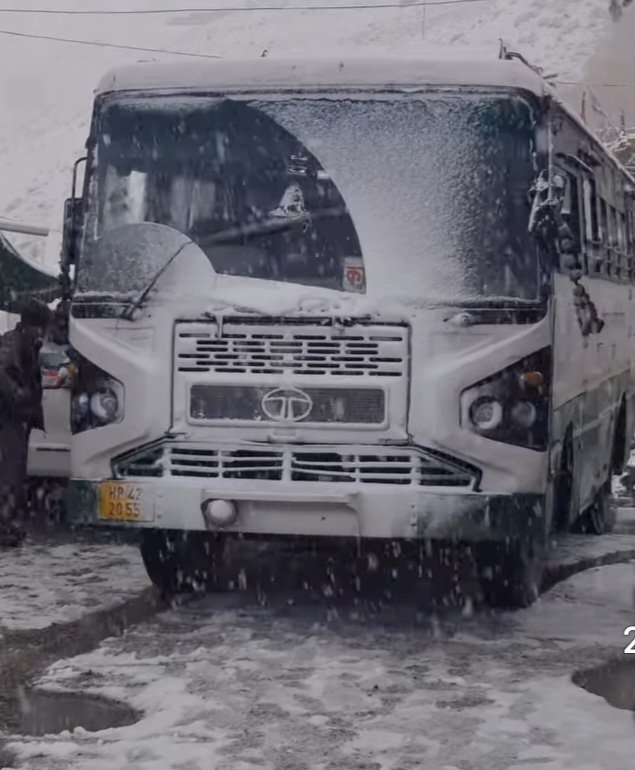
For example the government has no policy for reforming the state- run PSUs like HRTC, HRTC, whose cumulative loss today stand at Rs 5000 Crore every year.
The absence of structural reforms—particularly in managing salary, pension, and administrative costs—leaves a critical gap in the economic narrative.
Himachal Pradesh’s 2026–27 Budget reflects a government attempting to balance economic stress with political commitments. It acknowledges the severity of the fiscal situation, even as it continues to expand welfare and development programmes.
The result is a budget that admits the crisis, manages its fine tuning, but it stops short of confronting its hardest truths.
#HimachalBudget #FiscalReality #EmploymentCrisis #SukhuGovernment #HPPolitics