
Himachal’s big climate pitch, but shaky ground beneath. Khattar Asks States to monetize their Assets and Earn More to sustain its infrastructure.
KOCHI/SHIMLA: Himachal Pradesh has promised to go climate-positive by 2040. But its urban infrastructure is already creaking under the weight of disasters.
Flash floods in 2023. Another round of cloudbursts and landslides in 2025. The hills are bleeding.
Towns like Shimla, Manali and Kullu are seeing drainage failures, road collapses, water scarcity. The built-up areas are stretched thin.
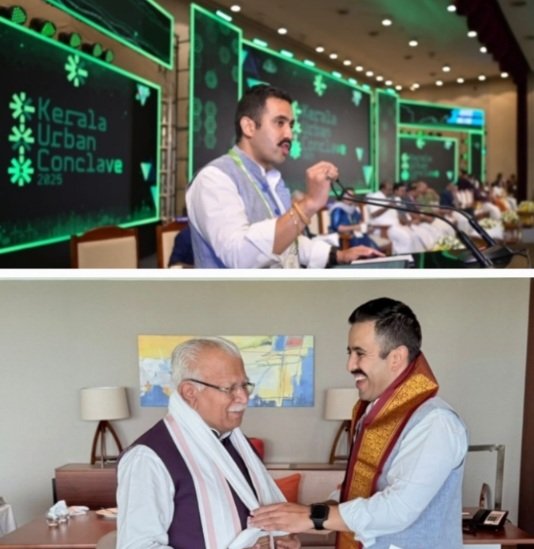
At the Kerala Urban Conclave in Kochi, Urban Development Minister Vikramaditya Singh made the grand pitch:
“Himachal has resolved to balance development and conservation. We will become a climate-positive Himalayan state by 2040.
We have launched a ₹5,000 crore Himachal Green Development Fund, created a Climate Intelligence Network, revived springs, and achieved 2,400 MW of renewable energy capacity — making us the first state to run fully on green power.”
That’s ambition talking. But sustaining hill towns needs more than big projects.
Roads and drains need retrofitting. Old houses need quake-resistant strengthening.
But these talks have been doing rounds and rounds over the years and nothing is done on ground zero.
Roads, Parking, sewage, waste, water supply — all need urgent overhauls to survive harsher rains and hotter summers.
Union Housing and Urban Affairs Minister Manohar Lal Khattar gave the national picture, with a blunt warning for states:
“Urban local bodies cannot depend only on central funds. They must mobilise their own resources. Asset monetisation, better tax collection, efficient financial practices — these are key.”
Khattar pointed out that India’s metro network now stands at 1,065 km across 24 cities, the third largest after China and the US.
With projects under construction for another 955 km, India will soon surpass the US’s 1,400 km network. He also flagged new reforms:
Super Swachh League’ to reward cities that consistently maintain cleanliness and shame those that fail.
Push for faster DPRs (Detailed Project Reports) so that transit and housing projects don’t get stuck in files.
Wider use of digital platforms in urban governance for speed and transparency.
For Himachal, that warning rings loud. It cannot build only new shiny projects.
It must also sustain the towns already crumbling. Drainage upgrades to handle cloudburst water.
Rainwater harvesting at scale. Waste recycling in tourist towns. Bio-engineering to stabilise slipping slopes by properly guiding the water into the river system.
Vikramaditya may dream of making Himachal the “world’s leading mountain development model by 2047.”
But the harder task is keeping Shimla from choking, congestion, Mandi from flooding, and Kullu from flooding, choking on traffic and waste — year after year.
If PWD, BRO and NHAI build and sustain roads, bridges, culverts and walls drains and Jal Shakti build water supply schemes that survive the monsoon fury and floods, then it will be more than Himachal becoming Climate positive by 2040.
The next monsoon will test promises faster than 2040.
#ClimatePositiveHP #UrbanConclave2025 #ResilientCities #GreenHimalayas