
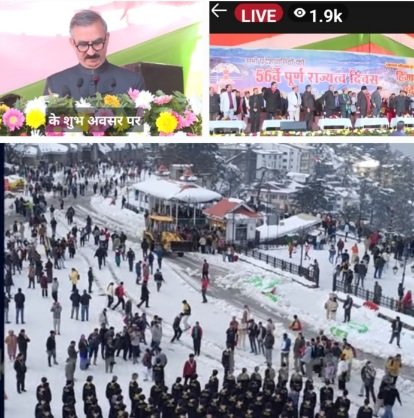
PARAGPUR (KANGRA), January 25, 2026
As Himachal Pradesh completed 55 years of statehood, Chief Minister Sukhvinder Singh Sukhu chose to underline institutional reform over populist announcements, announcing the constitution of a new Commission on Agriculture and Horticulture .
He rolled out the contours of the government’s long-term SMRIDH Himachal Vision, even as the state grapples with a mounting debt of over ₹1 lakh crore and shrinking Central assistance.
Addressing the Statehood Day function at Pragpur in Kangra district, represented by his wife Kamlesh Thakur, the Chief Minister in his speech indicated that his government was consciously reserving major welfare expansions and Congress guarantee saturation for the final phase of the term leading into the 2027 Assembly elections, while the current phase would focus on structural correction and fiscal stabilisation.
Agriculture & Horticulture Commission: Back to the Economic Roots
The newly announced Agriculture and Horticulture Commission is being projected as the backbone of Himachal’s economic revival. Sukhu said agriculture, horticulture, dairy and allied sectors must again become the primary growth engines, especially when traditional revenue streams are weakening.
The commission will work on crop diversification, horticulture sustainability, climate-resilient farming, market reforms, farmer income security and policy restructuring, particularly for apple growers, vegetable belts and milk producers. With apple alone generating nearly ₹5,000 crore business annually, the CM said policy failures of the past denied farmers their rightful economic gains.
Hard Truths on Finances: Per Capita Income High, Treasury Under Stress
Sukhu struck an unusually blunt note on the state’s finances. Himachal’s per capita income has crossed ₹2.57 lakh, among the highest in the country, yet the government is burdened with expenditure and liabilities nearing ₹1 lakh crore.
He pointed out that while sectors like hydropower and tourism had the potential to make Himachal prosperous, “wrong policies and flawed agreements” ensured the state bore ecological and social costs without proportionate economic returns.
Central Support Shrinks, Burden Shifts to State
The CM detailed how Central financial transfers have steadily declined. Revenue Deficit Grants have fallen from about ₹10,249 crore earlier to nearly ₹3,200 crore now, translating into an annual loss of roughly ₹7,000 crore. GST compensation of nearly ₹12,000 crore received during the previous regime has ended, while additional Covid-era assistance provided in 2020–21 has also stopped.
“Earlier governments received extraordinary financial support but failed to build long-term buffers,” Sukhu said, adding that his government inherited a fragile treasury with limited fiscal headroom.
Borrowing with Brakes: From Populism to Fiscal Discipline
In three years, Himachal’s borrowings rose to around ₹49,500 crore, largely to service old loans and interest. Sukhu defended the borrowing, saying funds were channelled into capital expenditure, roads, infrastructure and public assets, not election-driven giveaways.
He said transparent mechanisms like auctioning power projects and tightening revenue leakages were necessary to ensure the state “stands on its own feet”.
Employees, Pensioners and Social Commitments
Even amid the crunch, the CM announced priority clearance of arrears for Class-IV employees and pending dues of pensioners and family pensioners above 70 years of age. He reiterated that over 1.36 lakh employees were given financial security decisions in the first cabinet itself.
Sukhu said employee welfare and pensions would not be sacrificed, but “reckless expansion without resources” would not be repeated.
Resource Sovereignty & Legal Battles
The Chief Minister emphasised protecting Himachal’s natural resources and economic rights. The government fought legal battles to reclaim hydropower projects and revenues earlier handed to private firms on unfavourable terms and is asserting its share in projects involving neighbouring states.
“Himachal is the ecological lungs of North India. Its rivers irrigate Punjab and Haryana. We will not allow the state’s interests to be compromised,” he said, referring to ongoing efforts to secure rightful hydropower royalties and control.
Environment Linked with Livelihoods
Balancing development with ecology, Sukhu announced schemes like the Rajiv Gandhi Van Samvardhan Yojana, aimed at increasing community participation in forest conservation while generating employment. He said Himachal could repay its debt by selling forests, “but we will never take such irresponsible decisions”.
SMRIDH Himachal Vision: The Long Game
At the heart of the address was the SMRIDH Himachal Vision Document, being prepared with inputs from experts, administrators, grassroots communities and civil society. The vision focuses on eco-friendly development, inclusive growth, youth employment, agricultural resilience and fiscal sustainability.
The CM said the document would serve as a roadmap beyond electoral cycles, ensuring development that protects Himachal’s identity, environment and social fabric.
Guarantees on Hold, 2027 in Sight
Significantly, Sukhu avoided announcing big-ticket populist schemes, signalling that Congress guarantees would be fully rolled out closer to 2027, once fiscal correction stabilises revenues. The message was unmistakable: reforms first, rewards later.
As Himachal enters its 56th year, the Sukhu government is betting that institution-building, tough decisions and delayed gratification will ultimately pay political and economic dividends.
Whether voters reward patience in 2027 remains the biggest question hanging over the hill state.