

New Delhi/Shimla |
Renowned strategic affairs analyst Brahma Chellaney has questioned what he describes as a manufactured controversy around former Army chief General M.M. Naravane’s unreleased memoir, warning that the debate is veering dangerously away from substance and into political theatre.
While reiterating his public appeal to the government to clear Naravane’s manuscript for release, Chellaney said the selective focus on a single passage relating to the Rechin La standoff of August 2020 obscures a far more serious issue — the nature of command responsibility and the proper boundary between political leadership and military decision-making.
“The government is being oddly defensive and, in the process, fuelling a controversy that need not exist,” Chellaney said.
“Delegation of authority in a crisis is not abdication. It is recognition of professional military judgment.”
Full Authority Was Granted
In his memoir, Naravane recounts that when Chinese tanks advanced towards Indian positions on the Kailash Heights, he sought urgent guidance from the defence minister and the national security adviser and was told, “Jo uchit samjho, woh karo” — do what you consider appropriate.
Despite this carte blanche, Naravane presents the episode as a failure of political leadership, arguing that the government should have specified the precise response.
Chellaney and other analysts find this assertion deeply problematic.
“A general is expected to present options and act within political objectives,” Chellaney said. “Tactical decisions on the ground cannot — and should not — be dictated by civilian leaders sitting in Delhi.”
A Question of Command, Not Censorship
Chellaney argues that the real question raised by the memoir is not about censorship or embarrassment, but about whether India’s top military commander was comfortable exercising operational judgment without explicit political cover.
“Does an Army chief require political clearance to counter localised enemy aggression?” he asked. “If so, that points to a troubling dependency mindset.”
Analysts also point out the irony that Naravane ultimately took the correct decision, ordering Indian tanks to the ridgeline and training their barrels on advancing Chinese columns — a move that halted the PLA advance and ensured Indian control of the Kailash Heights.
“He ended up doing exactly what was required,” Chellaney said. “That should have been the end of the story.”
Rahul Gandhi Escalates the Row
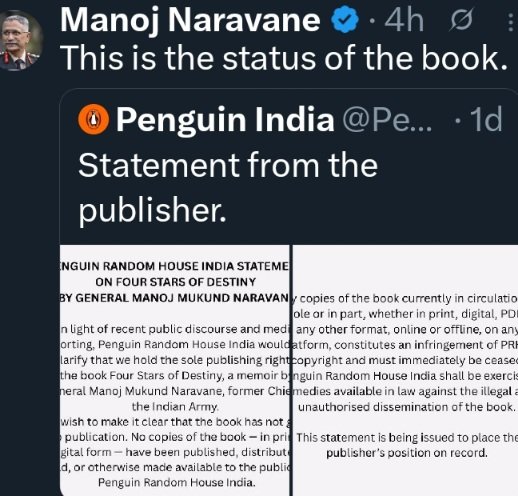
The controversy escalated after Leader of Opposition Rahul Gandhi raised the issue in Parliament and later told the media in Delhi that “either Penguin is wrong or General Naravane is lying.
” The remark was aimed at Naravane’s December 2023 tweet, in which the former Army chief tweeted about the book. He tweeted the Penguin clarification that book was not published in any form when he was asked about the status of the book, Four Stars of Destiny.
However, observers note that Naravane did not specify which book he was referring to in December 2023 tweet— whether the unreleased memoir Four Stars of Destiny or earlier published works such as Cantonment.
Rahul Gandhi, too, has not clarified whether the copy of Four Stars of Destiny he once displayed before the media is actually in his possession.
This lack of clarity, analysts say, has turned the episode into a muddled political spectacle, with competing claims and counterclaims obscuring the substantive issues.
Context That Cannot Be Ignored
Chellaney also stresses that Naravane’s account must be read against the broader backdrop of the 2020 eastern Ladakh crisis, which unfolded under his tenure as Army chief.
The coordinated Chinese incursions of April–May 2020 fundamentally altered the status quo along the LAC, yet no senior military accountability followed.
Naravane’s public statements at the time — describing clashes as stemming from “differing perceptions” of the LAC and declaring the situation “under control” days before the Galwan clash — further diluted India’s public messaging during a moment of grave crisis, critics argue.
Debate Needs Course Correction
Strategic experts warn that dragging the political leadership into tactical decision-making through memoirs and counter-allegations risks damaging civil–military trust.
“The book is not the problem,” Chellaney said. “The problem is our inability to have an honest debate about responsibility, judgment and leadership without turning it into drama.”
As the row continues to spiral, analysts caution that China’s enduring strategic gains in eastern Ladakh remain the unresolved reality, far more consequential than the noise surrounding an unpublished memoir.
“This should be a debate about command,” Chellaney said. “Not a spectacle about who said what, which book was quoted, or who is lying.”