Shimla/New Delhi:
Himachal Pradesh has once again raised a fundamental question before the Centre — how long will a hill state that protects India’s ecology continue to be short-changed?
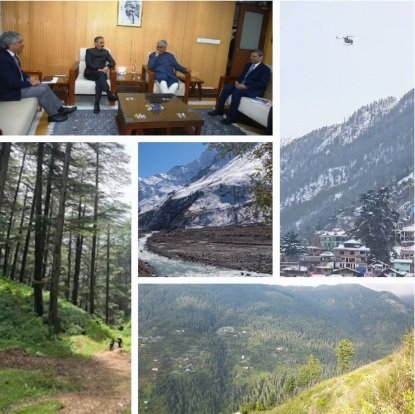
During Chief Minister Thakur Sukhvinder Singh Sukhu’s meeting with Union Environment, Forest and Climate Change Minister Bhupendra Yadav in New Delhi, the long-standing issue of undervalued forest and tree cover came back into focus.
Official records peg Himachal’s forest cover at 27.99 percent. Ground reality tells a different story. When Trees Outside Forest (ToF) on private and non-forest land are counted, the state’s green cover rises to 29.5 percent.
Yet, this additional 1.5 percent finds no place in national calculations used for forest grants, Finance Commission allocations or ecological compensation.
This exclusion ignores the fact that Himachal enforces strict regulatory control on tree felling even on private land. Trees are protected. Forests are guarded. But the state receives little credit for doing what many others do not.
Geography that Delhi refuses to see:
Himachal’s case becomes stronger when geography is honestly accounted for. Of the state’s 55,873 sq km geographical area, over 25,000 sq km lies in cold desert and high-altitude arid zones.
Large parts of Lahaul-Spiti, upper Kinnaur and Pangi, along with Bharmour, Chanshal and the Sangla range, fall above the tree line.
These regions are geologically treeless, climatically hostile and largely uninhabitable.
Yet, these naturally barren areas are included in forest cover calculations, distorting Himachal’s ecological performance.
Applying the same forest yardstick to cold deserts and fertile plains is not environmental science — it is bureaucratic convenience.
Forests that feed India:
Himachal’s forests and rivers do not serve the state alone. They sustain the grain bowl of India.
Rivers rising from Himachal’s glaciers and forests irrigate Punjab and Haryana, powering agriculture that feeds the nation. Hydropower from these rivers lights up northern India.
Soon, Renuka Ji Dam will quench Delhi’s thirst as well. Water will flow downstream
. Environmental costs will remain upstream. Once again, Himachal will bear the burden while benefits travel far beyond its borders.
A pattern of neglect:
For decades, Himachal has been pleading for ecological justice. From Virbhadra Singh to Prem Kumar Dhumal, Jai Ram Thakur and now Sukhu, every Chief Minister has taken this case to Delhi.
The tone changes. The argument remains. The response from the Centre largely does not.
At a time when Himachal is battling a deep financial crisis, rising disaster costs and climate-induced vulnerabilities, the demand is neither political nor excessive. It is structural and overdue.
A state that safeguards forests, feeds rivers, stabilises mountains and absorbs environmental shocks for the rest of India deserves better than what the Centre has given so far.
Recognition of 29.5 percent forest and tree cover, exclusion of naturally treeless cold deserts from calculations, and fair ecological compensation are no longer requests. They are necessities.
Himachal is not asking for charity. It is asking for its due and its future and future of ecology of the region and nation as a whole. Will PM Narendra Modi take a call ?
#HimachalDeservesItsDue
#EcologicalInjustice
#GreenStateIgnored
#MountainsPayPlainsGain
#ForestsFeedIndia