Natural glacier collapse coupled with the dam construction upstream may have triggered the catastrophe, but the absence of timely cross-border warning has become a major diplomatic concern as the death toll climbs and thousands remain missing..
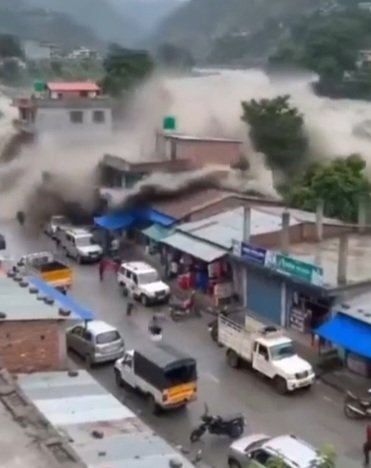
KATHMANDU: The catastrophic flash flood that tore through Nepal’s Bhote Koshi–Trishuli river system has raised serious questions in international diplomatic circles over whether China provided Nepal with timely information about the rapidly developing danger on the Tibetan side of the border.
The distinction is important. Preliminary technical assessments point to a glacial or ice-rock collapse, followed by a landslide and temporary blockage of the Lhende tributary, as the immediate trigger. There is, however, no established evidence that Chinese infrastructure caused the glacier collapse itself.
The far more pressing question is whether the disaster could have been detected and communicated earlier.
Nepalese hydrologists say the flood entered Nepal at about 8:40 a.m. on Wednesday and reached Syabrubesi roughly 10 minutes later. Nepal received information about the major surge only around 9 a.m., after the flood had already crossed the border. Early-warning SMS messages were subsequently sent downstream.
That gap has become the centre of the controversy.
The technical question: when did the disaster actually begin?
A flash flood does not necessarily begin when villagers see the water.
In a high-altitude Himalayan valley, the sequence can start much earlier: a glacier or ice mass becomes unstable, collapses, pushes rock and debris into a tributary, blocks the river, and creates a temporary lake.
Water continues accumulating behind that natural dam. When the blockage fails, millions of cubic metres of water, ice, mud and boulders can be released almost simultaneously.
The resulting flood wave then travels downstream.
That means the observable flood at the Nepal border can be the final stage of a process that began upstream much earlier.
The technical report released by Nepal’s Flood Forecasting Division says an earthquake of magnitude 4.4 was recorded at 8:37 a.m.; the Bhotekoshi-Syafrubesi station stopped transmitting at about 8:50 a.m.; information about a major flood entering from Tibet reached authorities around 9 a.m.; and warnings began going out at about 9:15–9:16 a.m.
Four hydrological monitoring stations were subsequently swept away.
The flood then continued its journey for hours. It reached Galchhi around 10:28 a.m., Malekhu around 11:50 a.m., Muglin at about 1 p.m. and the Narayani–Devghat area around 3:20 p.m.
The technical assessment estimates that approximately 20 million cubic metres of additional water passed through Devghat during the event.
This timeline is crucial.
Lm,t demonstrates that although the initial surge was exceptionally fast in the upper valley, downstream communities did not all face the same warning window. As the flood travelled through the river system, authorities had opportunities to issue increasingly wider evacuation and road-closure warnings.
Why the China question matters
The most serious concern is not that Beijing should have predicted the precise moment of a glacier collapse.
Glacial collapses and ice-rock avalanches are notoriously difficult to forecast to the minute.
The issue is different: once an abnormal event was detected on the Tibetan side—such as a massive ice collapse, landslide, river blockage, rapidly forming lake or sudden rise in water level—was that information transmitted immediately to Nepal?
Nepal News reported that Nepali officials were unaware of the approaching torrent until it had crossed the border and said the country had received no timely warning. Nepali hydrologists have specifically linked the warning gap to the absence of effective cross-border information sharing.
That claim is now being disputed by the Chinese Embassy in Kathmandu, which has described allegations that China failed to provide an early warning as misleading. The embassy has pointed to the sudden nature of the event.
That response, however, does not eliminate the underlying technical question.
When was the first reliable indication of the upstream collapse or river blockage obtained on the Chinese side, and when was that information communicated to Nepal?
That is a question that can potentially be answered through satellite imagery, hydrological records, seismic data, surveillance footage, river gauges, emergency communications logs and Chinese and Nepali disaster-management records.
A warning does not have to prevent the flood to save lives.
This is perhaps the most important lesson.
An early warning does not need to stop a flood.
It needs to give people enough time to get out of its path.
Even a 20- or 30-minute warning can allow authorities to close bridges, stop buses and trucks, evacuate riverbank settlements, move tourists away from vulnerable corridors and suspend operations at hydropower projects.
A longer warning could have been even more consequential.
The flood eventually travelled from the border region through the Bhote Koshi and Trishuli systems toward the Narayani. The official technical timeline shows that the danger propagated downstream for several hours.
That makes the question of upstream intelligence-sharing impossible to dismiss as a technicality.
Infrastructure adds another layer of concern
The disaster has also renewed scrutiny of the expanding infrastructure footprint in the fragile Himalayan landscape.
Road construction, hydropower projects, tunnels, transmission infrastructure and other engineering interventions do not automatically cause glacier failures. It would be scientifically irresponsible to claim that they did without evidence.
But such interventions can change drainage patterns, slope stability, sediment movement and the consequences of a major natural event.
The right question therefore is not simply “Did Chinese infrastructure cause the flood?”
It is: Did upstream infrastructure, altered hydrology or human activity influence the volume, routing or destructive power of the resulting flood—and what monitoring systems were in place to detect that risk?
Those questions require an independent technical investigation rather than political speculation.
The human catastrophe
Whatever the eventual findings on causation and warning, the scale of the disaster is already enormous.
The death toll has climbed to around 359, while more than 1,000 people are reported missing across Nepal and Tibet. The missing include hundreds of foreign nationals from more than two dozen countries.
Nepal Tourism Board figures have also continued to rise sharply, with the latest update reporting 644 Nepali and foreign travellers unaccounted for, including 517 foreign nationals. Indians constitute the largest group among the missing foreign nationals.
The catastrophe has destroyed roads, bridges, homes, border facilities, communications networks and hydropower infrastructure. The Gyirong/Rasuwagadhi trade and travel corridor has been particularly badly hit.
For families searching for relatives, the distinction between a natural disaster and a preventable warning failure offers little comfort.
Nepal Army takes on the rescue battle
As communities struggle through destroyed roads, power outages and broken communications, the Nepali Army and other security agencies have been pushed into a massive search-and-rescue operation.
Helicopters are being used to reach isolated locations, evacuate survivors and deliver emergency supplies, while ground teams continue searching through debris and damaged settlements.
The scale of the operation is being compounded by the destruction of the very infrastructure needed for rescue.
Bridges have disappeared. Roads have been cut. Hydrological stations have been swept away. Communications have failed. Entire stretches of the river corridor have become inaccessible.
Local residents are meanwhile battling the most basic problems—food, electricity, transport and safe shelter—as rescue teams race against time.
Dalai Lama’s warning adds a deeper dimension
His Holiness the Dalai Lama has expressed condolences over the devastation in Rasuwa and Kyirong, while pointing to the possibility of deeper underlying causes, including climate change and other factors.
His intervention comes as scientists increasingly warn that warming temperatures are destabilising glaciers and high-altitude mountain slopes across the Himalayas.
The disaster therefore cannot be reduced to a single argument about China, climate change or a natural glacier collapse.
It is a compound Himalayan risk—cryospheric instability, landslides, temporary river blockages, extreme flood waves, infrastructure exposure and inadequate cross-border early warning can combine to produce catastrophic consequences.
The diplomatic question Beijing cannot avoid.
China has now warned Nepal about the danger posed by a newly formed barrier lake upstream, demonstrating that cross-border warnings are technically possible. The new warning follows the destruction caused by the earlier flood.
That creates an uncomfortable comparison.
If Chinese authorities can provide an urgent warning about a newly formed lake today, international observers will inevitably ask:
What information was available on the Tibetan side before the August 26 flood crossed into Nepal—and why was Nepal not alerted sooner?
The answer should not be buried beneath competing political narratives.
Nepal, China and the wider Himalayan region need an independent reconstruction of the event—minute by minute and kilometre by kilometre.
Satellite imagery, seismic records, glacier observations, hydrological measurements, construction records and communication logs should establish when the chain of events began, what was known upstream, when the information became actionable and when it was communicated across the border.
The glacier may have triggered the disaster.
But if a warning was possible and was not communicated in time, the tragedy raises a very different question: whether some of the deaths and destruction could have been reduced.
That is the question Beijing now faces, and one that Nepal cannot afford to leave unanswered.