UGC’s New Anti-Discrimination Rules Trigger Social Media Firestorm, Govt Moves to Douse Flames
Shimla /New Delhi:
The University Grants Commission’s newly notified anti-discrimination regulations have set off a massive social media firestorm, sharply dividing opinion across campuses, caste groups and political lines.
While the UGC says the rules are meant to ensure safety, dignity and quick justice in higher education institutions (HEIs), critics fear misuse, overreach and a chilling effect on academic freedom.
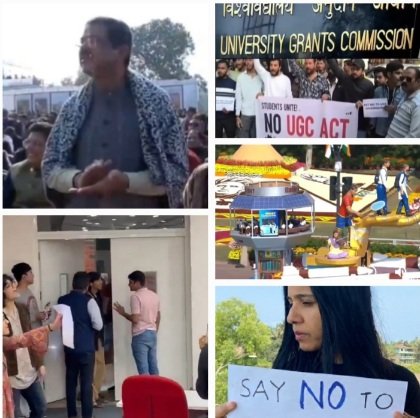
As hashtags trend and heated debates rage online, Savarna groups have staged protests outside the UGC headquarters, demanding a rollback of what they call “one-sided” regulations.
At the same time, leaders from SC, ST and OBC communities have so far largely remained silent in public, even as many activists quietly welcome the stricter safeguards.
What has drawn sharp attention is the political silence. Neither the BJP nor the RSS has made a clear statement.
The Congress, too, has stayed away from taking a firm stand, even as the issue snowballs into a nationwide controversy touching students, teachers and administrators alike.
What the new UGC rules say
Under the new framework, any student, faculty member or staff—whether a victim or even a witness—can report incidents of discrimination.
Complaints can be filed through an online portal, email, written submission or an Equity Helpline.
If requested, the complainant’s identity will be kept confidential, and protection against retaliation is guaranteed.
A key provision that has drawn both praise and criticism is the time-bound action mechanism.
The institution’s Equity Committee must meet within 24 hours of receiving a complaint.
It must submit its report within 15 working days, after which the Head of the Institution has seven working days to initiate action.
If the complaint involves penal offences, police authorities are to be informed immediately.
The rules also provide for an appeal before an Ombudsperson within 30 days, with the option of appointing an amicus curiae.
At the national level, the UGC will set up a monitoring committee with representatives from statutory bodies and civil society, mandated to meet at least twice a year to oversee implementation and suggest preventive steps.
Fears, anger and counter-arguments
Opponents argue that the rules, read with existing legal provisions, could create an atmosphere of fear on campuses, making general category students and teachers vulnerable to false or exaggerated complaints.
They point to earlier policy decisions, including the expansion of provisions under the SC/ST Act, claiming that unintended consequences are now being felt in educational institutions.
Supporters, however, counter that discrimination in higher education is real and persistent, and that fear of misuse cannot be an excuse to deny protection to vulnerable groups.
“The problem is not the law, but implementation,” said a senior academic, urging balanced and fair inquiry processes.
Government steps in
Amid the escalating backlash, the Modi government is learnt to be considering a high-level committee comprising educationists, senior officials and UGC representatives to review the concerns.
Union Education Minister Dharmendra Pradhan has indicated that the government is open to dialogue and is keen to quell misinformation and calm tempers.
The ministry maintains that the intent of the regulations is inclusion, accountability and swift justice, not harassment or witch-hunts.
Reacting to the new UGC anti-discrimination rules, BJP MP Manan Kumar Mishra said the decision appeared to have been taken without clear reasoning and would benefit no one.
He stressed that dividing people on the basis of caste was wrong and called for equal treatment of all students in colleges and institutions.
“If something is banned, it should be banned for everyone. The government should take note of this, or the UGC should review the decision itself,” he said.
As protests spill from social media to the streets and campuses remain on edge, the controversy has exposed a deeper fault line in India’s higher education system.
Whether the new UGC rules become a shield against discrimination or a fresh source of conflict will depend entirely on how fairly and transparently they are enforced.
But its political backlash remains a grave risk for the Modi government.