

A view from the Himalaya
New Delhi/Shimla:
India today paused to remember two significant anniversaries that touch both its spiritual and political journey. It is another matter that Congress and Its INDIA partners think otherwise.
The first was the anniversary of Swami Vivekananda’s historic speech at the Parliament of Religions in Chicago in 1893. The second was the 75th birthday of Dr Mohan Bhagwat, the Sarsanghchalak of the Rashtriya Swayamsevak Sangh.
It was also the anniversary of the third major figure of India: Bhudaan Andolan Stalwart, Acharya Vinoba Bhave, who brought land to landless in India after independence.
Incidentally, Prime Minister Narendra Modi will also turn 74 in September this year and would turn 78 when the Lok Sabha poll will be held in April, 2029.
The convergence of these developments in BJP and RSS has triggered fresh speculation about the future of the BJP-RSS relationship and the political roadmap ahead.
BJP and RSS social media handles, including its mouth piece, Panchjanya are going viral celebrating the anniversaries of Dr Bhagvat and Swami Vivekanand and the upcoming birth anniversary of PM Modi on September 17 may be done in the same enthusiasm.
Swami Vivekananda’s address in Chicago remains one of the most defining moments of India’s intellectual engagement with the world at that point of time.
When he began with the words “Sisters and Brothers of America,” he was greeted with thunderous applause. His speech introduced the global audience to the spirit of Indian philosophy, tolerance, and unity of religions.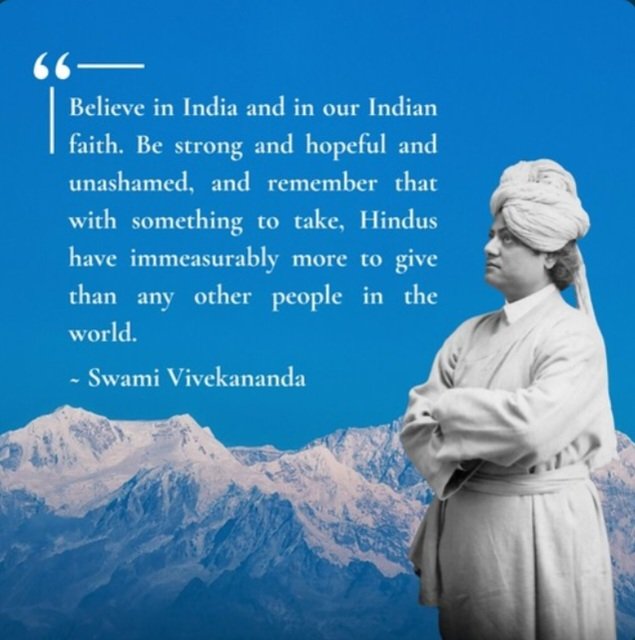
Vivekananda argued that India had given the world the message of harmony and compassion. He said the essence of Indian civilization was not conquest or conversion but coexistence and service.
These words, delivered more than a century ago, still hold ground in Indian politics, where leaders across the spectrum invoke his message to underline national pride and cultural confidence.
On this occasion, Prime Minister Modi penned a long article published in national newspapers, which doubled as a tribute to RSS chief Mohan Bhagwat on his 75th birthday.
This article came hot on the heals of PM"s Independent Day address to the nation on August 15 from the Ramparts of Red Fort in which he mentioned and praised the role of RSS in the service of Nation for the first time. The address had invoked uneasy reactions from opponents and so-called secularists.
Modi described Bhagwat’s tenure as the most transformative period in the hundred-year history of the RSS.
He praised Bhagwat for steering the Sangh through turbulent times. He kept alive the vision of integrating society under the ancient ideal of “Vasudeva Kutumbakam” — the world is one family.
Modi stressed that the RSS under Bhagwat has given strength to the revival of Sanatan values, ensuring they remain relevant to a rapidly modernising India.
The article also carried political undertones that went far beyond a ceremonial greeting.
Modi emphasised that the ideological foundation of today’s BJP-led government owes much to the work of the RSS and the values preached by Vivekananda.
By placing Bhagwat in the lineage of leaders who have carried forward India’s cultural and spiritual mission, Modi firmly underlined the Sangh’s continuing importance in India’s public life and in BJP's brand of politics.
This message also signals that all talk of internal differences between the Sangh and the Modi government, especially after the 2024 elections, may now be put to rest.
For critics and Modi’s detractors, the article came as a surprise and a setback. Opposition parties and civil society voices had long argued that there was a distance between Modi and Bhagwat after the general elections.
They had predicted a push for a change in leadership when Modi turned 75, pointing to the precedent of the ‘Marg Darshak Mandal’ created in 2014.
At that time, senior BJP stalwarts like L.K. Advani, Murli Manohar Joshi, and Yashwant Sinha were nudged out of active politics once they crossed the 75-year mark.
This council of elders was meant to honour their contribution but in effect sidelined them from decision-making.
Many believed Modi too would face the same fate when his turn came. Modi’s tribute to Bhagwat now makes it clear that this 75-year rule is in for a amendment as it may not apply to the current "Top Two" leadership of the BJP and RSS, reveal insiders.
The timing of the article is politically significant. Just days after Vice President Dr Thiru Radhakrishnan’s election, Modi became the first to publicly frame Bhagwat’s legacy as one of national importance.
This is not just a personal gesture but also a political signal. It suggests that the BJP and RSS remain inseparable despite differences in style and emphasis.
The BJP brings political power, while the RSS provides organisational muscle and ideological clarity. Both need each other to remain dominant in India’s political landscape.
Modi also used the occasion to remind the nation of how Vivekananda carried India’s civilizational essence to the West.
He noted that the monk’s Chicago speech gave Indians the courage to face colonial rule with pride in their own culture. Vivekananda spoke of tolerance at a time when religious conflict was tearing apart societies across the globe.
Modi drew a parallel between that message and the current challenges of polarization and division, suggesting that the RSS and BJP were working to revive the same values in contemporary India.
Interestingly, Modi’s praise found an unlikely echo from Congress MP and writer Dr Shashi Tharoor, a controversial Neta, who is warming up to Modi.
Tharoor has often written about Vivekananda’s global impact and agreed with Modi’s emphasis on the monk’s relevance today.
But his comments have created unease within the Congress, where Rahul Gandhi and others see any public alignment or praise with Modi as damaging to the opposition’s credibility.
This also highlights how Vivekananda’s message continues to cut across party lines, even if its political usage divides leaders internally.
The broader message of the day was unmistakable. The BJP-RSS relationship is entering a new phase of consolidation after the 2024 electoral hiccups.
BJP's Last Lok Sabha poll slogan, 'Ab ki Bar, Char Sau Par' fell short and earned a lot of flake in the last session of Parliament from the Opposition.
Mohan Bhagwat has been reaffirmed as the second "most influential figure" in the country after Modi.
Will there be question of retirement at 75 for either of them? Has precedent of Advani and Joshi’s quiet exit been firmly set aside?
These questions are doing the rounds not only within BJP-RSS debates, but also in political chatbots and media circles. Opponents are creating negative contents.
The old guard like Guru Golwalkar may belong to the past, but Bhagwat defines the present and "Modi is charting the future", say critics.
Together, they are positioning the BJP-RSS trinity of Vivekananda, Bhagwat, and Modi as the ideological and political engine for India’s next chapter that has already started unfolding for 2029.