Shimla:
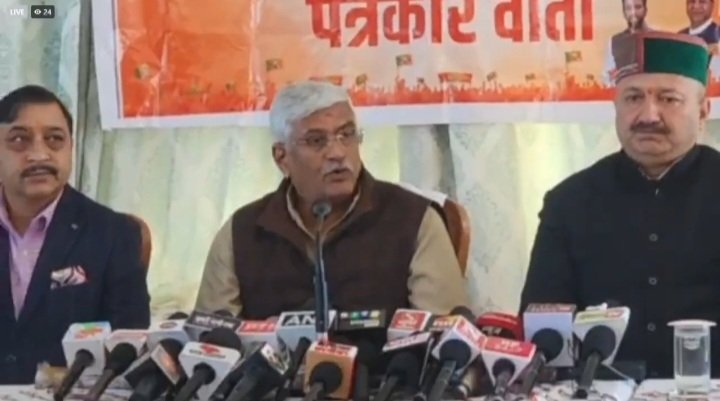
Union Civil Aviation and Culture Affairs Minister Gajendra Singh Shekhawat’s press conference in Shimla on Sunday not only raised serious questions over tourism funding and project exclusions, but also underlined the politics of the “double-engine government”.
While the Union Minister projected Budget 2026 as a roadmap of continuity, reforms, self-reliance and inclusive growth, he stopped short of explaining how Himachal can actually access these promises.
Shekhawat said that the Revenue Deficit Grant (RDG) was never meant to be a permanent entitlement, asserting that long-term fiscal discipline—not recurring central doles—is the only sustainable path for states, including Himachal Pradesh.
Shekhawat said India’s economy is entering a phase of major global opportunity, driven by Budget 2026 and a series of recent international trade agreements.
He said sectors such as textiles, handicrafts, electronics, mobile manufacturing, consumer goods and agricultural products are poised to gain expanded access to EU and US markets in the coming years.
Describing the trade agreements as among the most comprehensive globally, the Union Minister claimed they open new doors for Indian manufacturers and MSMEs without compromising core farm and dairy interests.
On RDG, Shekhawat said the grant was introduced on the recommendation of earlier Finance Commissions as a temporary, transitional support for fiscally stressed states to manage short-term gaps.
“It was never designed as a lifelong arrangement,” he said, adding that even when successive Finance Commissions extended RDG, they did so with cautionary notes.
He pointed out that during the 15th Finance Commission period—particularly during the COVID-19 crisis—RDG support was front-loaded at unprecedented levels to help states recover.
Himachal Pradesh, he said, received substantially higher RDG support in recent years than in earlier cycles, but with a clear signal that states must strengthen their own revenue systems.
“Fiscal deficit is essentially the gap between income and expenditure. This gap cannot be bridged through political blame games, but only through structural financial reforms,” Shekhawat remarked.
He said that under the new Finance Commission formula, tax devolution to states has increased structurally, and Himachal Pradesh’s share has also gone up.
With better devolution and improved fiscal management, states can offset the tapering of RDG without compromising development spending, he claimed.
The Union Minister, however, flagged concerns over rising debt levels, noting that Himachal’s debt-to-GDP ratio crossing 40 per cent should be seen as a warning sign requiring corrective financial planning.
On central support to Himachal, Shekhawat said the Centre has consistently backed the state in tourism and infrastructure development.
He highlighted that under the Special Assistance for Capital Infrastructure (SASCI) scheme, Himachal has recently been approved a 50-year interest-free loan for tourism infrastructure, which he described as “virtually grant-like support.”
He added that under schemes such as Swadesh Darshan, PRASAD and challenge-based destination development, Himachal has received substantial assistance and will continue to get support for viable and well-prepared project proposals.
Addressing disaster management, the Union Minister said allocations under the SDRF and NDRF have been significantly enhanced over the past decade.
He also noted that states are now permitted to use funds for preventive and mitigation measures, not just post-disaster relief, urging Himachal to invest more in resilience in view of changing climate patterns.
On the India–US trade arrangement and farmer concerns, Shekhawat accused the Congress of spreading confusion, particularly on apple imports.
He clarified that imported apples cannot enter the Indian market below roughly ₹100 retail-equivalent cost, factoring in a base price of about ₹80 and duties and charges of ₹20–₹40, thereby protecting domestic apple growers.
He asserted that there is no market opening for core staples such as wheat, rice, pulses, common vegetables, dairy products and major spices, and that farmers’ and MSMEs’ interests remain fully safeguarded.
Meanwhile it is also true that state tourism department has failed to submit DPRs on new projects for the last three years for approval from the centre.
However, he avoided disclosing the quantum of funds, implementation timelines, sector-wise breakup, or procedural roadmap—leaving unanswered questions on whether projects would be sanctioned automatically or only after fresh proposals and approvals.
Equally significant was the absence of clarity on how Himachal should capitalise on the newly announced tourism initiatives—be it heritage experience destinations, eco-tourism circuits, trekking and birding trails, tour-guide training or hospitality infrastructure.
No operational framework, eligibility criteria or state-specific pathway was outlined, reinforcing the perception that announcements remain aspirational rather than actionable.
The silence was particularly glaring on the Buddhist circuit issue. Despite Himachal having home to some of the most prominent Buddhist regions- Lahaul-Spiti and Kinnaur-in the western Himalayas, Shekhawat neither explained why the state was excluded while northeastern states were included, nor did he indicate whether Himachal could still be considered if it submits proposals.
The lack of clarity has strengthened concerns that political alignment, rather than cultural or tourism merit, is shaping priorities.
Throughout the press interaction, the subtext of the BJP’s “double-engine” narrative was hard to miss.
While the Centre spoke of cooperative federalism and national growth, no firm commitments or hand-holding mechanisms were offered to a Congress-ruled state.
Shekhawat spoke at length about India’s economic transformation, ₹12.5 lakh crore infrastructure spending, MSME support, heritage conservation and high-value agriculture.
For a hill state facing repeated climate disasters, tourism stress and fiscal strain, the absence of a clear roadmap, procedural clarity and financial certainty has only deepened scepticism.