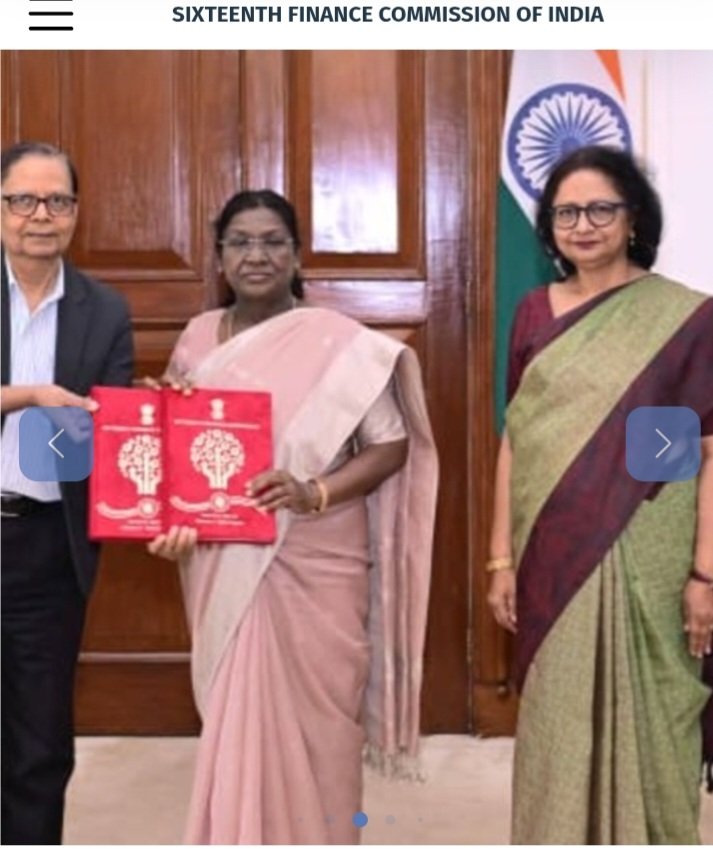
New Delhi / Shimla — The 16th Finance Commission’s decision to discontinue Revenue Deficit Grants (RDG), tabled in Parliament, has redrawn the financial map between the Centre and the states and triggered sharp unease in several hill states, including Himachal Pradesh and Uttarakhand.
While the Commission headed by its Chairperson Dr Arvind Panagariya has defended the move as a push towards fiscal discipline, states dependent on deficit support say the decision ignores the economic realities of governing difficult terrain.
Revenue Deficit Grants were meant to support states whose revenue expenditure exceeded their revenue receipts even after receiving their share of central taxes.
In effect, RDG helped states meet unavoidable routine expenses such as salaries, pensions, interest payments and basic administration.
For hill states with limited industrial activity, sparse populations and high delivery costs, this grant acted as a crucial financial cushion.
The Finance Commission has now decided to end this support altogether. In its report, the panel states that RDG was always intended as a temporary, transitional arrangement, not a permanent entitlement.
Continuing deficit grants across successive Finance Commission cycles, it argues, risks normalising revenue deficits and discouraging states from correcting structural weaknesses in their finances.
The Commission has justified the move by pointing to the stability provided through tax devolution.
It has retained the vertical devolution ratio at 41 per cent, meaning states as a group will continue to receive 41 per cent of the Centre’s divisible tax pool during the 2026–31 period, while 59 per cent will remain with the Centre. In simple terms, for every ₹100 of central taxes (excluding cesses and surcharges), ₹41 will flow to states.
However, while the size of the pool remains unchanged, the method of distributing this 41 per cent among states has been significantly altered.
Under the new horizontal devolution formula, the largest weight—42.5 per cent—has been assigned to per capita GSDP distance, aimed at supporting poorer states.
Population based on the 2011 Census carries 17.5 per cent weight, while demographic performance, geographical area and forest cover have each been given 10 per cent weight.
Most notably, the 16th Finance Commission has introduced a new criterion—contribution to GDP—with a weight of 10 per cent, signalling a clear shift towards rewarding economic performance.
At the same time, the earlier tax and fiscal effort criterion has been dropped. According to the Commission, the future of Centre–state fiscal relations should move from deficit compensation to growth-oriented incentives.
This recalibration has resulted in modest gains for some states and marginal losses for others.
Himachal Pradesh’s share in the divisible pool has increased from about 0.83 per cent under the 15th Finance Commission to around 0.914 per cent under the 16th.
Economically stronger states such as Karnataka and Kerala have also seen noticeable gains, while large states like Uttar Pradesh, Bihar and Madhya Pradesh have registered small reductions in their percentage shares.
Yet, hill states argue that these gains are insufficient to offset the loss of Revenue Deficit Grants.
According to estimates shared by Himachal Pradesh officials, the withdrawal of RDG could translate into an annual loss running into several thousand crore rupees, with cumulative losses over the award period being far higher.
The state government has already flagged that higher tax devolution on paper may not compensate for the disappearance of assured deficit support.
Politically, the decision has reopened the debate on fiscal federalism. The Himachal Pradesh government has maintained that while fiscal discipline is important, structural disadvantages of hill states cannot be wished away by formula changes alone.
Leaders have argued that higher costs due to terrain, climate vulnerability and dispersed settlements require sustained central support, not just percentage adjustments in tax sharing.
The Finance Commission, however, remains firm in its stance. It has emphasised that guaranteed deficit funding weakens incentives for states to expand their revenue base and control expenditure.
Future assistance, the panel has suggested, should come through targeted and conditional grants, rather than open-ended revenue gap funding.
As the new award period begins in 2026–27, the real impact of ending Revenue Deficit Grants will unfold on the ground.
While the Centre sees the move as a necessary correction backed by numbers and discipline, hill states warn that the arithmetic of devolution may not fully capture the economics of the mountains.
Himachal's revenue sources are with the big hydropower companies. The voices are getting louder for taking them back after 20 years of operation. The industries are not giving any GST gains to Himachal as the GST is linked to consumption. Himachal has just 75 lakh population and has little consumption base.
The clash between fiscal theory and regional reality is now firmly on the political and economic agenda.