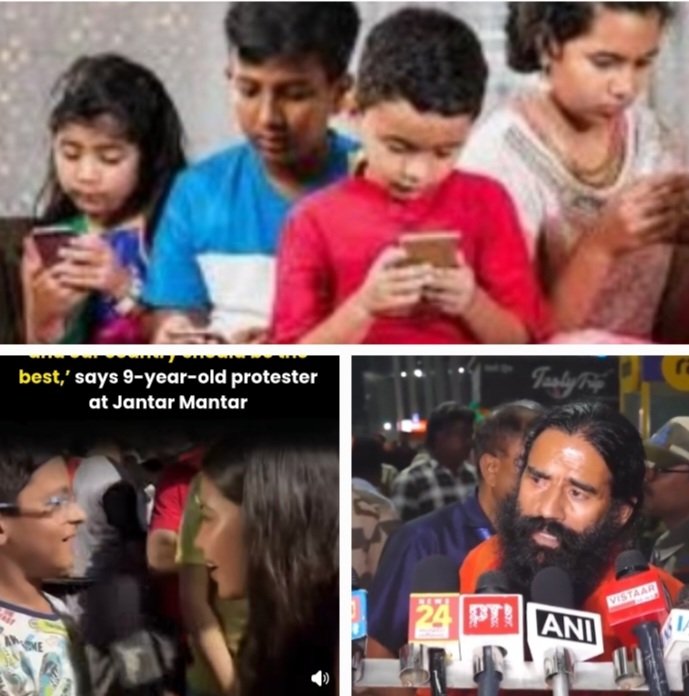
SHIMLA/NEW DELHI: Imagine a toddler in a middle-class Indian home, barely old enough to form complete sentences, sitting quietly with a mobile phone in his tiny hands and absorbed in a game.
The parents are busy with work, household pressures or their own screens.
The child appears occupied, perhaps even conveniently so. But behind that silence lies a much larger question: what is the screen teaching the child, and who is shaping the mind that is still being formed?
It is in this context that Yoga Guru Baba Ramdev's recent remarks in Raipur deserve attention.
He warned that India's biggest concern should be how to protect childhood from being exploited in political agitations and argued that children should not be pushed into protests they are too young to understand.
Ramdev has raised an important alarm—but he does not provide the complete picture of childhood in India, whether in its metros, smaller cities or villages.
The challenge is far wider than children appearing at protest sites. It begins much earlier, inside homes, classrooms, smartphones, social-media feeds and increasingly fragmented communities.
As a sadhu, Ramdev may not have the first-hand experience of parenthood. Yet his concern that childhood, youth and India's future need protection is rooted in a civilisational understanding that children require time, guidance, education, discipline and emotional security.
His intervention therefore provides the context for a larger debate rather than the final word on it.
The real childhood crisis begins long before the protest. Consider that toddler again.
The mobile phone may have been handed to him simply to keep him quiet while the parents finish work, attend a meeting, prepare dinner or take a break. There may be no sinister intention whatsoever. It is simply the reality of modern life.
But the child is entering a digital ecosystem designed to capture attention long before he understands what attention itself means.
A game leads to another video. A video leads to another recommendation. Cartoon characters give way to influencers. Entertainment can gradually become a stream of advertising, consumerism, fantasy and eventually political and social content.
The first political mobilisation of a child may not happen on a protest ground. It may happen through an algorithm.
That is why the national debate must go beyond asking who brought children to Jantar Mantar or another agitation. We must ask who is shaping their worldview every day.
India needs an urban—and rural—reality check
India's childhood is not uniform.The experience of a child growing up in a Delhi, Mumbai, Bengaluru or Shimla apartment can be completely different from that of a child in a village in Himachal Pradesh, Bihar, Jharkhand, Rajasthan or the Northeast.
Yet both are being touched by the same technological revolution.
Urban children may have access to private schools, smartphones, coaching, organised sports and abundant entertainment, but many face another crisis—they face time poverty within the family.
Parents are caught in the urban grind of work, commuting, financial pressure and professional competition. Nuclear families are increasingly common. Single-parent and separated households, broken families, adopted children and other family arrangements form part of the changing urban social landscape. Then social researchers also point out a new generation of LBGHQ seeking their social and political rights for their different sexualities.
None of these family structures is inherently harmful. What matters is whether the child receives emotional security, affection, attention and counselling.
A child can have a bedroom full of toys and still feel lonely.
In villages, the problems are different. There may be stronger community and family networks, but there can also be limited access to counselling, quality education, digital literacy, mental-health support and safe recreational spaces and proper nutrition and food.
Economic hardship, migration of parents, seasonal employment and unequal access to technology can create their own vulnerabilities.
The childhood crisis therefore cannot be reduced to an urban phenomenon or a digital phenomenon. It is becoming a national question with different faces.
Parents are losing the battle for attention. The modern Indian parent is often caught in a contradiction.
Parents want their children to succeed, but many are themselves exhausted by the demands of contemporary life.
They provide better food, better schooling, gadgets, coaching and material comforts, yet may struggle to provide the one thing no app can supply—undivided attention, emotional support and quality time to their children.
Social media has made this more complicated. Parents themselves are increasingly immersed in digital worlds while asking children to stay away from screens.
The result can be a household where everyone is connected to the internet but disconnected from each other.
Schools therefore need to become much more than examination centres. Age-appropriate counselling, digital literacy, emotional education, peer support and conversations about online behaviour should become part of the educational ecosystem.
A young India growing up inside the algorithm
India's enormous young population is its greatest potential demographic advantage. But a young population becomes a dividend only when young people acquire knowledge, skills, resilience and purpose.
Today's children are growing up inside a digital ecosystem that previous generations never experienced.
The internet can give them access to the world's knowledge. It can also expose them to misinformation, manufactured outrage, unrealistic lifestyles, pornography, bullying, political propaganda and communities built around anger.
Algorithms are not designed to raise children. They are designed to retain attention.
That distinction is fundamental. A young mind repeatedly exposed to outrage can begin to believe that outrage is political participation.
Repeated exposure to fantasy can distort expectations of real life. Constant comparison can create dissatisfaction. Online validation can become more important than real-world relationships.
The problem is not technology itself. The problem begins when technology becomes a substitute for parenting, companionship, education and social interaction.
The politics of Gen Z and Gen Alpha
This is also where the growing use of labels such as Gen Z and Gen Alpha deserves scrutiny.
Generational terminology may have sociological value, but turning an entire generation into a political category can be misleading. A schoolchild, college student, young entrepreneur, unemployed graduate and digital creator do not necessarily share the same aspirations or ideology.
Political movements may nevertheless find such labels attractive because they create the image of a generational uprising.
That is where Ramdev's warning about children in agitations becomes relevant.
There is a fundamental difference between a young adult consciously exercising democratic dissent and a child being placed on a protest platform by adults.
A child should not become a political shield for an adult agenda. Imagine the students are being used to speak abuses against Indian Army?
Children appearing before cameras, shouting slogans or delivering tutored political statements may create compelling imagery. But the image should never be mistaken for informed political agency.
The deeper question: who owns childhood?
The country therefore needs to identify the LSHQ—the larger social, psychological and cultural ecosystem shaping the Indian child.
It includes the family. It includes schools. It includes social-media companies, gaming platforms, influencers, peer groups, political organisations, advertising, entertainment and the rapidly changing labour market.
It also includes the parents themselves.
We cannot blame political organisers for exploiting childhood while ignoring the fact that many children first become dependent on screens because adults are unable—or sometimes unwilling—to spend enough time with them.
We cannot blame social media for everything while allowing children unrestricted access to platforms designed to maximise engagement.
And we cannot demand that schools solve every social problem while denying them the resources and trained counsellors needed to do so.
Childhood must not become political collateral
India has a proud tradition of youth participation in public life. Young people have contributed enormously to social reform, freedom movements, science, entrepreneurship and democratic change.
But there must be a clear distinction between youth participation and childhood exploitation.
Children need classrooms before protest platforms. Books before slogans. Playgrounds before political stages. Conversations before algorithms. And guidance before ideology.
Baba Ramdev's intervention is therefore best understood as a warning bell—not a complete diagnosis.
He is right to ask whether children should be dragged into political agitations they cannot understand. But the country must go further and ask why so many children are increasingly vulnerable to every kind of external influence in the first place.
The real national debate is not simply who brought the child to the protest.
It is: Who shaped the child before the protest? Who gave the child the phone? Who taught the child how to use it?
Who listened when the child became angry? Who explained the difference between information and propaganda? Who gave the child a sense of belonging?
Who taught the child to disagree without hatred?
And who helped the child discover a purpose beyond likes, followers, slogans and instant gratification?
These questions apply equally to the apartment in a metro, the middle-class home in a small town and the village school.
India's demographic dividend cannot be secured merely by counting its young population. It has to be nurtured.
The country must therefore save childhood not merely from political exploitation, but from neglect, loneliness, algorithmic manipulation, digital addiction, inadequate counselling and the loss of meaningful family time.
Because ultimately, the future of India will not be decided by how many children we can put on the streets, but by how many children we can prepare to walk confidently into the future.
They must be free and choose preferences and priorities for themselves. They must use AI technology and algorithm, They should not become its slave.
#Childhood #GenZ #GenAlpha #UrbanIndia