
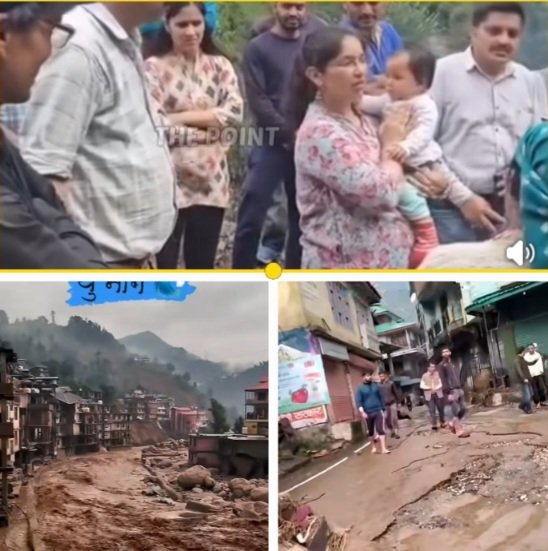

Nine-Month-Old Baby Survives, Whole Family Perishes: Himachal’s Monsoon Misery Is More Than Just Numbers.
Shimla, July 6:
Nikita is barely nine months old. Yet, in the darkest hours of a monsoon night in Gohar village, Mandi, she survived what nature—and perhaps the system—threw at her.
A flash flood swallowed her entire family: mother, father, and grandparents. She was the only one pulled out alive from the debris. Officials listed her kin as statistics in a report.
But for locals, it’s a wound that may never heal.
She plays about in the caressing lap of SDM Gohar Samritika Negi when she had gone to meet the victims and the families early this week. The scale of human tragedy is unfathomable in her case as she is now an orphan officially.
SDM DC Mandi Apporv Devgan have opened bank accounts in Nikita's name.
She is living at her relative home. Help has poured in from public at large.
The latest official bulletin from the State Emergency Operations Centre (SEOC) confirms 74 rain-related deaths across Himachal Pradesh from June 20 to July 5, not counting 27 additional road accident deaths.
But beyond the numbers lies a human crisis, one the government seems to only measure in columns and figures—not in loss of dignity, homes, or futures.
More Than Headcounts: Loss of Land, Livelihood, and Identity
Over 296 homes have been fully damaged, crops flattened in over 10,000 hectares, and public property worth ₹566 crore destroyed.
Yet, nowhere in the government’s monsoon assessment is there clarity on a question haunting thousands: Will the government compensate those who’ve been rendered landless?
Will it give land to rebuild homes? Or will they be left at the mercy of future notices branding them “encroachers”?
In the past, displaced villagers have seen this cycle play out. First they lose land to floods or landslides, then they’re forced to rebuild wherever possible—often on marginal terrain—and years later, are labeled as illegal occupants by the same system that failed to protect them.
“This has become fashionable—especially among the so-called champions of the environment—who target the poor and label them encroachers while big developers continue unchecked,” says flood victims from Thunag and Lambathaach, where both a government college and a horticulture institute were built on a floodplain and were promptly inundated this season.
Man-Made and "Mandated Disaster"
In Bhattakufar, Shimla, a multi-storey building collapsed, manu developed cracks after reckless earth-cutting and debris dumping by NHAI and Gavar Construction Company, locals allege.
Despite repeated warnings, muck was allowed to pile up next to river catchment and khads.
The result? Destruction blamed on rainfall—but clearly rooted in neglect and official silence.
In Thunag and Lambathaach, where government institutions came up on riverbeds, the damage wasn’t a matter of if, but when.
Monsoon rivers are unforgiving. And they did what they always do—took back their course.
The Chiuni khad had struck it blow in Thunag twice in the past- the most recent was in 2023, when logs and mud were pumped in town of exCM Jai Ram Thakur.
But no lessons were learnt and Thakur wanted to see Thunag become a trade centre in region.
But nature wants it otherwise and Chiuni khad reclaimed its natural course.
Climate Change or System Collapse?
While the government points to climate change—and yes, cloudbursts and weather extremes are on the rise—the state can’t wash its hands of accountability.
Experts agree that unchecked hill-cutting, deforestation, poor urban planning, and riverbed encroachments by government projects have worsened the natural risks.
The SEOC data shows 14 deaths from cloudbursts, 8 each from flash floods and drowning, and a shocking rise in cases of electrocution and fatal landslides.
Districts in Crisis: Mandi, Kangra, Kullu Worst Hit
Mandi reported 20 deaths, over ₹86 crore public property loss, and 118 schools damaged. Thank God, children were asked not to attend schools during rains.
Kangra logged 13 deaths, crop loss, and 47 education buildings hit.
Kullu saw floods wash through homes and orchards, with 33 schools affected.
Una lost 10,000 poultry birds, as farmers watch livelihoods crumble.
The only thing missing from these columns is what happens next. Will rehabilitation mean more than temporary tents and Rs 50,000 cheques?
Will people be given new land titles and homes? Or will they be left to fend for themselves until the next monsoon turns them into headlines again?
The Clock Ticks: Rain Isn’t Over
With July just beginning, 30 people have already died this month. Heavy rain alerts remain in place.
On July 5, two more deaths were reported—one in Bilaspur (electrocution), another in Kullu (slippage).
This takes the total monsoon death toll to 101, including road accidents.
From Crisis to Questions
The baby in Gohar may survive. But what future awaits her? A temporary shelter?
A forgotten file in a dusty office? Or a life spent proving she’s not an encroacher on the land her family once called home?
As Himachal drowns in rain and silence, one question keeps echoing through the hills:
Who will account for this man-made disaster? And who will stand by the living before they, too, become just another number?
(All data sourced from SEOC’s official monsoon damage report (as of July 5, 2025). Human stories and field insights verified through ground reporting).