
How Modi’s Government Answers the Long-standing Question of Farmers: Doubling Their Income
New Delhi | Jan 29
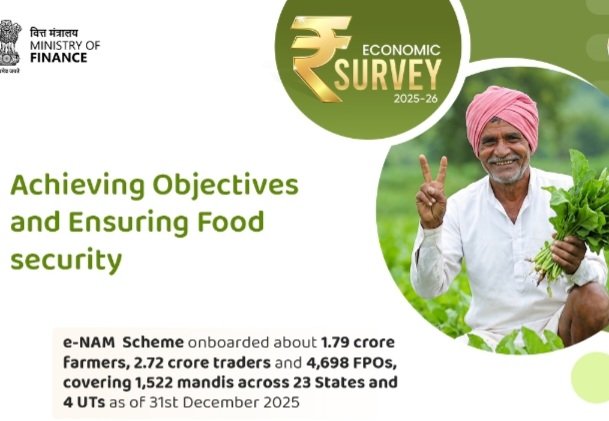
The Modi government on Thursday sought to answer the long-pending question of the farming community—how to double farmers’ income—with a multi-pronged strategy centred on productivity gains, policy push and institutional reforms, as outlined in the Economic Survey 2025-26 tabled in Parliament by Finance Minister Nirmala Sitharaman.
The Survey makes it clear that the objective of doubling farmers’ income is being pursued through a mission-mode approach, combining technology adoption, input support, market reforms, income support and risk mitigation.
Productivity at the core
At the heart of the strategy is the revamped National Food Security and Nutrition Mission (NFSNM)—earlier known as the National Food Security Mission—which focuses on boosting output of rice, wheat, pulses, coarse cereals, nutri-cereals (Shree Anna) and commercial crops like cotton, jute and sugarcane through area expansion and yield improvement.
Parallelly, the government has intensified efforts to reduce India’s dependence on imported edible oils. The National Mission on Edible Oils–Oilseeds (NMEO-OS) and National Mission on Edible Oils–Oil Palm (NMEO-OP) aim to push domestic oilseed production to nearly 70 million tonnes by 2030-31 through better seed varieties, good agricultural practices, private sector participation and assured procurement.
The impact is already visible. Between 2014-15 and 2024-25, the area under oilseeds expanded by over 18 per cent, production jumped nearly 55 per cent, while productivity rose by about 31 per cent.
Import dependence easing
Domestic edible oil availability has increased sharply—from 86.30 lakh tonnes in 2015-16 to 121.75 lakh tonnes in 2023-24. As a result, India’s dependence on imported edible oil has declined from 63.2 per cent to 56.25 per cent, despite rising consumption.
On pulses, the Survey highlights the launch of the Mission for Atmanirbharta in Pulses, approved on October 1, 2025, aimed squarely at achieving self-sufficiency by raising productivity and reducing imports.
100 aspirational agriculture districts
A major new intervention is the Prime Minister Dhan Dhaanya Krishi Yojana (PM-DDKY), announced in the Union Budget 2025. Approved in July 2025, the six-year scheme beginning FY26 will cover 100 Aspirational Agricultural Districts.
The scheme seeks to boost farm productivity, promote crop diversification and sustainable practices, strengthen post-harvest storage at panchayat and block levels, expand irrigation and improve access to both short- and long-term agricultural credit.
Safety net through crop insurance
The Survey also underlines the expanding footprint of the Pradhan Mantri Fasal Bima Yojana (PMFBY). In 2024-25, a record 4.19 crore farmers were insured—32 per cent more than in 2022-23—covering 6.2 crore hectares, a 20 per cent rise year-on-year. The scheme continues to provide protection against losses caused by natural calamities, pests, diseases and adverse weather.
Agriculture still central to growth
The Economic Survey notes that agriculture and allied activities contribute nearly one-fifth of India’s national income at current prices. With a large share of the workforce still dependent on farming, the sector remains critical to inclusive growth and food security.
The Survey concludes that sustained reforms, higher productivity and targeted institutional support are key to transforming Indian agriculture—and to turning the long-promised goal of higher farm incomes into reality.