
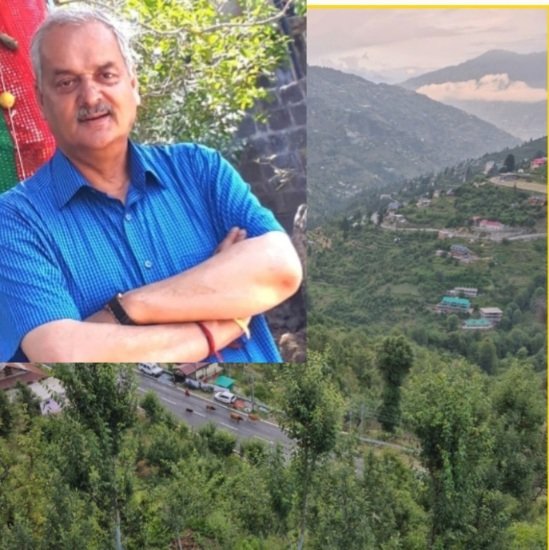
Dr. Vijay Singh ThakurFormer Vice-Chancellor, Dr. Y.S. Parmar University of Horticulture and Forestry, Nauni examines the trends in horticulture practices and calls for Himalayan friendly practices for a sustainable future of the Rs 5000 Crore Apple economy.
JUBBAL: Whenever tourists and visitors arrive in Jubbal Valley, they are captivated by its breathtaking hills, sprawling apple orchards and colourful homes dotting the hillsides.
Many ask me a simple question: How did apple come to Jubbal?
The answer is not merely a horticultural story. It is the story of how an entire mountain society transformed itself.
Today, nearly 90 per cent of the people in Jubbal Valley are connected with apple cultivation.
The crop has shaped our economy, our education, our aspirations and our standard of living. The journey from modest slate-roofed village homes to colourful modern houses and "kothis" reflects the prosperity that apple brought to these mountains.
Apple cultivation reached Jubbal around the 1940s through Praunthi village. The pioneering family was linked to the apple-growing traditions of Kotgarh and Thanedhar, where the famous Stokes family had already laid the foundation of commercial apple cultivation in the Himalayas.
However, replacing traditional agriculture with apple orchards was never easy.
The older generation relied on cereals and coarse millets that had sustained families for centuries.
Convincing our grandfathers and great-grandfathers to plant apple trees instead of food crops required patience, vision and courage.
It was a struggle between tradition and change, between survival and opportunity.
Eventually, the younger and educated generation prevailed. Apple cultivation expanded rapidly and by 1985 occupied nearly 90,000 hectares in Himachal Pradesh.
Today, the area under apple has crossed 1.22 lakh hectares, making it the backbone of the state's mountain economy.
Roads improved, markets expanded and government investments followed. Apple became the most suitable commercial crop for our difficult hill terrain and transformed the lives of thousands of families.
But the story did not end there.
Around the year 2000, fruit science adopted a new agenda influenced heavily by orchard systems in the United States and the United Kingdom.
Concepts such as dwarf rootstocks, spur-type varieties, High Density Plantations (HDP) and Ultra High Density Plantations (UHDP) entered the hills.
Many growers adopted these systems, often unwillingly and largely because they were projected as the future of apple cultivation.
Yet the Himalayan environment is vastly different from western growing conditions. Consequently, the results have been mixed and, in many cases, disappointing.
Today, another transformation is underway.
The new Gen-Z orchardists are educated, energetic and willing to invest heavily in their farms.
They are uprooting traditional orchards with machines, importing foreign planting material and redesigning orchards around imported rootstocks and varieties.
Trees are increasingly being trained into narrow forms with single central leaders and carefully managed canopies.
What concerns me is that many growers now receive their horticultural education not from scientists, universities or extension departments, but from YouTube channels, reels and social media influencers.
A remarkable shift has occurred. In many orchards, YouTubers and self-styled experts have become more influential than trained horticulturists.
While social media has made information accessible, it has also created a marketplace where advice is often driven by commercial interests.
Many of these so-called experts appear more interested in generating views, followers and income than promoting sustainable Himalayan horticulture.
A growing number function as agents or promoters for companies selling imported planting material, fertilizers, growth promoters, chemicals and orchard equipment.
Their recommendations frequently serve commercial interests rather than the long-term interests of growers.
The result is that many orchardists are persuaded to adopt expensive technologies and products without sufficient understanding of whether they are suitable for Himalayan conditions.
One such trend is excessive summer pruning and canopy restriction. Orchards are increasingly being designed to favour a single central leader while removing most lateral branches or "feathers."
These trees certainly look attractive in photographs, reels and promotional videos.
But an important question remains unanswered: where will the future fruit-bearing area come from if canopy development is continuously restricted?
In some modern systems, what was once a productive tree capable of yielding several boxes of apples is gradually being reduced to what resembles a heavily managed branch. The emphasis appears to be shifting from productivity to appearance.
At the same time, we constantly hear concerns about low productivity. Much of the productivity data being circulated today, in my opinion, requires closer scrutiny.
Comparisons based on different measurements per square foot, bigha or acre often create misleading conclusions.
Many figures being quoted do not accurately reflect realities in the field.
As someone who has been growing apples since 1952, I continue to learn from nature itself.
My own thinking is now shifting increasingly towards multi-leader systems that create larger fruit-bearing areas while maintaining balance within the tree.
Nature already knows how to shape an apple tree. A branch carrying fruit gradually bends under its own weight and naturally achieves angles of 45 to 90 degrees over time.
We should work with nature rather than attempting to turn every tree into a tailor-made architectural structure.
Fruit science should not focus merely on creating beautiful orchards for selfies, reels and social media posts. Its primary objective must remain helping growers produce more quality apples, improve profitability and ensure the long-term sustainability of mountain horticulture.
Apple transformed upper Shimla belt from a millet-growing mountain society into one of India's most prosperous horticultural regions. It created livelihoods, educated generations and reshaped the economy of the Himalayas.
As we move forward, we must not blindly imitate foreign models or social media trends.
The future of apple cultivation in the Himalayas lies in combining science with local wisdom, respecting natural tree behaviour and developing orchard systems suited to our unique mountain environment.
Only then will the apple story of Shimla apple belt continue to thrive for generations to come.