No Fruitful Outcome for the Himalayas is Possible Without Meaningful Engagement of Native Communities
DEHRADUN/SHIMLA/LEH:
In environmental and ecological discourse, particularly within elite institutions and academia, the most glaring omission is the voice of the native communities who have nurtured the Himalayas for centuries.
Their exclusion reflects a troubling pattern in which local people are often blamed for environmental degradation, while unsustainable development projects and the massive expansion of religious tourism escape serious scrutiny.
Both Uttarakhand and Himachal Pradesh have borne the brunt of such developmental interventions and the unchecked growth of mass tourism.
Much of what is described as tourism in the Himalayas is, in reality, pilgrimage.
Yet the crisis deepens when pilgrimage and tourism merge without any regard for the ecological fragility of the Himalayan region or the rights and concerns of its native communities.
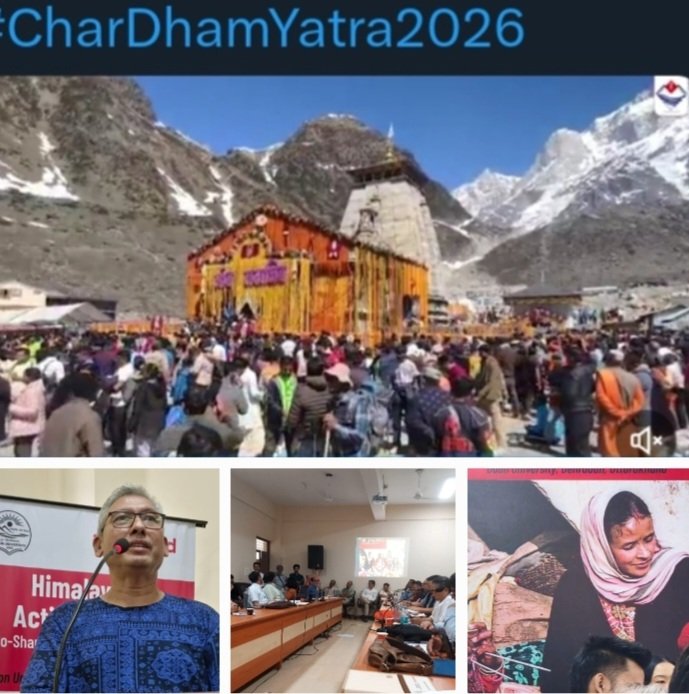
Most visitors travelling to Uttarakhand during the Char Dham Yatra visit Yamunotri, Gangotri, Badrinath and Kedarnath without ever interacting meaningfully with local communities.
The only engagement is transactional—through porters, horsemen, taxi drivers or dhaba owners. Rarely does a visitor ask for local food or seek to understand local culture.
Instead, Maggi noodles, chhole bhature and idli-sambar dominate menus across the mountains.
What we are witnessing today is not merely tourism but a cultural invasion. Instead of appreciating local traditions, many outsiders bring practices that are alien to the ecological and cultural ethos of the Himalayas.
Loud, vulgar music blares in front of sacred heritage sites such as Kedarnath and Badrinath, places where silence was traditionally considered the highest form of prayer.
Social media has transformed holy shrines into backdrops for performances and viral content, where visitors arrive in large groups to display their dancing skills without understanding the fragility and sanctity of these landscapes.
Those who question such behaviour are often intimidated. Locals are told that their livelihoods depend entirely on tourists and that without visitors they would starve.
Yet these same tourists frequently smoke hookahs on mountain roads, drive vehicles into riverbeds, consume alcohol while sitting atop SUVs, and sometimes even wash, bathe or urinate in rivers that local communities regard as sacred.
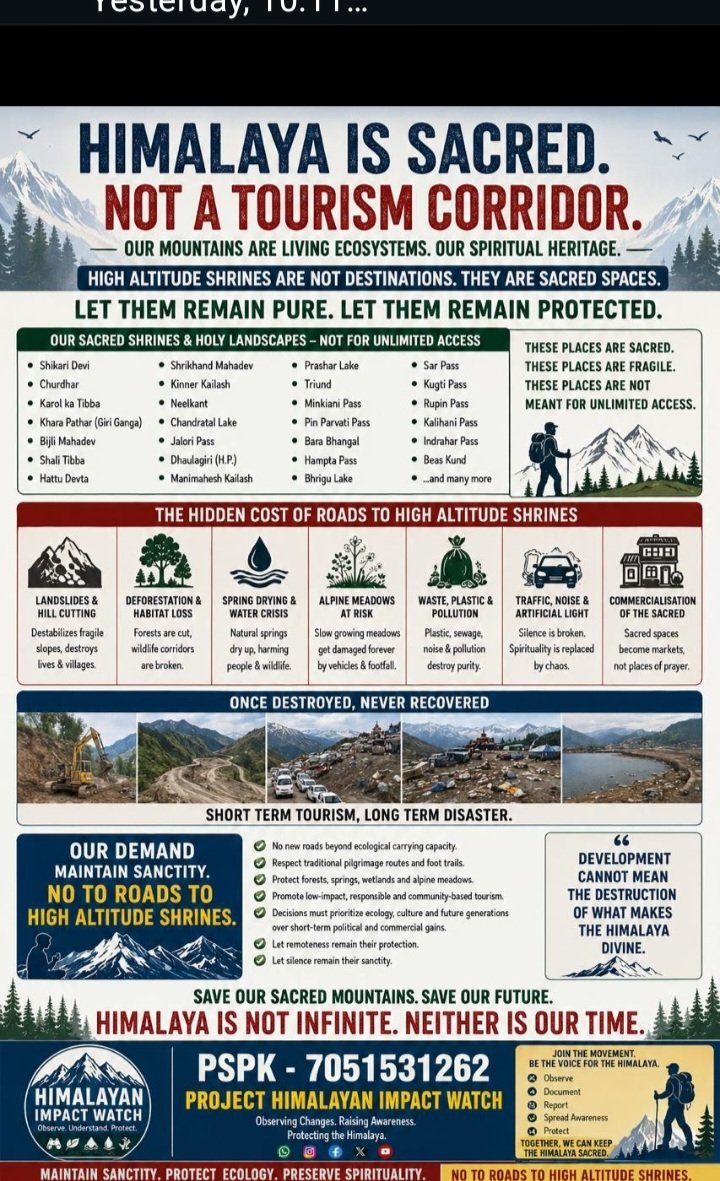
The relentless construction of highways, dams and other infrastructure projects designed to facilitate pilgrimage and tourism is placing enormous pressure on Himalayan ecosystems and the communities that depend on them.
Kedarnath, for example, can safely accommodate only a limited number of visitors at a time, yet thousands arrive daily throughout the pilgrimage season.
How long can such infrastructure sustain this burden? Where will the sewage go when there are no adequate treatment systems in these fragile regions?
I was deeply disturbed to see toilets near the source of the Yamuna at Yamunotri.
Equally alarming is the sight of people leaving clothes and waste in the river after bathing in the hot springs. Native Himalayan communities never had a culture of ritual bathing in rivers.
We worship rivers, but we do not immerse ourselves in them. This restraint stems not only from climatic realities but also from a desire to preserve their sanctity.
The culture of mass river bathing evolved primarily in the plains at places such as Haridwar, Prayagraj and Varanasi. Ironically, these are also places where rivers face some of their greatest pollution challenges.
Why should we repeat these mistakes at the very source of our rivers? Can we not simply admire and respect these rivers for their beauty, power and spiritual significance?
The upper Himalayan regions are home to indigenous communities such as the Bhotiyas, Marchhas, Tolchhas, Rongpas, Jadhs, Rungs and Joharis. Across the Himalayan arc—from Jammu and Kashmir to Ladakh, Himachal Pradesh, Uttarakhand and Nepal—live native Khas and Kirat communities who have sustained mountain agriculture and pastoral traditions for centuries.
Unfortunately, our people know very little about their own history. Indian history has largely been reduced to Hindu-Muslim and British-Indian binaries.
As a result, young people know about Chhatrapati Shivaji, Maharana Pratap, Tipu Sultan, Robert Clive and Babur, but remain unaware of Himalayan heroes such as Tilu Rauteli, Nain Singh Rawat, Sansar Chand and the Katyuri rulers.
The current debate over Lipulekh and Kalapani illustrates this disconnect. Few people understand the historical context of these regions.
The Katyuris ruled Garhwal, Kali Kumaon and parts of western Nepal for centuries.
The Gorkha invasions of Kumaon and Garhwal between 1790 and 1815 are remembered by local communities as a period of immense hardship and oppression.
The Treaty of Sugauli, signed in 1816 between British India and Nepal, established the Kali River as the western boundary of Nepal.
However, disagreement persists over the river’s true source. India regards the stream emerging from Kalapani as the source of the Kali, while Nepal argues that the Kutiyangti River is the actual origin.
Yet throughout the Indian subcontinent, river identities have historically been shaped more by mythology, culture and tradition than by hydrological volume.
At Devprayag, the larger Alaknanda merges with the Bhagirathi, yet the resulting river is called the Ganga.
At Prayagraj, the larger Yamuna merges with the Ganga, but the combined river retains the name Ganga. Similar examples exist elsewhere. Historical records and colonial-era gazetteers consistently identify Kalapani as the source of the Kali River.
The Himalayas today face not merely an environmental or climatic crisis but a civilisational one.
For mountain communities, the Himalayas are not simply a resource. They are our identity, heritage and way of life.
Development is necessary, but the crucial question remains: are local communities ever genuinely consulted? Do people know the risks associated with the projects being imposed upon them?
One important suggestion that emerged during recent discussions was the protection and insurance of community assets.
Yet little attention is paid to livestock, which are often the first casualties during disasters. Goats, sheep, yaks and cattle, nurtured over many years, are swept away in floods, killed by landslides or struck by lightning. Compensation is negligible, and insurance coverage is either unavailable or prohibitively expensive.
Governments should support affordable insurance schemes for livestock and pastoral communities.
I also believe that Jammu and Kashmir, Ladakh, Himachal Pradesh and Uttarakhand require special constitutional protection similar to the safeguards available under the Sixth Schedule in the Northeast.
While the social realities differ, the ecological vulnerabilities and cultural sensitivities are comparable.
Without creating new conflicts, Himalayan regions need stronger protections to preserve their ecological integrity and safeguard local communities.
Another neglected issue is the management of Common Property Resources.
The Forest Rights Act remains poorly implemented in many Himalayan states. Alpine meadows are increasingly being converted into tourist attractions, while the communities that traditionally managed and depended upon them are excluded from discussions about their future.
Tourism must be regulated. River bathing and activities that pollute rivers at their source should be strictly prohibited throughout the Himalayan region.
Respect for local sentiments and ecological sensitivities demands stronger regulation.
The use of packaged foods, plastic bottles and other disposable materials should be significantly restricted, if not completely banned, in the middle and upper Himalayan zones.
It is deeply ironic that Himalayan communities provide water to vast regions of the Indian subcontinent yet increasingly face water shortages themselves.
Equally disappointing is the silence of many non-resident people from these states, who celebrate their cultural identity but rarely speak about the crises facing their homelands.
The Himalayas are the source of some of the world's most important river systems.
Rivers flowing through Uttarakhand ultimately nourish Uttar Pradesh, Bihar, Jharkhand, West Bengal, Nepal and Bangladesh before reaching the Bay of Bengal.
Saving the Ganga therefore means protecting all its tributaries and the entire riverine ecosystem connected to it.
The Namami Gange programme must move beyond symbolic ghats and publicity campaigns. The Ganga is not merely a spiritual symbol; it is the foundation of food security for millions of farmers and fisherfolk.
Protecting the river requires protecting its sources, tributaries and the fragile Himalayan ecosystems that sustain them.
For me, the Himalayas are not a resource to be exploited. They are my identity, heritage and home. We must respect their ecological sensitivities and protect their future.
However, no meaningful outcome for the Himalayas will ever be possible unless the local communities who have nurtured these mountains for generations become central participants in every discussion, policy and decision concerning their future.
(Presented at the Himalayan Action School: Co-Shaping a Sustainable Future, held from 1–3 June 2026 and organised by ActionAid at Doon University, Dehradun.)
ABOUT THE AUTHOR:
Vidya Bhushan Rawat is a noted social activist, author and filmmaker who has worked extensively with India's marginalized communities.

A keen observer of social and environmental issues, he has travelled across the Ganga Basin from the Himalayas to the Bay of Bengal, including Bangladesh. He has authored over 25 books, produced documentaries, and writes regularly on social and climate justice.