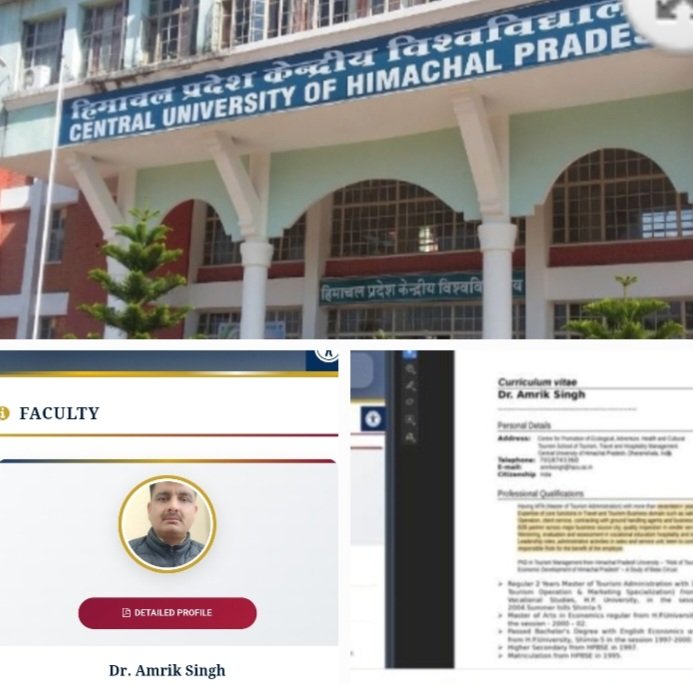
Dharamshala, September 6: The appointment of Dr Amrik Singh as Director of the Centre for Tibetan Studies at Central University of Himachal Pradesh (CUHP) has triggered questions on social media over his academic background and suitability for the specialised field of Tibetan studies.
A post circulating on X has questioned how a faculty member whose academic and professional profile is primarily rooted in Tourism Studies came to head a university centre dedicated to Tibetan Studies. The post also refers to his professional experience with organisations including Cox & Kings, Hotel Rahat Regency and Himachal Adventure Leisure & Holidays, questioning the relevance of such experience to a specialised academic discipline such as Tibetan studies.
The questions have gained traction after a review of Dr Singh’s publicly available curriculum vitae. His listed academic qualifications include a PhD in Tourism Management from Himachal Pradesh University, a Master of Tourism Administration and an MA in Economics. His stated areas of expertise include adventure tourism, cultural tourism, destination planning, sustainable tourism, travel-agency operations, business development and event marketing.
Significantly, the CV does not list a degree or formal specialisation in Tibetan Studies, Tibetan language, Tibetan history or Buddhist philosophy.
His academic and research profile does, however, indicate some engagement with the broader Buddhist and Tibetan cultural landscape. His research work includes subjects relating to Humanistic Buddhism in Himachal Pradesh, the Buddhist tourism circuit and Dharamshala's Tibetan cultural environment. Such work demonstrates an interface with Tibetan and Buddhist culture, particularly from the perspective of tourism and cultural studies.
But this distinction has become central to the online debate: does expertise in cultural or Buddhist tourism constitute specialised academic expertise in Tibetan Studies?
The issue is particularly relevant because Tibetan Studies encompasses disciplines such as Tibetan history, language, religion, philosophy, culture, Tibet-China relations and India-Tibet relations—areas that are distinct from tourism management.
The controversy, therefore, raises a larger question of academic suitability and institutional transparency in appointments to specialised university centres. The university is yet to publicly clarify the eligibility criteria, selection process and academic considerations on the basis of which Dr Singh was appointed to head the Centre.
Social-media users are now seeking a clear explanation from CUHP on whether the appointment was based on specialised expertise in Tibetan Studies, research experience related to Buddhism and Tibetan culture, administrative considerations, or broader academic qualifications.
The debate is thus increasingly shifting from an individual appointment to a broader question: what academic qualifications should be considered essential for heading a specialised Centre for Tibetan Studies at a Central University located in Dharamshala, the global centre of the Tibetan exile community?
#TibetanStudies #CUHP #Dharamshala #AcademicAppointments