
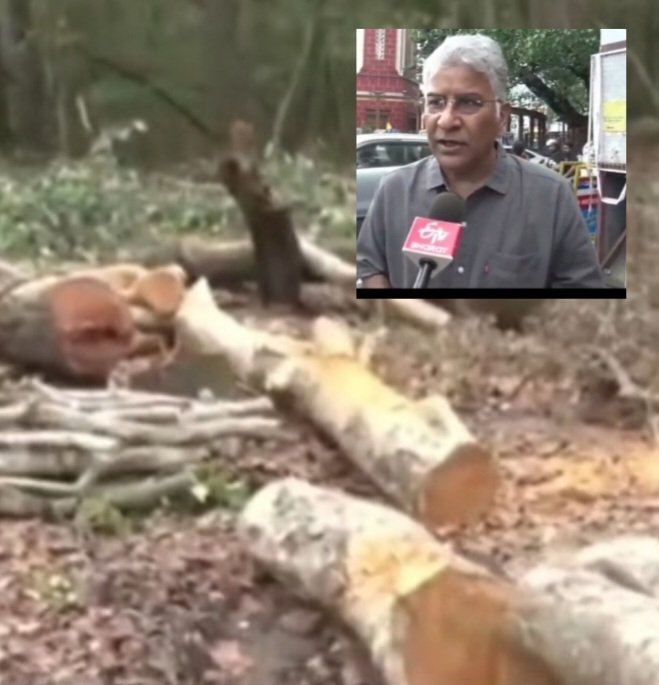
Harela Sparks Fresh Alarm as 46,203 Hectares of Uttarakhand Forests Diverted in 25 Years
DEHRADUN, JULY 16: Even as Uttarakhand celebrated the green festival of Harela with large-scale plantation drives, concerns over the shrinking forest cover overshadowed the festivities after fresh data revealed that 46,203 hectares of forest land have been diverted for development projects over the past 25 years.
Raising the issue on Harela, social activist Anoop Nautiyal said the scale of forest diversion should compel both the government and citizens to rethink the state's development trajectory. He warned that while saplings are planted every year during Harela, thousands of hectares of natural forests continue to be lost, particularly in the ecologically fragile Himalayan region.
Nautiyal cited an RTI reply dated June 16, 2026, showing that since Uttarakhand's formation in November 2000, 46,203 hectares of forest land have been diverted for infrastructure and other projects. He noted that roads account for over 10,070 hectares, mining 9,289 hectares, transmission lines 3,005 hectares, power projects 2,250 hectares, irrigation 456 hectares, drinking water projects 294 hectares, while nearly 20,838 hectares—about 45 per cent of the total—fall under the broad "Others" category, raising questions over transparency.
He expressed particular concern that Dehradun alone accounts for 21,618 hectares, nearly 47 per cent of all forest diversion in the state, making it the most affected district. Haridwar, Nainital, Chamoli and Tehri Garhwal follow behind.
The social activist said the ongoing felling of thousands of trees for the Rishikesh–Bhaniyawala four-lane highway reflects a development model that is placing increasing pressure on Uttarakhand's forests. He urged the Centre and the state government to reconsider projects that involve avoidable destruction of natural forests.
Warning that Uttarakhand is already witnessing more frequent flash floods, landslides, forest fires and extreme rainfall events, Nautiyal said unchecked diversion of forests could further weaken the state's ecological resilience. He argued that the burden of environmental degradation is ultimately borne by ordinary citizens, especially vulnerable communities living in disaster-prone areas.
Calling for a balance between development and conservation, he advocated scientific carrying-capacity studies before approving tourism, pilgrimage and infrastructure projects, stricter compliance with environmental laws, cumulative impact assessments, improved urban planning and greater protection of natural forests and biodiversity.
Nautiyal also questioned the absence of information on compensatory afforestation in the RTI response, saying mature Himalayan forests cannot simply be replaced through plantation drives. Protecting existing forests, he said, remains the most effective safeguard against climate change and ecological disasters.
Extending Harela greetings, he expressed hope that the festival would become a reminder not only to plant trees but also to protect Uttarakhand's remaining natural forests for future generations.