
World Environment Day Triggers Green Mania Across Himachal, But Will Saplings Survive the Headlines?
CM Sukhu Calls for People's Movement on Environment; Eco Task Force Launches Mission for 75,000 More Trees
SHIMLA, June 5: Himachal Pradesh witnessed a massive show of green activism on World Environment Day with plantation drives, cleanliness campaigns, awareness programmes, mini marathons and anti-drug pledges being organised across the state. But amid the celebrations, environmentalists raised a crucial question: will the enthusiasm for planting trees translate into long-term protection of forests and survival of saplings?
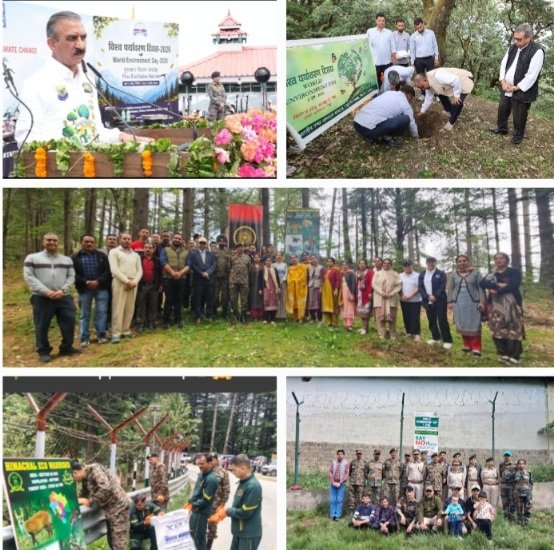
Leading the campaign was the 133 Ecological Task Force (Dogra), which launched an ambitious mission to plant an additional 75,000 saplings across Himachal Pradesh.
Plantation drives were organised on the slopes of Kufri, at Chinni Bungalow and Radisson Kufri, while large-scale cleanliness campaigns and environmental awareness programmes were conducted in collaboration with Waste Warriors, Wildlife Division Shimla, Gram Panchayat Kufri, Himalayan Nature Park and educational institutions.
The Eco Task Force's initiative came against the backdrop of growing environmental concerns in the Himalayas, including climate change, recurring forest fires, shrinking water sources, landslides, cloudbursts and increasing tourist pressure on fragile mountain ecosystems.
At the historic Ridge in Shimla, Chief Minister Sukhvinder Singh Sukhu called upon citizens to transform environmental protection into a mass movement.
"Himachal is the lungs of North India," he said, adding that the state provides ecological services worth nearly Rs 90,000 crore annually to the country through its forests, rivers and watersheds but receives inadequate compensation in return.
The Chief Minister urged people to make environmental conservation part of their daily lives by planting trees, conserving water and reducing plastic consumption.
Referring to the devastating disasters of 2023 and 2025, he said repeated cloudbursts, flash floods and landslides were reminders of the growing environmental crisis facing the Himalayan region.
He announced that the government has set a target of increasing forest cover to 32 percent by 2030 through initiatives such as the Mukhya Mantri Van Vistar Yojana, Rajiv Gandhi Van Samvardhan Yojana and the Green Adoption Scheme.
The state is also promoting electric mobility, with 297 new electric buses set to join the fleet of the Himachal Road Transport Corporation.
Two biochar plants are also being established to convert highly inflammable pine needles and forest biomass into useful products while reducing forest fire risks.
Meanwhile, at the historic campus of the Indian Instituteof Advanced Study, a plantation drive brought together academics, researchers, forest officials and students.
Principal Chief Conservator of Forests Sanjay Sood said environmental degradation, climate change and pressure on natural resources could not be addressed through government policies alone.
"Public participation must become a mass movement," he said, stressing that forests are directly linked to water security, biodiversity conservation and human well-being.
IIAS Director Chaturvedi observed that environmental conservation is not merely an administrative responsibility but a social and moral obligation. Oak and deodar saplings were planted across the campus by participants.
However, environmental experts argue that Himachal's biggest challenge is not plantation but survival.
Over the decades, successive governments, departments, NGOs and institutions have planted millions of saplings.
Yet many plantations have failed because of poor maintenance, grazing pressure, moisture stress, invasive weeds, forest fires and lack of long-term monitoring.
The concern is especially relevant today. Although nearly two-thirds of Himachal's geographical area falls under forest land, the state continues to witness drying springs, declining snowfall, erratic rainfall, rising temperatures and increasing frequency of extreme weather events.
Large tracts of forest are also under pressure from roads, hydropower projects, urban expansion and unregulated tourism.
Environmentalists point out that the true measure of success is not how many saplings are planted on June 5 but how many remain alive after five years.
The Chief Minister also used the occasion to intensify the government's campaign against narcotics, warning that the "chitta mafia" would be crushed completely.
He said 174 drug traffickers had been detained under the PIT-NDPS Act, assets worth Rs 51 crore seized, 76 properties linked to drug trafficking identified and 17 such properties demolished.
Action has also been taken against 123 government employees allegedly involved in drug-related activities, including 31 dismissals.
During the function, Environmental Excellence Awards were presented to institutions and individuals for outstanding contributions to conservation.
Among the winners were Government Senior Secondary School Bhaleeth in Hamirpur, Municipal Corporation Mandi and Gram Panchayat Sheela Bhuted in Kangra.
Environmental awareness has certainly caught the public imagination. The real challenge now is ensuring that the momentum continues after the banners come down, the photographs are filed away and the monsoon arrives.
For Himachal Pradesh, increasingly vulnerable to climate change and natural disasters, sustainable conservation—not ceremonial plantation—will determine whether today's saplings become tomorrow's forests.