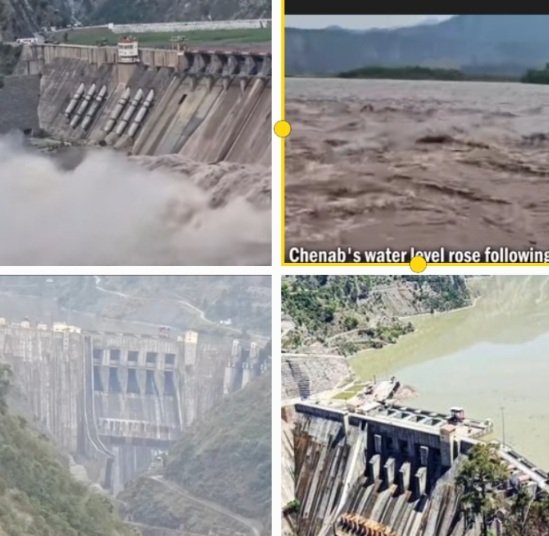
SHIMLA/NEW DELHI: India’s decision to keep the Indus Waters Treaty (IWT) “in abeyance” rather than formally terminate it has reignited a legal and strategic debate after an arbitral tribunal ruled that the move was not permissible under the treaty or applicable international law.
But beyond the legal terminology New Delhi has conveyed a much harder strategic message: Pakistan cannot expect normal water cooperation while cross-border terrorism continues.
The word abeyance simply means put on hold. It is not a clearly defined mechanism under international treaty law for suspension or withdrawal. That ambiguity has prompted questions over why India chose this formulation instead of invoking established provisions governing treaty suspension or termination.
Yet the ambiguity may also be deliberate. A formal withdrawal could create a far more complicated legal and diplomatic confrontation over a treaty that has governed the sharing of the Indus river system for more than six decades.
By placing it in abeyance, India has avoided declaring the agreement permanently dead while making clear that the old relationship cannot continue unchanged.
The message is essentially: stop terror, and the water relationship can be reconsidered. India has repeatedly linked its decision to Pakistan's alleged support for cross-border terrorism, arguing that terrorism and water cooperation cannot continue together.
The government has also indicated that the treaty could return to the table if Pakistan credibly and irrevocably ends support for terrorism.
This gives New Delhi strategic room to manoeuvre. Rather than shutting the door permanently, India has kept it open—but has changed the conditions for reopening it.
The tribunal's ruling has nevertheless highlighted the sharp divide between India's strategic position and international legal interpretation. The tribunal considers the treaty legally operative, while India rejects the tribunal's jurisdiction and maintains that its decision on abeyance is a sovereign matter.
The controversy also raises another important question: does legal terminology matter more than the actual objective and conduct of a state?
India has not formally declared the treaty void. Nor has it, at this stage, sought to deprive Pakistan overnight of the entire flow of the Indus system.
Instead, it has created political and strategic pressure while retaining the option of using the water resources to which it is entitled, experts say.
Congress MP and writer Dr Shashi Tharoor has also pointed out that India has not yet fully utilised the water rights available to it under the treaty. His broader argument is that Pakistan must change its conduct, particularly on terrorism, if it wants the existing water relationship to continue.
For Pakistan, the stakes are enormous. The Indus river system is the backbone of its agriculture, food security and economy. Any prolonged uncertainty over the treaty therefore carries consequences far beyond diplomacy.
For India, however, the issue has increasingly become one of national security, strategic leverage and sovereign rights.
India Rejects Indus Waters Tribunal Award, Calls It ‘Illegal’
New Delhi: India has rejected the latest award of the Court of Arbitration on the Indus Waters Treaty, calling the tribunal “illegal” and reiterating that it does not recognise its proceedings or jurisdiction.
The latest rejection deepens the crisis over the 1960 treaty, which survived wars and decades of India-Pakistan hostility but has come under unprecedented strain since India announced in April 2025 that it would hold the pact in abeyance following the deadly Pahalgaon terror attack on civilians in Kashmir.
Signed on September 19, 1960, and brokered by the World Bank, the Indus Waters Treaty divided the Indus river system between the two countries. Pakistan was allocated the western rivers—the Indus, Jhelum and Chenab—while India received the eastern rivers—the Ravi, Beas and Sutlej.
In fact, the present dispute centres on Pakistan’s objections to India’s Kishanganga and Ratle hydroelectric projects, raised in 2017. In 2022, the World Bank initiated two mechanisms—a Neutral Expert and a Court of Arbitration—to address the dispute.
India sought modification of the treaty in 2023, but Pakistan refused. New Delhi also challenged the competence of the Court of Arbitration and subsequently stopped meetings of the Permanent Indus Commission in 2024.
In June 2025, the Court of Arbitration issued a supplemental award holding that the treaty does not provide for unilateral abeyance and reaffirming its jurisdiction. India rejected the ruling, maintaining that the tribunal itself was illegally constituted.
In May 2026, the tribunal issued another award concerning maximum pondage, reportedly upholding Pakistan’s interpretation that the treaty imposes substantive limits on India’s ability to regulate water at its hydroelectric projects. India rejected the award as well.
The experts say that treaty moreover was discrimatory. India has not used the water awarded under the treaty itself.
The treaty may be on hold. The door is not necessarily shut. But New Delhi is making clear that terrorism and water cooperation cannot flow together.
#IndusWatersTreaty #IndiaPakistan #WaterSecurity #NationalInterest