

Shimla/Srinagar:
As free trade agreements (FTAs) and proposed import relaxations threaten to flood Indian markets with foreign apples, apple growers from Himachal Pradesh, Jammu & Kashmir, Uttarakhand and the Northeast are pushing back—armed not with slogans alone, but with science.
Medical experts and nutrition researchers now say that the widespread belief that imported apples are “premium” or “healthier” is scientifically flawed and economically damaging to Indian farmers.
Leading the call is Dr Sudhir Kumar, a Hyderabad-based physician and public health advocate, who says Indian consumers are being misled by glossy marketing while nutritionally superior Himalayan apples are undervalued.
“Never go after those dead, fleshy, red, shining foreign apples. Be Indian. Buy Indian,” Dr Kumar said, bluntly rejecting the myth that shine equals health.
Months in Storage, Miles at Sea: Why Imported Apples Lose Nutrition
Imported apples are harvested early and stored for five to nine months in Controlled Atmosphere (CA) storage before travelling over 10,000 kilometres by sea to reach India. While this process preserves appearance and crunch, it significantly reduces nutritional value.
Scientific studies cited by health experts show that:
Vitamin C, a highly unstable nutrient, can drop by 40 to 85 percent during prolonged cold storage
Extended transit exposes fruit to light, temperature variation and oxidation, accelerating nutrient degradation
“In contrast, apples grown in the Himalayan belt reach Indian consumers far quicker. That freshness gap directly translates into better nutrition,” Dr Kumar explained.
Himalayan Apples: Naturally Superior, Not Artificially Preserved
Research conducted on apples grown in the Western Himalayan region highlights their exceptional nutritional profile—particularly traditional Indian varieties such as Royal Delicious and Starkrimson.
Studies have found high concentrations of: Phloridzin, which helps regulate blood sugar, Quercetin and catechin, powerful antioxidants linked to heart health, Anthocyanins, visible in the deep red colour of Kashmiri and Himachali apples, known to fight oxidative stress and inflammation.
“These benefits come from altitude, intense sunlight and natural temperature variation—not from chemical coatings or gas chambers,” Dr Kumar said.
Food Miles, Carbon Cost and Farmer Distress
Beyond nutrition, experts warn that importing apples already grown in abundance in India carries a heavy environmental and social cost.
Long-distance shipping adds enormous carbon emissions
Imported apples depend heavily on refrigeration, wax coatings and preservatives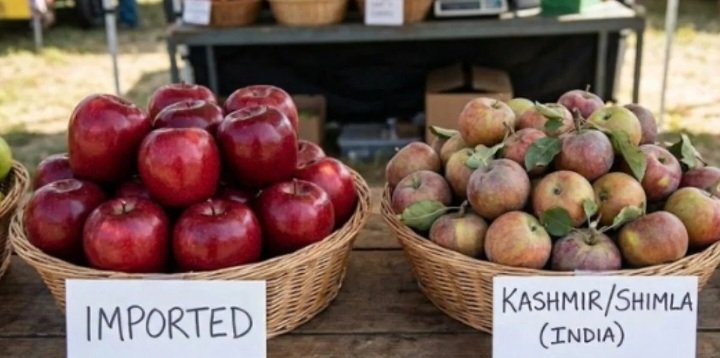
Domestic growers face price crashes, delayed payments and rising debt
“When consumers buy imported apples, they fund shipping companies and foreign exporters. When they buy Indian apples, they protect farmers, orchards and rural livelihoods,” Dr Kumar said.
Trade Policy vs Ground Reality
Apple growers argue that while trade negotiators focus on market access and global integration, the ground reality in orchards is being ignored.
Indian apple farmers are already battling climate change, erratic snowfall, pest attacks and rising input costs. Flooding markets with nutritionally inferior imports, they say, is nothing short of economic injustice.
“Trade should not become a tool to destroy farmers who are producing better food under tougher conditions,” said a growers’ representative.
The Bottom Line: Health, Farmers and India First
Doctors and farmers are unanimous on one message: local apples are not a compromise—they are the benchmark.
“An apple a day is good. A fresh Himalayan apple is better—for health, for farmers and for India,” Dr Kumar said.
As imported apples continue to dominate urban shelves with glossy stickers and inflated prices, experts urge consumers to look beyond shine and labels.
Real nutrition grows in the hills of Himachal and the valleys of Kashmir.
#FarmersFirst #SaveIndianApples #BeIndianBuyIndian #HimachalApples #KashmiriApples #NoToFoodDumping #EatLocalIndia