Sangrah Mining Cannot Be Just About Extraction: My First-Hand Account of an Ecological and Social Crisis
Sangrah, Sirmaur | September 28, 2026
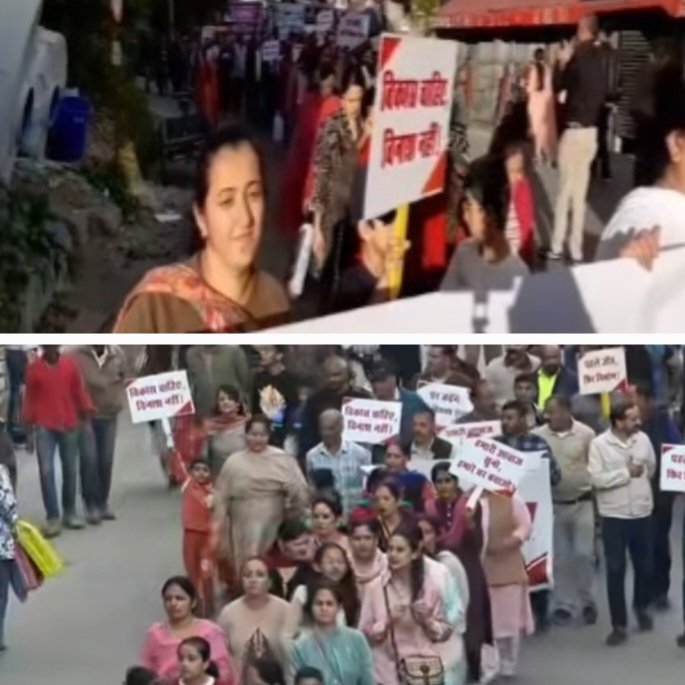
I did not come to Sangrah merely to join a protest against mining. I came because what is happening in and around the mining belt raises a much larger question: can we call it development when the economic value extracted from the mountains is accompanied by damaged slopes, pressure on roads and bridges, dust, threats to water sources and uncertainty over the future of local livelihoods?
My concern is not against mining as an industry, nor against any individual company. Minerals are needed for construction and development, and mining can generate employment and economic activity.
But what I witnessed and what our continuing exercise of seeking information from government departments has revealed raises serious questions about whether mining in parts of Sangrah is being carried out scientifically, within environmental limits and with adequate accountability.
The National Green Tribunal has now taken note of allegations of illegal, unregulated and unscientific mining of limestone and riverbed minerals in Sirmaur, including Sangrah, and has sought responses from the authorities. The case also covers allegations concerning mining and stone-crushing activity in several parts of the district.
For me, this makes the issue no longer something that can be dismissed as a local protest.
It demands facts, measurements and accountability.
My RTI exercise exposed a fragmented system
Over the past several months, I have sought information from the Mining Department, Forest Department, Pollution Control authorities, district administration, PWD and other agencies concerning mining permissions, transportation, dumping, environmental safeguards and infrastructure impact.
What emerged was not one consolidated picture.
Information is spread across departments. Responsibilities overlap. Several questions require separate applications and follow-ups.
A citizen should not have to go from one government office to another simply to understand what is happening to the land, water, roads and communities around a mining belt.
The government needs to put the complete picture in the public domain.
That means identifying the mines, their approved areas, production limits, environmental conditions, transportation routes, dumping sites, compliance status and restoration obligations.
Illegal and unscientific mining must be separated from lawful mining
I want to make another point clear.
An allegation of illegal mining is not a finding of guilt.
Where mining is authorised and compliant, it should be allowed to operate within the law.
But where mining takes place beyond approved limits, without required permissions, through unauthorised dumping or in violation of environmental and safety conditions, the authorities must identify it and act.
The same principle applies to unscientific mining.
A mining operation may possess paperwork and still raise questions about slope stability, blasting, drainage, overburden disposal, dust control, water protection or transportation safety.
That is why compliance cannot remain a file exercise.
It must be measured on the ground.
The mountain cannot be treated as an unlimited resource
In Sangrah, the real issue is not simply how much limestone or other mineral can be extracted.
The question is how much the mountain can sustain.
Every excavation alters the terrain.
Every overloaded truck puts additional pressure on roads and bridges.
Every dumping site can alter drainage. Every blasting operation requires assessment of vibration and its impact on nearby structures and slopes.
Every change in the landscape can affect water.
And every loss of agricultural, forest or grazing land can carry a social cost that does not appear in the mining revenue figures.
This is the calculation that I believe is missing from the public debate.
We count what is extracted.We must also count what is lost. Roads and bridges cannot become the hidden subsidy of mining. Mining does not end at the lease boundary. The extracted material has to travel.
That means public roads and bridges become part of the mining supply chain.
I want clear answers on vehicle weights, permissible axle loads, bridge capacities, road design standards and the condition of vulnerable stretches.
If public infrastructure is being subjected to loads beyond its design capacity, the issue is no longer simply about road maintenance.
It becomes a question of public safety.
Mining transportation corridors should therefore undergo independent technical safety audits.
Water may be Sangrah's biggest unanswered question
For me, the most serious concern is water.
Sangrah and the wider Himalayan landscape depend on springs, streams, traditional water sources and drainage systems.
Before we allow long-term alteration of the terrain, we should establish a scientific baseline.
Which springs exist today? What is their discharge? What is the quality of their water? Which streams serve villages and agriculture?
What happens to these sources after mining begins?
Without baseline data, future damage can always be disputed because there is no scientifically documented starting point.
A spring that disappears cannot be restored simply by announcing a compensation package.
Dust, blasting and air quality need measurement. Mining, crushing, loading and transportation inevitably raise dust concerns.
The answer should not be political claims from either side.
It should be scientific monitoring. PM10 and PM2.5 levels should be monitored near settlements, schools and other sensitive locations wherever mining and transportation create significant exposure.
Blasting should also be documented through records of timing, frequency, quantity of explosives and vibration monitoring wherever required.
The public should have access to the results.
Evidence is stronger than accusation.
What about the people who live here?
The debate cannot be reduced to the question of how many jobs mining creates.
We must ask how many local young people receive skilled employment.
How many are trained in machine operation, surveying, safety, environmental monitoring and technical services?
What happens to farmers whose land or water sources are affected?
What happens when agriculture, horticulture, grazing or forest-based livelihoods decline?
What health safeguards exist for workers and communities exposed to dust, blasting and heavy traffic?
Development must be measured not only by production and revenue, but also by the quality of life of the people living beside the resource.
CSR cannot become a publicity exercise
There is another issue I want to raise strongly. Corporate Social Responsibility is not the same thing as legal compliance.
Pollution control required by law is not CSR. Worker safety required by law is not CSR.
Payment of legally mandated compensation is not CSR. CSR should create measurable community benefits.
I want mining companies operating in the region to publicly disclose their CSR spending over the past five years, village-wise and project-wise.
How much was spent? Where was it spent?
What changed?
Did schools improve? Did healthcare improve? Were water systems strengthened? Were local youth trained? Were degraded slopes or water sources restored?
Were women and vulnerable households provided livelihood opportunities?
These are measurable questions. I propose a Sangrah Mining Accountability Framework
I believe Sangrah now needs a transparent mechanism rather than another round of allegations and counter-allegations.
There should be a mine-wise public disclosure system covering leases, approved areas, production and compliance conditions.
Mining, Forest, Pollution Control, Revenue, PWD and district officials should conduct coordinated inspections rather than working in departmental silos.
Mineral transportation routes should undergo road and bridge safety audits.
Important springs, streams and drinking-water sources should be mapped and periodically tested.
Air and noise should be scientifically monitored in affected settlements.
All authorised muck and overburden dumping sites should be geo-tagged.
Villagers should have a formal grievance mechanism allowing them to submit photographs, locations and complaints and receive trackable acknowledgements.
Social and environmental compliance should be periodically audited.
Major mining operators should disclose CSR expenditure and outcomes publicly.
And the entire compliance picture should be available through a public dashboard.
Give the administration 60 days to show the facts
I believe the district administration should prepare a consolidated Sangrah mining compliance report within 60 days.
It should state what inspections were carried out, what deficiencies were found, what notices were issued, what corrective measures were taken and what remains pending.
Such transparency does not target the industry.
It protects responsible operators from unfounded allegations while ensuring that proven violations do not disappear into departmental files.
The Sangrah administration already has a dedicated sub-divisional structure, while the district administration maintains separate Mining, PWD and Forest responsibilities. The government therefore has the institutional framework to bring the information together.
My appeal to Sangrah's youth
I believe the youth can become the strongest guardians of this landscape.
But the movement must be evidence-driven. Photograph damaged roads. Record the date and location. Use GPS coordinates. Document dumping sites. Track changes in water sources. Use RTI. Study satellite imagery. Create before-and-after records. But an observation should not automatically become an accusation.
If we want authorities, courts and the public to take us seriously, our evidence must be stronger than our rhetoric.
What will Sangrah inherit? I leave Sangrah with three questions. How much has mining taken from this region?
How much has it returned? And when mining eventually ends, what will remain for the next generation?
A mountain is not merely rock. It stores water. It supports forests. It carries villages and roads. It sustains agriculture and livelihoods Its slopes feed streams and rivers.
Minerals can be extracted, but not without recognising the mountain's carrying capacity.
Industry can operate, but environmental costs cannot simply be transferred to local communities.
Employment can be created, but not by destroying other livelihoods.
Profit can be earned, but ecological liabilities cannot be abandoned.
My position is therefore simple: Sangrah needs scientific mining, transparent governance, social accountability, safe infrastructure, clean water and air, and strict action wherever illegal or unscientific practices are established.
If mining is lawful, its records should withstand public scrutiny.
If environmental safeguards are working, monitoring data should be available.
If CSR is being undertaken, its impact should be visible.
And where violations are established, corrective action should be visible too.
Transparency is not anti-industry.
It is the minimum requirement for responsible development.
The natural wealth extracted from Sangrah must not leave behind an ecological debt for its next generation.
#Sangrah #IllegalMining #EnvironmentalProtection #HimachalPradeshI have kept “illegal mining” as an allegation/issue under scrutiny rather than stating every operation is legally established as illegal, which is particularly important now that the NGT proceedings are examining those allegations.