
Budget 2026 sets reform fast-track: BioPharma SHAKTI, ISM 2.0, rare earth corridors headline push for Viksit Bharat
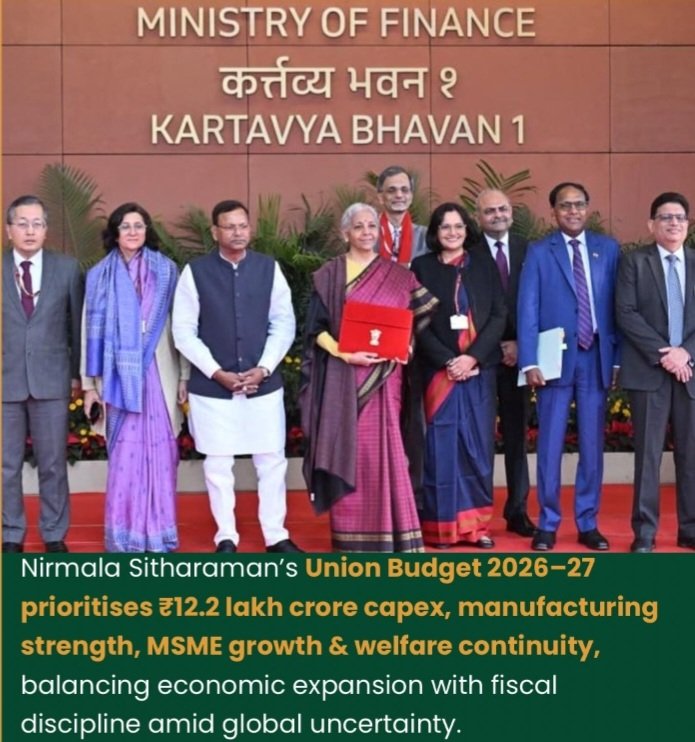
New Delhi: Union Finance Minister Nirmala Sitharaman, presenting her ninth Union Budget 2026 in Parliament on Sunday, said the government has consistently chosen action over ambivalence, reform over rhetoric, and people over populism, even as the world grapples with heightened uncertainty, fractured trade and disrupted supply chains.
She said sustained fiscal prudence, monetary stability and a strong thrust on public investment have helped India maintain around 7 per cent growth, reduce poverty and improve the quality of life of citizens. Anchored in Atmanirbhar Bharat, India has strengthened domestic manufacturing, enhanced energy security and reduced critical import dependence, while continuing to remain deeply integrated with global markets to expand exports and attract stable long-term investment.
A major Budget announcement was the launch of BioPharma SHAKTI—Bio-pharma Strategies for Health Advancement through Knowledge, Technology and Innovation—with an outlay of ₹10,000 crore over the next five years. The initiative aims to position India as a global biopharma manufacturing hub, especially as the disease burden shifts towards non-communicable diseases such as diabetes, cancer and autoimmune disorders. The strategy includes setting up three new NIPERs, upgrading seven existing ones, creating a network of 1,000 accredited clinical trial sites, and strengthening the Central Drugs Standard Control Organisation (CDSCO) through a dedicated scientific review cadre to meet global standards and speed up approvals.
“With BioPharma SHAKTI, we are laying the foundation for India to emerge as a global hub for biologics and biosimilars, ensuring affordable, high-quality medicines while strengthening domestic manufacturing and innovation. These initiatives reflect our resolve to build resilient supply chains, develop full-stack Indian intellectual property, and make India future-ready in critical sectors such as biopharma, semiconductors and electronics,” Sitharaman said.
Building on the success of India Semiconductor Mission 1.0, the Finance Minister announced ISM 2.0, aimed at manufacturing semiconductor equipment and materials, developing full-stack Indian IP, and fortifying supply chains. Industry-led research and training centres will be set up to create a skilled workforce.
Citing strong industry response, Sitharaman said the Electronics Components Manufacturing Scheme, launched in April 2025 with an outlay of ₹22,919 crore, has already attracted investment commitments at over twice the targeted level. The government will now increase the outlay to ₹40,000 crore to leverage this momentum.
The Budget also proposes support for Odisha, Kerala, Andhra Pradesh and Tamil Nadu to develop dedicated rare earth corridors covering mining, processing, research and manufacturing, following the launch of the rare earth permanent magnet scheme in November 2025. To reduce chemical import dependence, the Centre will roll out a new scheme to help states establish three dedicated chemical parks through a cluster-based, plug-and-play challenge route.
Highlighting the importance of capital goods for productivity and quality across sectors, the Finance Minister said further steps will be taken to strengthen domestic manufacturing depth.
The Budget, inspired by ideas shared at the Viksit Bharat Young Leaders Dialogue 2026, adopts a Yuva Shakti-driven approach with a clear sankalp to prioritise the poor, underprivileged and disadvantaged. A three-kartavya framework—accelerating growth, building people’s capacities, and ensuring inclusive access under Sabka Saath, Sabka Vikas—will guide policy.
Under the government’s “Reform Express”, Sitharaman said over 350 reforms have been rolled out since the Prime Minister’s Independence Day 2025 announcement, including GST simplification, notification of labour codes, rationalisation of quality control orders and coordinated deregulation with states.
The Budget’s message is clear: ambition with inclusion, reforms at speed, and a determined march towards making India one of the world’s largest and most resilient economies.