
SHIMLA: Modern civilisation rests on a fragile assumption: that nature will remain predictable. Every road, bridge, and building is designed around tolerance limits—expected ranges of rainfall, temperature, wind, and geological stability derived from past data. Engineering, in essence, is a contract with history.
Climate change has broken that contract.
What were once rare extremes are becoming routine. Rainfall exceeds design thresholds, heat weakens materials, and saturated slopes collapse without warning. Infrastructure built for yesterday’s climate now stands exposed to tomorrow’s volatility.
This is not merely an engineering challenge; it is a philosophical reckoning with the idea of limits.
Nowhere is this clearer than in the mountains.
Unlike plains, mountain systems are inherently fragile. Their stability depends on forests that bind soil, slow hydrological cycles, and geological processes measured in millennia. Urbanisation here is not neutral development—it is a deep intervention into delicately balanced ecosystems.
Roads carve into slopes, concrete replaces permeable earth, and buildings impose new loads on unstable terrain. Each project may appear minor. Together, they rewrite the landscape’s logic.
Cities such as Shimla and Dharamshala illustrate this transformation. Once modest hill settlements shaped by climate and topography, they now face relentless pressure from tourism, migration, and speculative construction. Infrastructure designed for small populations must suddenly support many times that number, swollen further by seasonal visitors.
Water systems strain, waste accumulates, traffic thickens, and slopes grow increasingly vulnerable.
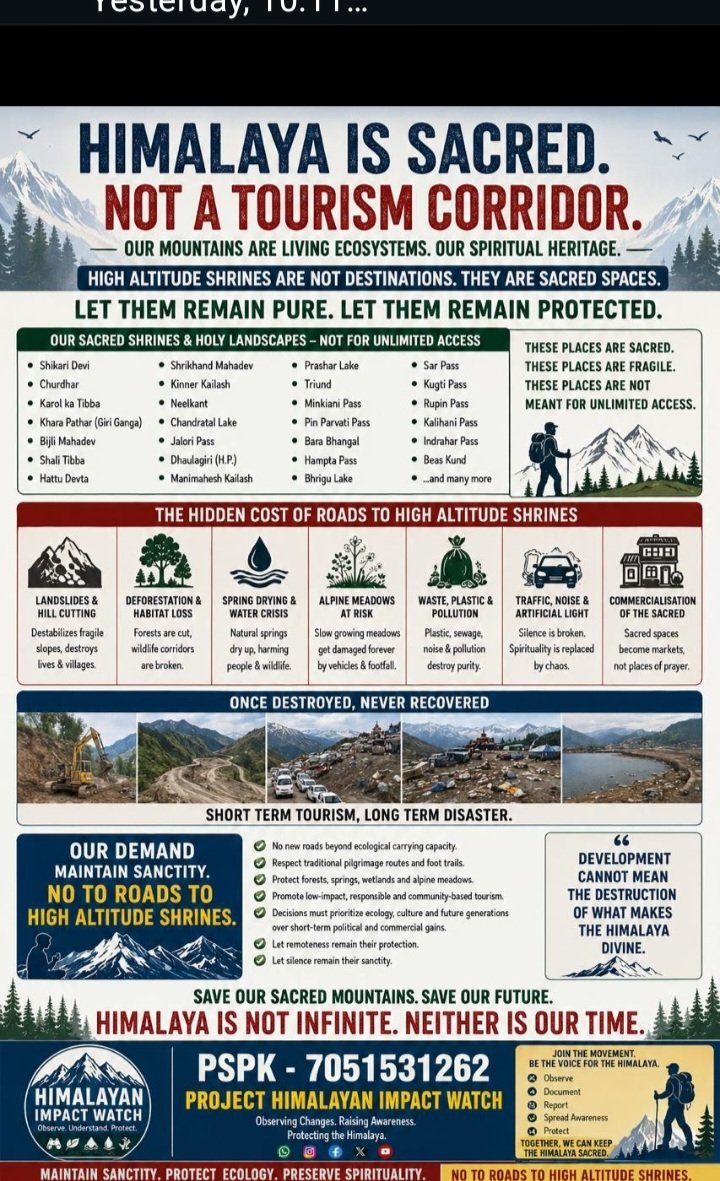
Alongside this urban expansion is a quieter shift: steady encroachment into rural and forested regions across Himachal Pradesh.
As life in the plains becomes denser, faster, and psychologically exhausting, the mountains are reimagined as spaces of escape and possession. People arrive carrying not only capital but also fatigue—seeking peace, yet often reproducing the same high-consumption lifestyles they hoped to leave behind.
Here, ecology meets psychology. The mountains become a stage for unresolved urban desires: oversized homes replace modest dwellings, traffic invades silent valleys, nightlife enters fragile ecosystems, and slopes are asked to support concrete aspirations.
What appears as individual choice accumulates into collective stress. Rivers clog with debris, forests fragment, groundwater depletes, and hillsides destabilise.
Disaster, then, is not sudden. It is slowly assembled.
Beneath this trajectory lies a persistent modern illusion—that technology has freed us from natural constraints. In reality, it has merely postponed their consequences.
Climate change now returns those consequences with interest. Landslides, flash floods, subsidence, and water scarcity are not random misfortunes; they are feedback. Nature is responding, as any system does, when pushed beyond tolerance.
There is also an ethical dimension rarely acknowledged. Development is typically framed through rights—property ownership, mobility, economic growth.
Seldom is it discussed in terms of responsibility: to future generations, to non-human life, or to the geological integrity of landscapes.
Progress measured only in square footage and tourist arrivals is shallow. Real development must be judged by resilience, restraint, and continuity.
The deeper lesson is humility.
Mountains teach slowness. They evolve over epochs, not electoral cycles. To inhabit them wisely requires a shift from conquest to coexistence, from excess to sufficiency, from ownership to belonging.
Architecture must become lighter and locally rooted. Governance must prioritise carrying capacity over short-term revenue. And individuals must recognise that moving to the hills does not absolve them of ecological responsibility.
What confronts us today is not only a climate crisis—it is a crisis of imagination.
We must relearn how to live within limits. Not as deprivation, but as wisdom.
For when tolerance thresholds are repeatedly crossed—whether in materials, mountains, or minds—collapse ceases to be an exception.
It becomes the rule.
(Atul Kaushik is a public-interest writer concerned with sustainable development, fragile ecosystems, and climate adaptation, with particular attention to India’s mountain regions)