
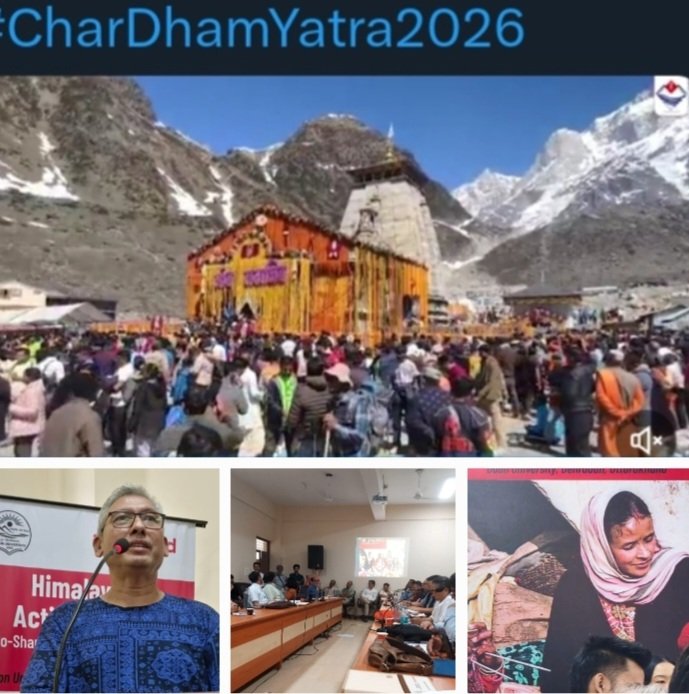
SHIMLA/DEHRADUN: The fragile Himalayan region urgently needs a shared "Himalayan Code for Living" that places ecological limits, community wisdom and sustainable livelihoods at the heart of development, experts, policymakers, activists and researchers concluded at the three-day Himalayan Action School (HAS) held in Dehradun.
Organised by ActionAid India in collaboration with Doon University from June 1 to 3, the deliberations brought together representatives from nine Himalayan states, Nepal, academia, civil society, government institutions, journalists and grassroots organisations to discuss the mounting ecological and social challenges confronting the world's youngest mountain range.
The participants warned that the Himalayas, often described as the world's "Third Pole", are approaching a critical tipping point.
Retreating glaciers, erratic rainfall, flash floods, landslides, biodiversity loss and declining agricultural productivity are no longer isolated incidents but signs of a deeper crisis driven by climate change and unsustainable development.
A recurring theme throughout the discussions was that many of the region's problems stem not merely from global warming but from development models that ignore the ecological realities of mountain landscapes.
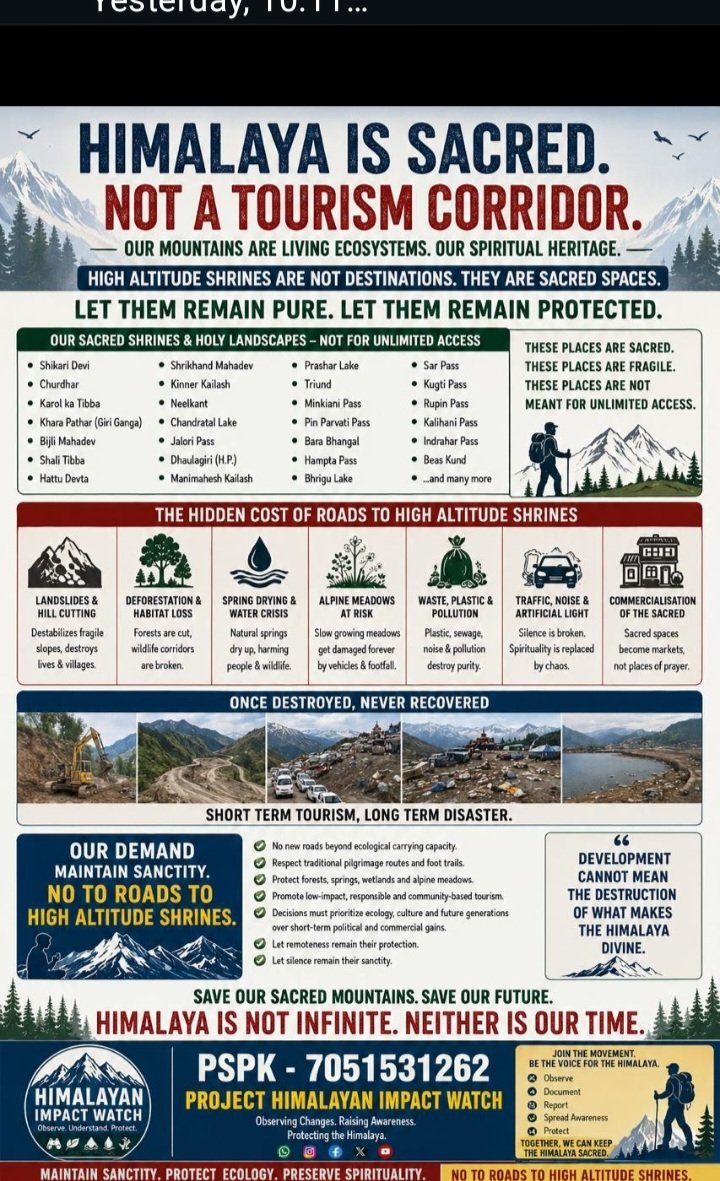
Across the Himalayan belt, roads are being carved into unstable slopes, rivers dammed and diverted, forests fragmented, and tourism and urbanisation expanded without adequate regard for ecological carrying capacity.
Participants noted that recent disasters across the Himalayas have demonstrated how extreme weather events interact with local terrain, land-use changes and ecological degradation, making conventional planning approaches increasingly ineffective.
Entire valleys can be devastated by cloudbursts, flash floods and landslides while neighbouring regions remain relatively unaffected, underscoring the need for hyperlocal planning and adaptation.
Inaugurating the event, Kusum Kandwal highlighted how women bear the brunt of environmental degradation and natural disasters. She stressed the need for collective action and said recommendations emerging from the workshop should reach policymakers.
ActionAid India Executive Director Sandeep Chachra underscored the diversity and shared identity of Himalayan communities and called for a common vision for sustainable mountain futures shaped by the people of the region themselves.
Former Nepal Foreign Minister Bimala Rai Paudyal advocated balanced development that places environmental sustainability on par with economic growth.
She stressed that infrastructure, tourism, hydropower and urbanisation projects should be evaluated not only for financial returns but also for their long-term impacts on forests, water resources, biodiversity and local communities.
A strong call also emerged for restoring the role of local communities in decision-making.
Speakers argued that mountain residents have developed sophisticated systems of managing forests, water sources, grazing lands, agriculture and disaster risks over centuries, yet their knowledge remains largely absent from contemporary planning processes.
Ramesh Negi, President of the Integrated Mountain Initiative, expressed concern that increasing privatisation has shifted natural resource management away from public welfare towards private interests. He observed that despite policies relating to housing, health and sanitation, their intended benefits often fail to reach people on the ground.
Dr. Amba Jamir from Nagaland highlighted how traditional community-based governance systems in the Northeast, which once safeguarded local rights over natural resources, are steadily weakening.
Participants stressed that preserving indigenous institutions, customary laws, community-managed forests and traditional water systems is essential for building climate resilience.
Speaking on urban governance, former Shimla Deputy Mayor Tikender Panwar advocated sustainable urbanisation models suited to mountain conditions.
Kuldeep Verma of People's Action for People in Need, Himachal Pradesh, warned that traditional agriculture and animal husbandry-based livelihoods are declining while unchecked tourism and extensive road construction are placing immense pressure on fragile mountain ecosystems.
The deliberations repeatedly highlighted the need to strengthen mountain agriculture, pastoral systems, forest-based livelihoods, medicinal plant cultivation, women-led enterprises and local value addition.
Participants argued that these sectors not only provide livelihoods but also help maintain ecological balance.
One of the most striking observations emerging from the Action School was that indigenous Himalayan communities themselves do not require lessons on sustainable living.
Participants emphasized that mountain societies already possess a well-established code of living that has evolved over centuries through their intimate relationship with forests, rivers, pastures and landscapes.
Traditional practices governing the use of water, forests, grazing lands and agricultural resources have enabled these communities to survive and thrive in one of the world's most fragile ecosystems.
Several speakers argued that the real need is for the "neo-educated" classes—bureaucrats, planners, politicians, corporations, contractors and urban consumers—to adopt a Himalayan Code for Living.
Many of the ecological crises confronting the region today, they noted, are not the result of traditional mountain lifestyles but of externally imposed development models that disregard ecological limits and local wisdom.
"The Himalayas do not need lessons from boardrooms; it is the boardrooms that need lessons from the Himalayas," was a sentiment that resonated strongly throughout the deliberations. Participants maintained that indigenous mountain communities have long practised concepts now described as sustainability, carrying-capacity management, resource conservation and climate adaptation, even though such terms were absent from their vocabulary.
The idea that attracted widespread support during the Action School was a proposal by Meghalaya-based independent journalist Linda Chhakchhuak for a living "Himalayan Code for Living" that would guide governments, businesses, communities and individuals in their relationship with mountain ecosystems.
The proposed code would recognise the Himalayas as a fragile living system rather than an inexhaustible resource frontier. It would place ecological resilience, protection of water sources, forests and biodiversity, community well-being, democratic participation and the rights of future generations at the centre of development decisions.
Participants said the Himalayas are entering a period of profound ecological uncertainty. Climate change will continue to intensify existing vulnerabilities, while growing pressures on land, water and natural resources are likely to fuel further ecological stress and social conflict. Incremental policy adjustments, they warned, will no longer be sufficient.
The overarching message from the three-day conclave was clear: the future of the Himalayas will not be secured by more concrete, more dams and more roads alone. It will depend on whether modern society can rediscover the ecological wisdom that Himalayan communities have practised for generations and learn to live within the limits of nature.
In that sense, the mountains do not need a new code—the neo-educated world does.