Shimla, October 29:
Chief Minister Thakur Sukhvinder Singh Sukhu’s latest pitch to the Centre marks a decisive step toward making Himachal Pradesh technologically equipped against the growing onslaught of natural disasters.
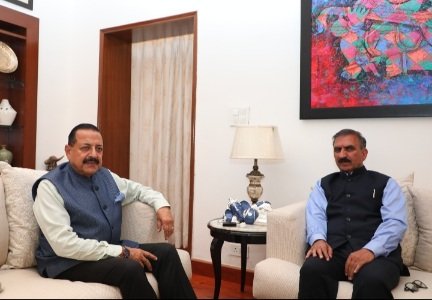
Meeting Union Minister of State for Science and Technology and Earth Sciences Dr. Jitendra Singh in New Delhi on Tuesday evening, Sukhu pressed for a network of 150 automated weather stations and a Doppler weather radar before the next monsoon — a move that could significantly sharpen the state’s early-warning and disaster-response systems.
Climate Change Forcing Himachal to Modernize
Citing the rising frequency of cloudbursts, flash floods, and landslides, the Chief Minister underscored how Himachal’s fragile topography and changing climate have combined to make the region one of the most disaster-prone belts in the western Himalayas.
The state, he said, was incurring “huge recurring losses” every monsoon and could no longer depend solely on manual data or delayed central alerts.
Sukhu’s demand for automated weather systems isn’t new — but his renewed urgency reflects the lessons from the last two monsoons, when erratic weather wiped out infrastructure worth thousands of crores.
By requesting a real-time data network and integration with national early-warning agencies, Sukhu is essentially trying to bridge a fatal gap: the time lag between central forecasts and local ground alerts.
Call for Seismic and Air Monitoring Systems
Beyond rainfall data, Sukhu also pitched for a seismic laboratory and analysis centre in the Kangra-Hamirpur zone, which lies in seismic zone-V — the most earthquake-prone belt in Himachal.
Two additional air monitoring systems in high-altitude areas and a compact radar network for shadow zones were also on his wish list, along with a centralized weather data centre at Hamirpur.
Such a network, if approved, could transform disaster preparedness in Himachal — especially in districts like Kullu, Mandi, and Kinnaur, where early alerts can mean the difference between safety and tragedy.
Bio-Manufacturing and Eco-Packaging Pitch
Interestingly, Sukhu also broadened the discussion beyond disaster management — pushing for the establishment of Bio-Manufacturing Hubs that would leverage Himachal’s rich plant-based natural resources.
His emphasis on plant-based packaging units ties into his government’s recent push for a “Green Himachal” model — aiming to align environmental protection with sustainable livelihoods.
He further sought central support to boost space science education, AI-based refresher courses, and the ‘Space on Wheels’ outreach programme to inspire students toward modern science learning.
Centre’s Response and the Broader Message
Dr. Jitendra Singh reportedly assured the Chief Minister that the Centre would “fulfill the demands on priority,” signaling a possible breakthrough in Centre-State coordination on disaster preparedness.
For Sukhu, this meeting isn’t just about technology — it’s about political positioning.
With Himachal repeatedly ravaged by monsoon fury and climate-linked losses, the Chief Minister appears determined to project himself as a proactive leader pushing for a scientifically equipped, self-reliant mountain state.
Whether Delhi matches that intent with timely execution, however, remains the bigger test.
#HimachalDisasterPreparedness #SukhuInAction #ClimateChangeImpact #BioManufacturingHub