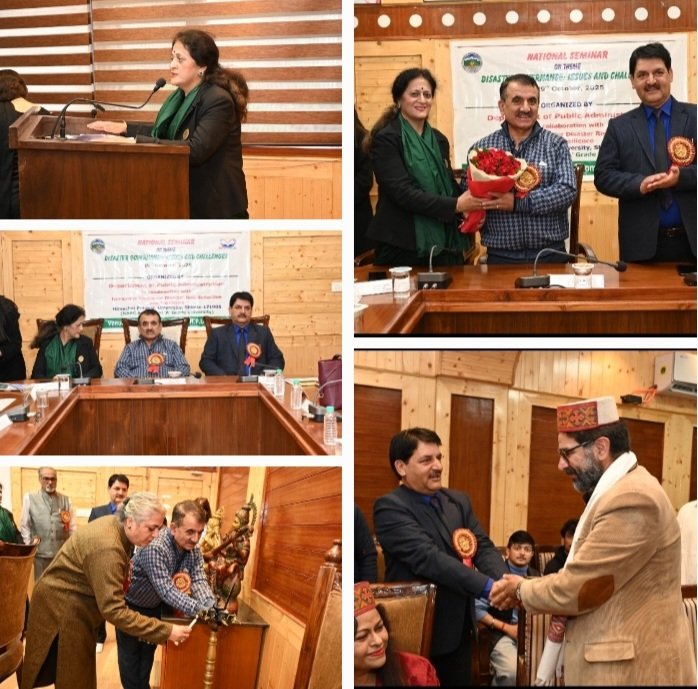
Himalayan States Face Triple Threat — Rising Disasters, Weak Governance, and Failing Early Warnings, Experts Warn at HPU Seminar
Shimla:
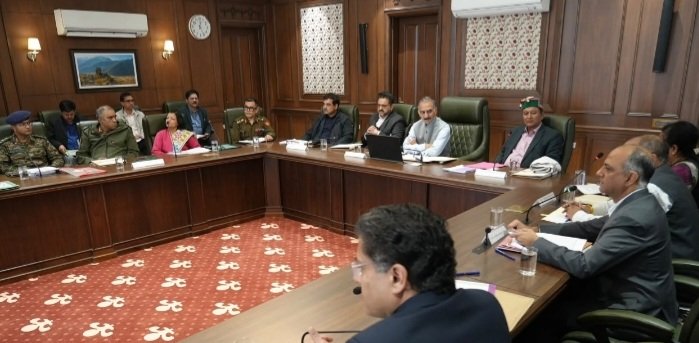
Himalayan states are staring at a dangerous cocktail of extreme weather, fragile mountains, and weak disaster governance, experts warned at a national seminar held at Himachal Pradesh University on Wednesday October 29.
From collapsing early warning systems to unplanned urban growth and warming seas, speakers painted a stark picture of a region inching towards deeper risk unless planning and governance drastically improve.
The day began with Prof. Mamta Mokta, Seminar Director, who hit the alarm bell early.
She said disasters are “increasing both in frequency and intensity,” and governance systems are “failing to keep pace.”
She stressed four essentials — accountability, transparency, participation, and coordination.
“These pillars must anchor every disaster plan,” she said, adding that communities and institutions have to be part of the process, not afterthoughts.
Prof. N.S. Negi, Director of HIM DR3, placed the Himalayan region at the centre of the crisis.
He said the mountains are exposed to multidimensional threats — ecological, climatic, and institutional.
“Our research with the University of Boston shows the need for strong vertical and horizontal coordination,” he said. “Mountain ecosystems demand a multidisciplinary lens.”
Vice-Chancellor Prof. Mahavir Singh, who presided over the inaugural session, underlined a crippling weakness — broken warning and communication systems.
He said most rural and remote areas still lack real-time alerts.
“Poor communication increases vulnerability manifold,” he warned.
He pushed for deployment of GIS, AI, and IoT to strengthen early warning networks.
He also announced an MoU with Home Guards and Civil Defence to build a collaborative response mechanism.
“Our university will work with international organisations through HIM DR3,” he said.
The biggest ground reality came from the Chief Guest, Mrs. Satwant Atwal, Commandant General Home Guards and Director of Fire Services.
She revealed that only 32% of Himachal’s population is aware of emergency helplines.
“This shows how vulnerable our people are,” she said.
She stressed intensive community literacy programmes and stronger volunteer networks.
Her call to include women volunteers and local bodies added urgency to the preparedness debate.
Chairing the plenary session, she listened as keynote speaker Tikender Panwar, former Shimla Deputy Mayor, laid out the climate dimensions.
He warned that carbon emissions, extreme weather, and poor planning are turning the Himalayas unstable.
“Unplanned urbanisation is pushing people into high-exposure zones,” he said.
He pointed to deforestation, encroachments, and garbage mismanagement as triggers behind floods and landslides.
Panwar urged Himalayan states “from Kashmir to Tripura” to mainstream sustainable development and climate planning.
He stressed community-based disaster risk reduction and stronger local capacity.
Dr. Suresh Attri, Chief Scientist (Climate Change), added a blunt scientific assessment.
He said glacial retreat, slope fragility, and changing Arabian Sea temperatures are reshaping Himachal’s climate risks.
RCM–GCM data, he said, indicates sharper moisture swings and rising climate volatility.
“Policy reform must go hand-in-hand with behavioural change,” he warned.
Prof. Durgesh Nandini from IGNOU traced India’s disaster policy evolution — from the DM Act 2005 to the Policy 2009 and the Plan 2016.
She said India remains the sixth most disaster-affected nation, a fact that demands stronger local governance and accountability.
She also highlighted the wider inclusion of women in disaster planning.
Prof. Sanjeev Mahajan expanded the debate to global lessons.
He emphasised accountability, decentralisation, transparency, and community participation as the four global principles of good disaster governance.
He said disaster governance must merge with climate and development planning to survive an era of global interdependence.
The technical session chaired by Prof. Nandini and co-chaired by Dr. Ishwar Sharma and Dr. Kuldeep saw fifteen research papers.
The discussions were sharp, participative, and rooted in real challenges facing the mountains.
The valedictory session featured Prof. D.D. Sharma, former Vice-Chancellor of Sardar Patel University, who flagged a chronic administrative problem.
“Overlapping roles between NDMA, SDMAs, district authorities, and NGOs weaken governance,” he said.
He added that poor coordination and weak enforcement of disaster policies remain major threats to effective disaster management.
Certificates were presented by Chief Guest Prof. Shyam Lal Kaushal, Controller of Examinations, HPU.
By the end of the day, a single message echoed across all panels:
Resilience must be built before disaster, not after.
The seminar closed with Prof. Mamta Mokta thanking all experts, faculty, and volunteers.
She stressed that genuine resilience demands coordination between government agencies, civil society, private sector, and communities.
“Preparedness, mitigation, response, and recovery must all work together,” she said.
The seminar exposed cracks in disaster governance but also strengthened collective resolve to plug them with better planning, accountability, and community-driven resilience.
#DisasterGovernance #HimalayanResilience #ClimateRisk #DisasterPreparedness