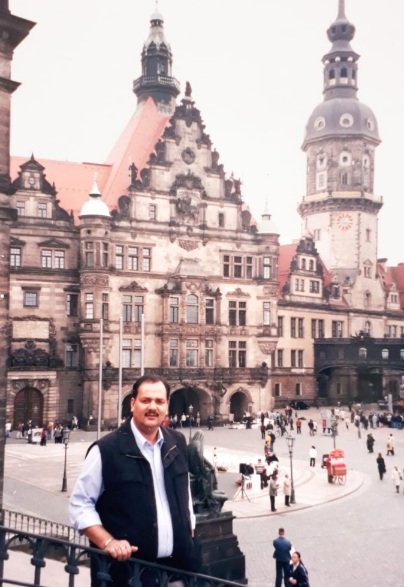
SHIMLA: As a Visiting Scientist, I had the privilege of working in Germany for nearly five months.
My research was conducted at the Research Institute for Breeding and Biotechnology, Pillnitz, Dresden, with short assignments in Berlin and Hamburg. My work involved biotechnology experiments, particularly the molecular identification of apple scab isolates and their comparison with Indian isolates.
Germany is one of Europe's major apple-growing countries. What impressed me most was not merely its scientific infrastructure but the philosophy behind its research.
Every research programme is designed to address Germany's own needs, climate, farmers and consumers. Research there is driven by national priorities rather than commercial dependence.
One incident from my stay has remained with me for decades.
My mentor presented me with a beautifully illustrated book containing numerous apple varieties developed in Germany.
While studying the book, I identified nearly ten varieties that I believed could perform well under Indian, especially Himachali, conditions. I requested him if I could take a few budwoods to India for evaluation.
His answer was immediate and firm—No.
He explained that Germany does not permit the exchange of plant material, including seeds and budwood, because of extremely strict phytosanitary and quarantine regulations.
Even movement of certain plant material between neighbouring European regions is tightly regulated to prevent the introduction of new pests and diseases.
That single conversation taught me what true agricultural self-reliance means.
Germany believes in developing its own varieties for its own farmers. It neither depends upon foreign planting material nor encourages unnecessary imports.
The country protects its genetic resources and invests continuously in indigenous research. To me, this is real nationalism in agriculture and an example of sustainable development.
When I compare this with India, I feel concerned.
Today, our apple-growing states—Himachal Pradesh, Jammu & Kashmir and Uttarakhand—are increasingly dependent upon imported apple varieties, particularly from Italy and the United States.
We proudly display these imported varieties in orchards, discuss them on social media and make video reels showcasing them.
But I often ask myself: Have we forgotten our own strengths?
India is a vast country with remarkable climatic diversity and highly capable agricultural scientists.
Why have we not developed enough indigenous apple varieties suited to our own topography, climate and future challenges? Why have we become increasingly dependent upon imported genetic material?
Successive governments have celebrated agreements for importing planting material, pesticides and technologies.
Farmers, too, have accepted these introductions because the fruits appear attractive and command higher prices in the market. However, this has also created increasing dependence on imported technologies and costly external inputs.
I deeply respect innovation. I am not opposed to scientific progress. But scientific progress should strengthen our self-reliance rather than increase our dependence.
I also feel emotional when I see the gradual replacement of the legacy created by the late Satyanand Stokes, who laid the foundation of commercial apple cultivation in Himachal Pradesh.
Today many traditional orchards are being replaced by imported cultivars supplied by foreign companies. This deserves serious discussion.
Another issue that concerns me is the increasing occurrence of diseases such as Alternaria leaf blotch.
During my studies, Alternaria was generally regarded as a saprophytic fungus causing negligible damage towards the end of the season, often below 0.5 percent incidence. Today, however, it has become a major concern in many orchards, compelling farmers to spend heavily on imported fungicides.
Whether these changing disease patterns are linked to imported planting material, climate change or other ecological factors requires detailed scientific investigation. We should not ignore these questions.
I believe India has all the scientific expertise needed to develop climate-resilient, disease-tolerant and high-quality apple varieties suited to our own conditions.
Our research institutions should receive stronger support so that future generations of apple growers depend more on Indian science than imported technology.
This is not an argument against international cooperation. Scientific collaboration is essential. But collaboration should never replace self-confidence.
As someone who has spent decades in apple research and orchard management, I firmly believe that India's future lies in strengthening indigenous research, protecting our biodiversity and restoring confidence in our own scientific capabilities.
The debate is much larger than apple varieties alone. It is about the direction of Indian agriculture, our scientific priorities and whether we wish to remain consumers of foreign technology or become creators of our own.
RESPONSES:
1. I fully & whole heartedly agree with Dr Vijay S Thakur !!! That's a remarkable, well researched piece of writing he's painstakingly put forth for the readership of Himbumail...
Lessons from Dr Swaminathan's Green Revolution, which undoubtedly saved a Nation from the brinks of starvation to self sufficiency but also morphed into a magnanimous exporter of agricultural produce; have warned us to be vigilant against the short comings of unscientific & over usage of unmonitored foreign material, especially the chemical fertilisers, pesticides & fungicides.
Himachal's Farming Community should be saved from having to face a phenomenon of "the Cancer Express" type & entire villages being labelled as "Napunsak", courtesy- innumerable incidences of carcinogenic diseases due to unregulated usage of unabashedly promoted MNC products...
Hushed up incidences of similar fallouts in the vegetable growing areas of Theog and to some extent in the apple growing belts of upper Shimla, need to make the concerned people sit up and take notice , nay, Action...
Playing into the hands of unscrupulous MNC manufacturers and suppliers might necessitate the shifting/construction of a new Homi Bhaba Cancer Hospital from Mullanpur, New Chandigarh to closer vicinity of Shimla - the erstwhile Queen of The Hills.
-BALWANT DUTTA, KALGAON, Teh ROHRU, DST SHIMLA, HP, INDIA 171205