
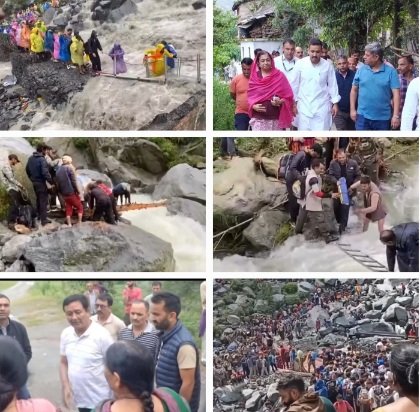
Six Mani Mahesh Pilgrims Still Trapped in the Mountains as Monsoon Toll Mounts in Himachal
Chamba/Shimla:
Six pilgrims who perished during the sacred Mani Mahesh Yatra remain stranded on the high-altitude trek, their bodies still lying in the mountains as bad weather has grounded rescue teams for days.
For their families waiting below, the pilgrimage has turned into a nightmare of helplessness — no last rites, no closure, just endless prayers that the skies clear long enough to bring their loved ones home.
This heartbreak is just one chapter in Himachal Pradesh’s monsoon tragedy.
As per the State Emergency Operations Centre, the rains since June 20 have claimed 523 lives — 360 in disaster incidents and 163 in rain-linked road accidents.
Almost 200 people died in landslides, flash floods, drowning, electrocution, and other calamities.
The devastation doesn’t stop there. The monsoon has wiped out 1,967 livestock and nearly 27,000 poultry birds.
Over 28,922 hectares of crops stand damaged, while 2.42 lakh hectares of farmland lie battered. Public property losses have already touched a staggering ₹3,97,952 lakh (≈ ₹3,980 crore) — roads caved in, schools crumbled, and bridges snapped like twigs.
Chamba, where the Mani Mahesh Yatra unfolds, has itself seen 43 deaths and 267 houses destroyed or damaged.
Mandi district leads the state’s death count with 58 fatalities, followed by Kangra (50) and Shimla (39).
Rescue teams say reaching the pilgrims is their “highest priority,” but landslides and blizzards have narrowed weather windows to a few dangerous hours.
“The terrain is unstable. We’re waiting for even a small opening to retrieve the bodies,” a disaster management official confirmed.
For ordinary villagers, every rumble of thunder is a reminder of survival by chance.
In Kullu, 33 have died since June; in Kinnaur, rockfalls have made apple harvest roads deadly.
In far-off Lahaul-Spiti, even a single death shakes the valleys where villages count populations in hundreds.
Behind the statistics are shattered families. Each lost pilgrim, farmer, or commuter leaves behind unanswered prayers. And in Chamba, six families still wait for the mountains to return their dead.