
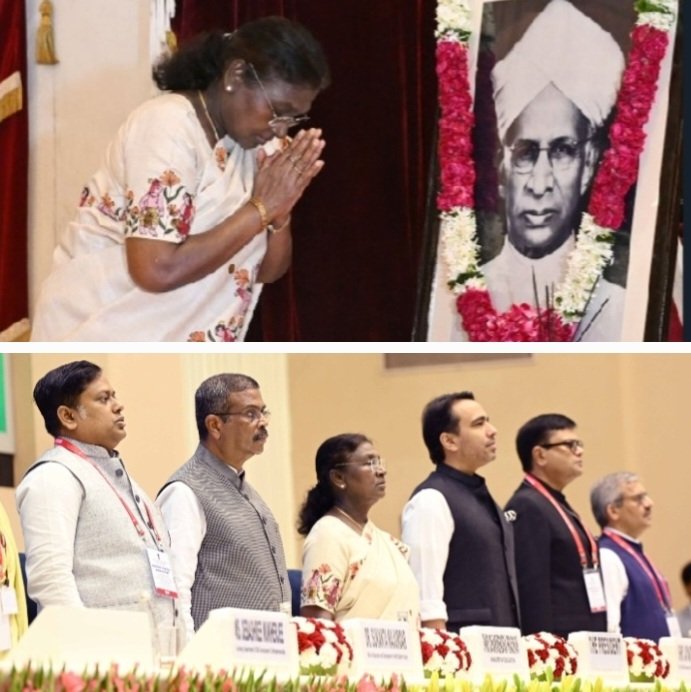
New Delhi/Shimla September 5: President Droupadi Murmu on Teachers’ Day conferred the National Teachers’ Awards 2025 on 66 educators from across the country—45 from schools and 21 from higher education institutions.
The glittering ceremony at Rashtrapati Bhavan celebrated the backbone of India’s education system.
But behind the applause lurks a tough new challenge: Artificial Intelligence.
In her address, President Murmu reminded the gathering that “smart classrooms and blackboards have their place, but the most important are smart teachers.”
That’s the crux of today’s education crisis—when AI can churn out answers, only a teacher’s creativity, empathy, and character-building role can keep learning human.
Educators now walk a tightrope: use AI as a tool for efficiency without letting it hollow out originality. If teachers surrender creativity to machines, the system risks producing information-rich but imagination-poor students.
From Gurukul to Global Classrooms
India’s guru–śiṣya paramparā was rooted in one-to-one learning, values, and discipline.
Modern schooling—layered with textbooks, timetables, and exams—shifted the focus to measurable outcomes.
Now, with NEP 2020 pushing for critical thinking, skill-based education, and inclusion, the pendulum is swinging again.
The President stressed girls’ education as the most effective route to women-led development, citing NEP’s emphasis on expanding Kasturba Gandhi Balika Vidyalayas and creating pathways for underprivileged students.
Yet, the big question remains—will policy frameworks succeed if teachers lose the human spark in a tech-driven race?
A Global Knowledge Superpower or a Tech Dependency?
NEP aims to project India as a Global Knowledge Superpower. But the foundation of that ambition lies in the shoulders of teachers who must nurture not just coders and engineers but citizens with values, empathy, and imagination.
The National Awards, while symbolic, spotlight the larger truth: India doesn’t just need “award-winning teachers,” it needs an education system that refuses to outsource thinking to algorithms.
Awardees at a Glance
Sonia Vikas Kapoor (Mumbai): Turned classrooms into playful learning spaces, introduced sustainability projects like school gardens.
Mohammad Shaikh (Nanded, Maharashtra): Tackled girls’ dropout rates, promoted menstrual health awareness.
Sandipan Jagdale (Latur, Maharashtra): Bridged language barriers by translating textbooks into the Waddar tribal language; used songs to spread awareness.
Kandhan Kumaresan (Andaman & Nicobar Islands): Championed inclusive learning in remote island communities.
Shashi Paul (Himachal Pradesh): Recognised for innovative teaching practices in hill-state schools.
Madhurima Acharya (Kolkata): Advocated arts-based learning and holistic student development.
Revathy Parameswaran & Vijayalakshmi (Tamil Nadu): Pioneered child-friendly approaches and community-driven education initiatives.
Prof Vibha Sharma (AMU): Honoured among higher education faculty for academic leadership and mentoring students in cutting-edge research.
#NationalTeachersAwards #TeachersDay2025 #PresidentMurmu #NEP2020 #AIinEducation #GuruShishyaParampara #GlobalKnowledgeSuperpower