

Forest Encroachments in Himachal: A Problem We Can No Longer Ignore.
ROHRU: For someone who has spent most of his life in the hills of Himachal Pradesh, the changes we’re seeing around us today are not just visible — they are deeply worrying.
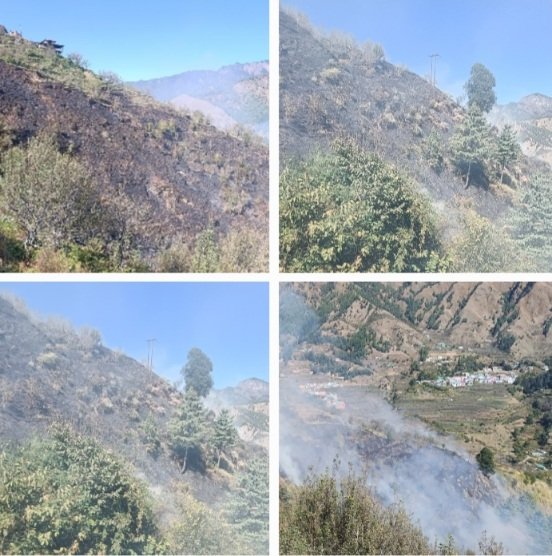
Over the last several years, forests across the state have come under serious threat, not only from industrial hydropower, highway projects or large cement companies and real estate builders, but also from the slow and steady clearing of forest land for fruit orchards and resorts.
In many parts of Himachal, individuals have occupied and cleared hundreds bighas of forest land, converting it into private orchards of apples, plums, cherries, apricots, and pears and resorts.
These are not isolated cases. Large sections of forest, once thick with native trees and full of wildlife, have been systematically cleared in many areas.
The cost of this expansion may not be visible in market prices, but it is showing up all around us — in our environment, in our weather, in our water, and in our daily lives.
I still remember my childhood days vividly. Winters were proper winters. By the time the month of Posh (mid-December to mid-January) arrived, snowfall was certain.
We would play in the snow, build snowmen, and wait for the season’s first flakes with excitement.
The snow would come on time, and so would the rains.
Everything had a rhythm — one that matched the forests and the seasons. But today, that rhythm is gone.
Now, winters arrive late and linger well into spring.
Sometimes, snowfall is delayed till late March or even April, long past the traditional winter months.
The month of Posh, once guaranteed to bring white hillsides, now often passes with dry, cold winds and no snow at all.
At the same time, cloudbursts — something we barely heard of earlier — have become far more frequent in the last few years.
Torrential downpours that once happened once in a decade are now almost an annual event.
Villages suffer landslides, roads get blocked, and lives are lost. This increase in extreme weather is not a coincidence.
It is directly connected to the loss of forest cover and climate change — a cover that was critical in regulating rainfall, snow patterns, and soil stability.
Where there used to be thick jungle, now there are fences and pipelines.
The result is simple: animals that once lived deep inside the forest are now being seen regularly inside villages.
Wild boars, monkeys, bears, and even leopards are showing up near homes.
But can we really blame them? We cleared their homes. They are only trying to survive.
There is another kind of silence creeping in — the silence of birds disappearing. Mornings in Himachal used to be filled with bird calls.
I remember a local bird we call Losri, which was once common across our valleys.
Today, even common birds like crows are rarely seen, and the losri is now found only in a few scattered locations.
This drop in bird population is not just about beauty — it is about the health of our ecosystem.
Our traditional water sources have suffered too. The bawdis — small spring-fed ponds — that once flowed year-round have dried up. Forests helped recharge these sources.
With the forests gone, the water is gone too. Many of these sources, spoken of by our elders, exist now only in memory.
In this context, the High Court’s recent order to remove forest encroachments is a much-needed step. Then the government and the Court also need to bridle the construction of the highways, power projects and cement factories, industrial estates which have also deluded the hills without planting the trees.
Many of us support this decision on removing of encroachments on forest land because we now understand what’s at stake.
Without timely action, Himachal may lose not just its forests, but also its identity as a land of snow, rivers, and rich wildlife.
But clearing land is only half the job. The real challenge now lies with the government and forest department.
A large-scale reforestation effort is urgently needed. These cleared areas must not remain barren — they must be replanted and restored. Forests take decades to grow, and the time to start is now.
That said, it is also important to acknowledge that many families who created orchards on forest land did so through years of hard labour.
Their trees were felled just before the harvest — a painful loss, no matter what the legal position may be.
Cutting trees in the dormant winter months would have caused less financial harm.
Strict action is justified, but wherever possible, a little compassion could go a long way for sustainable living of small farmers who live on the edges.
Himachal has always taken pride in its natural beauty. But that pride must now be matched with responsibility.
We cannot continue to cut forests in the name of short-term economic gain.
Cash crops are not wrong — but their cultivation must not come at the cost of the environment.
It is not too late. If we act now — as citizens, farmers, and policymakers — we can still reverse the damage.
Let’s not wait until snow becomes a memory and water a luxury. Let’s restore Himachal — tree by tree, hill by hill.