
HFRI’s ‘Wild Fruit and Fodder Bank’ Talk Raises Eyebrows – WHere Are the Trees, Where’s the Fodder?
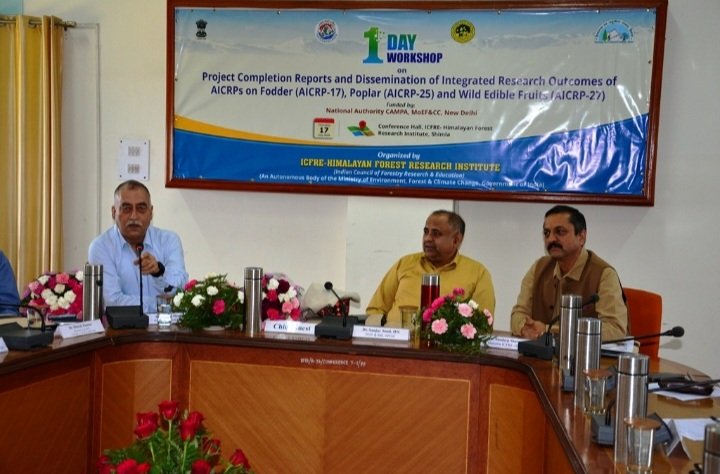
SHIMLA: The Himalayan Forest Research Institute (HFRI), Shimla, recently hosted a high-profile workshop on July 17, claiming major successes in three All India Coordinated Research Projects—on fodder banks, poplar plantations, and wild edible fruits.
While officials lauded these efforts as game-changers for forest conservation and rural livelihoods, critical questions still remain: What exactly was done, and where are the results?
The event, attended by scientists, forest officials, and academicians, celebrated the “completion” of projects that, on paper, promise ecological and economic transformation.
But ground-level data is missing, and stakeholders are asking: Where are the trees, the fodder, and the benefits?
1. Where are the wild fruits?
The project on the conservation and management of wild edible fruit species, such as kafal and burans, was hailed for its potential to support sustainable livelihoods and biodiversity.
Dr. Sandeep Sharma, Director, HFRI, said:
“Conservation of native wild edible fruits is essential to provide alternative livelihood options to forest-dependent communities. Kafal, for instance, has huge potential if managed scientifically.”
He also pointed out that non-scientific methods and overexploitation have led to the decline of many wild species.
“Unknowingly, people destroy these species while collecting them, which is why awareness and sustainable harvesting techniques are critical,” he added.
But despite these strong words, details are absent:
How many kafal or burans saplings were planted?
In which forest ranges?
What’s their survival rate?
No clear data was shared with media or participants, making it hard to assess the real impact of the project.
2. What happened to the fodder banks?
The Fodder Bank project, meant to reduce unsustainable grazing and aid livestock-based rural economies, was another focus. Yet, there was no field-level data presented.
Dr. Dinesh Kumar, Scientist-G and National Project Coordinator from Forest Research Institute, Dehradun, said:
“Fodder and poplar are lifelines of rural people. We’ve worked on reducing the time for availability of quality fodder and on techniques for green and dry fodder conservation.”
These are important goals—but again, the key implementation metrics are missing:
How many fodder banks were established?
What varieties of grass or legumes were used?
Which areas of Himachal were selected?
Farmers and local representatives report no knowledge of such fodder banks being set up in their areas. The absence of third-party verification or pilot-site visits raises concerns.
3. Where are the poplars?
Poplar plantations were promoted as a fast-growing solution for timber, carbon capture, and agroforestry integration.
Their role in soil stabilization and industrial supply chains was underlined.
Dr. Dinesh Kumar added:
“Poplar has proven economic value for rural farmers and is crucial for both small landholders and industries. We need to push it under agroforestry more aggressively.”
Yet the workshop failed to clarify:
How many saplings were distributed under the project?
Who received them and where?
What survival percentage has been tracked?
Again, there is no open-access data or public reporting on plantation coverage.
Grand Announcements, But Ground Questions
Officials from the Indian Council of Forestry Research and Education (ICFRE), Dehradun, emphasized that these projects aim at knowledge creation, capacity building, policy support, and livelihood improvement.
Dr. Rajesh Sharma, Deputy Director General (Research), explained that the Council had launched 31 such projects nationally after 2019–20, with support from the Ministry of Environment, Forest and Climate Change.
“These projects were designed to fill research gaps, support sustainable forest management, and inform policy decisions.
We hope the findings will lead to actionable changes on ground,” Dr. Sharma said.
While the intentions sound noble, the absence of on-ground validation makes it hard for stakeholders to connect the dots between project claims and tangible benefits.
The Questions HFRI Must Publicly Answer:
Before calling these projects a “success,” HFRI and ICFRE must release transparent, verifiable information:
How many wild fruit tree saplings were planted? Where? How many survived?
How many fodder banks were actually established? In which blocks?
How many hectares of poplar were planted? Who benefited?
How much budget was spent on each project, and what are the audit findings?
Until then, these forestry projects risk being seen as well-worded documents with little evidence of field-level change.
For meaningful impact, research institutions must walk the talk—not just speak at workshops.
For independent reporting from the hills, visit www.himbumail.com