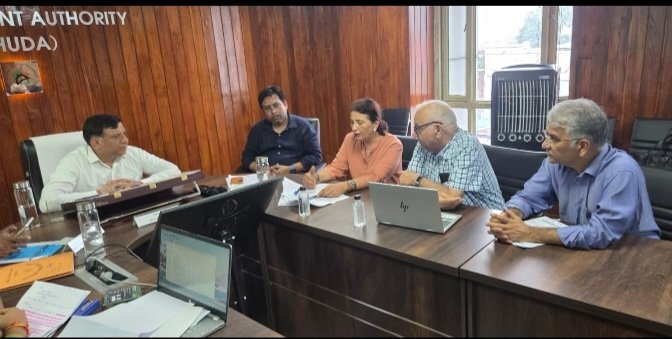
DEHRADUN, JULY 18: Raising serious concerns over Dehradun's rapidly changing urban landscape, the Dehradun Citizens Forum (DCF) on Saturday urged the Mussoorie-Dehradun Development Authority (MDDA) to institutionalise citizen participation and overhaul the city's planning approach, warning that unchecked construction and ecological neglect could irreversibly damage the Doon Valley.
During the public hearing on the proposed Dehradun Master Plan, the Forum submitted two detailed memorandums to MDDA Vice Chairman Bansidhar Tiwari.
Besides flagging issues ranging from construction on geologically sensitive land to shrinking green spaces, the citizens' group proposed setting up a permanent 11-member Dehradun Citizens Advisory Council to ensure that public participation in urban planning extends beyond occasional consultations.
Representing the Forum, Jagmohan Medhiratta, Retu Chatterjee and social activist Anoop Nautiyal argued that while governments and officials change over time, citizens remain the city's permanent stakeholders and should have an institutional role in shaping Dehradun's future.
The proposed council would periodically interact with MDDA, the Municipal Corporation, police and other agencies on issues including urban planning, mobility, environmental protection and waste management. MDDA Vice Chairman Bansidhar Tiwari appreciated the proposal during the hearing.
In a strongly worded 20-point representation, the Forum cautioned against the city's continued expansion through concrete-intensive development at the cost of forests, water bodies and open spaces.
It urged the authority to maintain a balance between urban growth and ecological conservation while protecting natural streams, drainage channels and traditional watercourses that have increasingly come under pressure from construction activity.
The Forum also expressed concern over permitting high-rise buildings and large commercial projects in geologically sensitive zones and near fault lines, warning that such development could increase disaster risks.
It sought strict restrictions on such projects and called for scientific assessments of carrying capacity, environmental impacts and technical feasibility before approving major infrastructure works, including new roads and bypasses.
Questioning the prevailing road-widening approach to tackle congestion, the Forum said traffic problems cannot be solved by expanding roads alone. Instead, it advocated strengthening public transport, improving last-mile connectivity, introducing intelligent traffic management systems and creating safe infrastructure for pedestrians and cyclists.
The memorandum further highlighted Dehradun's mounting waste management crisis, recommending segregation of waste at source, modern recycling infrastructure and ensuring adequate waste processing capacity before approving new residential or commercial developments.
It also called for an integrated rainwater drainage and sewage network, a comprehensive stormwater management strategy to reduce urban flooding and stronger measures to curb rising noise pollution.
Emphasising the city's ecological heritage, the Forum recommended protecting forests, biodiversity-rich landscapes and wildlife corridors by linking green areas such as Malsi, Galjwari, Dudhli and Danda through ecological corridors.
It also urged authorities to prioritise native Himalayan species in urban plantation drives instead of ornamental or exotic varieties.
Welcoming MDDA's decision to hold public consultations, the Forum expressed hope that its recommendations—including the creation of a Citizens Advisory Council—would be incorporated into the final Master Plan.
It maintained that safeguarding Dehradun's natural identity, water resources, green cover and quality of life must remain central to the city's long-term development strategy.