HimbuMail Exclusive
KASOL/ KULLU: Imagine the solitude of a Himalayan forest being ripped apart by pounding bass. And consider this: they have hired many bouncers and goons and not allowing people to film till festival starts on June 7.
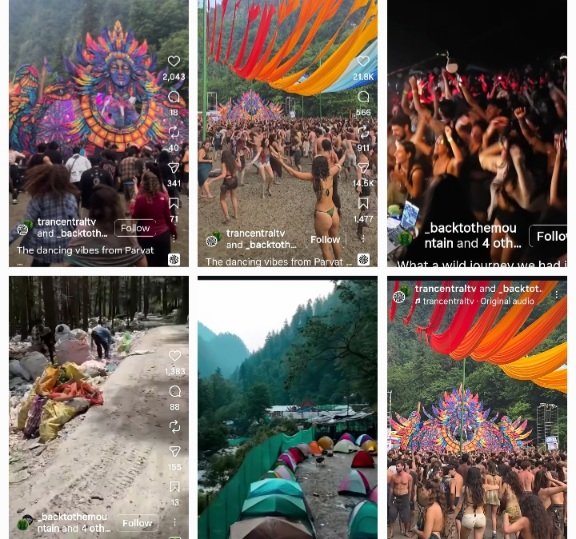
Imagine laser lights slicing through ancient deodar forests as thousands of young topless kick-seekers dance under the influence of ' drug dose' through the night in a remote mountain valley once known for solitude, spirituality and wilderness.
Imagine the banks of a pristine Grahan stream transformed into a sprawling campsite of music stages, tents, food stalls, massage parlour and all-night partying.
That is the spectacle unfolding deep inside the Parvati Valley as the controversial "Back to the Mountains" festival returns after more than a decade.
The sources told HimbuMail the rave party will be going ahead today for five days.
It has triggered alarm among conservationists, trekkers, nature lovers and local residents who fear a fresh assault on one of the Dev Bhoomi’s most fragile ecosystems.
The four-day event, scheduled from June 7 to June 11, is being promoted aggressively on social media by Munch Production.
Ticket prices reportedly range from ₹10,000 to ₹16,000 per participant, attracting visitors from Chandigarh, Delhi, Mumbai, Bengaluru, Hyderabad, Goa and overseas destinations like Israel.
As many as 10,000 revers have booked for the event, sources revealed. The main organizers are Isreali and they are charging more from Indians and less from Israelis, a participant revealed.
Organisers are advertising multiple stages under weird tags as Aghora, Green Nuns, Psychedelic, Tantra with crazy performers, camping facilities and round-the-clock bizarre music deep inside the valley.
The videos of topless dancers and women in bikinis and undergarments gyrating to the high decibel music are doing rounds of social media to attract more and more kick seekers to make dirty money.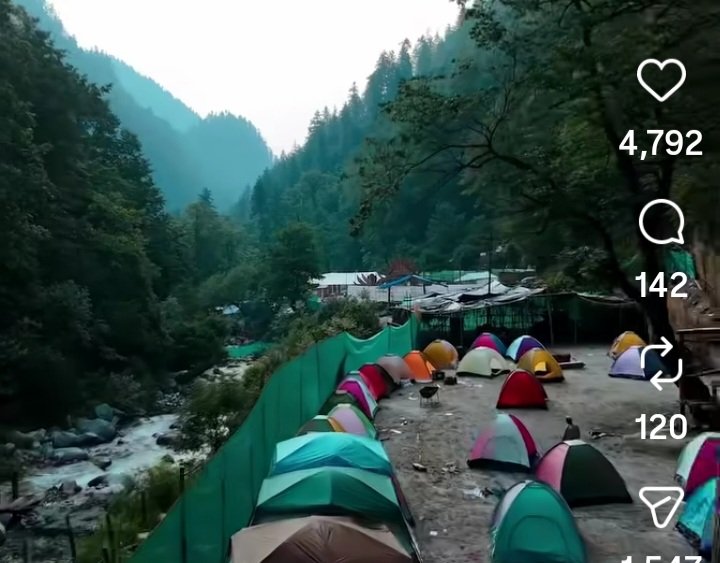
Days before the opening, the rave site is already visible. Temporary camps appeared in forest clearings. Massive sound systems were tested. The crazy cult stages rose from the riverbanks. Trucks carrying equipment moved through Kasol.
After it is unloaded near Kasol, labour carried the equipment through the terrain and foot bridge where trekkers once encountered little more than shepherds, locals, birdsong and the murmur of mountain streams.
What organisers call a celebration of music is being viewed by many locals as the return of a counter-culture that Parvati Valley spent years trying to shake off.
The Road to the Rave
The journey begins at Kasol. Cross the footbridge over the Parvati River and the trail climbs towards Grahan village. Beyond Grahan, the route snakes deeper into forests, following streams and traversing some of the most scenic terrain in the valley before reaching the rave site.
It is here that some of the most uncomfortable questions arise.
Local villagers often spend years seeking permissions for roads, community infrastructure and essential public facilities under forest regulations.
Many applications remain pending or are rejected because of restrictions meant to protect ecologically sensitive areas.
Yet residents say that infrastructure capable of supporting a large commercial gathering has somehow appeared deep inside the forest.
"Villagers are denied permissions for basic development works, but a commercial counter hippie culture rave hosting thousands seems to have found its way into the heart of the forest," remarked a local environmental activist.
The question being asked across Kasol, Grahan and Manikaran is straightforward: Who granted permission for this event? Who approved a gathering of this scale inside a fragile sacred Parvati valley ecosystem?
Did the Forest Department clear the site? Were environmental impact assessments conducted? Were gram sabhas consulted? Were disaster-management plans prepared?
Or has crass commercial tourism once again been allowed to override ecological and cultural concerns?
A Ban in Spirit, a Return in Reality
Parvati Valley's association with rave culture is not new. For years, authorities cracked down on controversial rave gatherings and so-called Full Moon Parties amid concerns over environmental degradation, law-and-order issues and the valley's growing reputation as a hub for drug tourism.
Many residents believed that chapter had finally ended. The return of a large-scale rogue festival has therefore shocked conservationists who say the valley risks slipping backwards after years of efforts to promote responsible tourism.
"What was once discouraged is now being openly advertised across social media platforms worldwide," observed a local resident. The event has already started as thousands have zeroed in on Ksaol for the four days long 24x7 raves under the nose of Kullu administration.
Noise Against Nature
The biggest casualty, conservationists argue, may be the valley and its young population itself. Many youths gave ruined their life due to drug addiction. 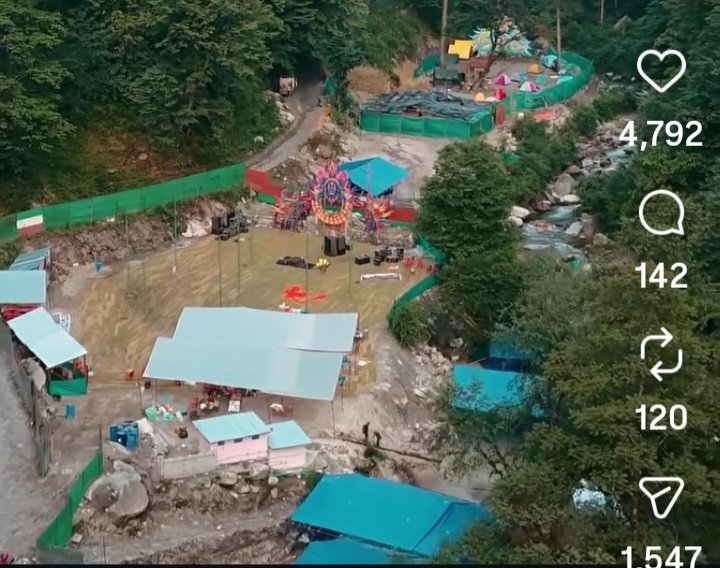
Parvati Valley is home to rich biodiversity, sensitive wildlife habitats and some of the most beautiful trekking routes in the western Himalayas.
Birds, small mammals and other wildlife species that depend upon natural cycles of sound and darkness now face days and nights of amplified music.
Environmentalists warn that prolonged high-decibel noise can disrupt wildlife movement, alter breeding patterns and drive species away from their habitats.
"The attraction of Parvati Valley was never noise," said a trekker who frequently visits the region. "People came here for silence."
A Sacred Valley Under Pressure
Parvati Valley derives its name from Goddess Parvati and the river that flows from the sacred Mantalai glacier and winds its way down through the hot springs of Gheer Ganga and Manikaran and join the Beas river near Bhuntar.
For generations, the Parvati valley has been revered not only for its natural beauty but also for its spiritual significance.
The valley has been rapped by the hydropower projects and have experienced flash floods that inundated Manikaran and marooned Tosh, Kulga Pulga and other villages in 2023 monsoons.
Yet the images being broadcast globally today by Munch tell a very different story.
Promotional videos show giant stages, flashing lights, all-night dancing and semi nude crowds gathering in forested areas, giggling madly along the streams dumping bottles and trash in the stream that many locals regard as sacred.
Conservationists fear that the message being sent to the world is not one of Himalayan culture, spirituality or ecological stewardship but of a counter culture destination for derelicts and drug abusing reavers.
The Waste Question
The festival site lies close to the Grahan stream, whose waters eventually merge with the Parvati River. Environmental groups fear that thousands of visitors camping for days could generate enormous quantities of plastic waste, food packaging, bottles and other refuse.
Past experiences in mountain destinations suggest that even when organisers promise waste management systems, large gatherings often leave behind a trail of litter that finds its way into forests and watercourses.
Photographs from previous events and camping areas in the valley have repeatedly shown discarded plastic, packaging material and other waste scattered across sensitive landscapes that find their ways into the Pavati and Beas rivers and clogged the barrages downstream.
Perhaps the most shocking is the silence of those expected to answer difficult questions. Where is the district administration and who has granted permission? Where are the inspection reports? Where are the elected representatives?
Residents are openly asking where Kullu MLA Sunder Singh Thakur stands on the issue. Similar questions are being directed at Manali MLA Bhuvneshwar Gaur, local panchayat representatives of Kasol, Grahan and Manikaran, and officials responsible for protecting the valley's forests and streams and ecology and culture. What happens to the Sukhu’s government vyastha parivartan and anti-Chitta drive.
Many residents argue that an event of this scale could not materialize without approvals, clearances, logistical coordination and administrative oversight.
A Test for the Government
The timing is politically significant. The Sukhu government continues to speak about environmental protection, sustainable tourism and campaigns against drug abuse.
Yet conservationists say that the return of a major rave gathering to Parvati Valley appears fundamentally at odds with those objectives.
Conservationists are demanding that the Home Department, Forest Department, Pollution Control Board, district administration, State Narcotics Task Force and other agencies scrutinize every aspect of the event, including permissions, environmental safeguards, waste-management plans and compliance with existing laws.
The Devbhoomi Deserves Better
This is about more than one festival. It is about what kind of future awaits the Himalayas. Will fragile mountain valleys be protected for future generations?
Or will they be gradually transformed into commercial playgrounds where ecology, culture and spirituality take a back seat to short-term dirty profits?
As speakers thunder through the forests above Kasol and crowds stream into the valley, many conservationists fear that the voice of the mountains is once again being drowned out.
The silence that made Parvati Valley famous is under siege. And unless authorities answer the growing questions surrounding this event, critics warn that "Back to the Mountains" may ultimately become another step away from everything the Parvati mountains once stood for.
#SaveParvatiValley
#HimalayasUnderThreat
#WhoApprovedThis
#EcologyBeforeProfit
#ProtectTheSacredHimalayas
RESPONSES:
1. I appreciate this coverage. During my tenure as District & Sessions Judge, Kullu (2015-17), I dealt with several rave party cases under the NDPS Act. The organisers were convicted, and one of the most satisfying judicial interventions was ordering the forfeited money seized during police raids to be used for the rehabilitation of drug addicts.
As Chairman of the District Legal Services Authority, I also held meetings with the DC, SP and other stakeholders to ensure a strict crackdown on rave parties. It is therefore surprising and disturbing to see such events now being openly advertised and organised. This reflects a serious lapse on the part of the district administration.
The drug menace in Kullu Valley has assumed alarming proportions. Well-organised networks operate in remote areas beyond Malana and on higher ridges where access for enforcement agencies is difficult. While poor labourers and porters are often arrested, the larger operators frequently remain beyond the reach of the law.
The long-term solution lies not only in stricter enforcement and modern surveillance but also in empowering local communities. The residents of Malana need better connectivity, land settlement, livelihood opportunities and greater integration with the mainstream. Unless these issues are addressed, the drug economy will continue to deepen its roots in the region.
- PREM PAL RANTA, FORMER DISTRICT AND SESSIONS JUDGE
2 Thanks Kuldeep ji for highlighting this brazen molestation of our Dev Bhumi ..if we care for Devtas...
Are Govts sold to money bags ..but what about our Hindu bhakts ..who can lynch in name of cow ..but allow all this.
-RAMESH NEGI, PRESIDENT INTEGRATED MOUNTAIN INITIATIVE
3.Disturbing Disturbing scenarios without answers by appropriate authorities
- Dr MP SUD, PRESIDENT, SDF HIMACHAL
4 Why is the govt not stopping all this?
-ANOOP NAUTIYAL, PRESIDENT, SDC Foundation, DEHRADUN
5. Himachal Police has zero tolerance against drugs. Rave parties promoting illegal activities will face strict action. Responsible tourism is welcome in Dev Bhoomi Himachal.
-A SENIOR POLICE OFFICIAL