Shimla, July 15: Despite years of promotion, natural farming in Himachal Pradesh continues to face a credibility test on the ground, with many farmers saying the model has yet to evolve beyond policy documents, workshops and review meetings into a practical and dependable farming system.
While government officials project the scheme as a transformative agricultural movement, cultivators in many parts of the state remain confused about the availability of natural farming inputs, market linkages and technical support.
The latest review meeting of the Rajiv Gandhi Natural Farming Khushhal Kisan Yojana once again highlighted ambitious targets and digital reforms, but it also revived questions about whether the programme has translated into widespread adoption in farmers' fields.
The meeting as was the case with previous ones as well, turned out to not up to mark.
The state government has no w shifted its focus from merely enrolling farmers to building a comprehensive digital ecosystem around natural farming.
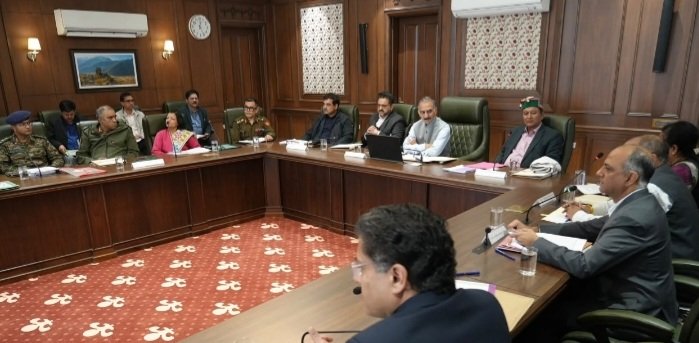
Chairing a high-level review meeting at the Directorate of Agriculture in Shimla, Agriculture Secretary C. Palrasu directed officials to prepare Aadhaar-linked, block-wise databases of farmers practising natural farming.
He also instructed the department to complete mapping of beneficiaries and integrate them with the Him Parivar Register so that farmers can receive benefits from multiple government schemes through a unified digital platform.
Officials believe that accurate digital records would help eliminate duplication, improve transparency and make future planning data-driven.
Branding and marketing have emerged as the government's new priority. It reflects concerns that production alone cannot improve farmers' incomes without assured markets.
During the meeting, the Agriculture Secretary stressed that natural farming products require strong branding, quality certification, value addition and organised marketing channels if farmers are to realise premium prices.
He asked officials to prepare a focused marketing strategy capable of establishing Himachal's natural farming produce in competitive domestic and international markets.
The emphasis also indicates that despite years of promotion, marketing infrastructure for natural farming remains in its formative stage.
The department is also banking heavily on digitisation to improve implementation of the scheme and monitor every stage of agricultural production.
Officials informed the meeting that an integrated digital portal is being developed to capture details of farmers' land holdings, crops, production, procurement and payments under one platform.
The government believes such a system will ensure transparency, enable faster payments and allow real-time monitoring of scheme implementation.
However, experts caution that digital platforms can support governance only if they are backed by effective field-level extension services and regular interaction with farmers.
Official statistics continue to paint an optimistic picture of the programme's expansion across Himachal Pradesh.
According to the Agriculture Department, more than 2.52 lakh farmers are practising natural farming on 44,138 hectares of land.
The government is also procuring wheat, maize, turmeric, ginger and Pangi Valley barley produced under natural farming at the Minimum Support Price (MSP), describing it as an incentive to encourage wider adoption.
These figures have frequently been cited by the department as evidence of the scheme's growing success.
Yet the impressive numbers have not fully convinced many farmers or agricultural observers.
They argue that statistics alone cannot establish the success of a farming model.
Across several districts, cultivators say they continue to face uncertainty over where approved natural farming inputs are available. They say from where and how to access quality bio-formulations and what scientific support is available when crops are affected by pests, diseases or changing weather conditions.
Many complain that while awareness campaigns are plentiful, practical handholding remains limited.
As a result, several farmers either continue with conventional farming or adopt natural farming only partially.
They also argue that natural farming has become more visible in conference rooms than in crop fields.
Over the years, the programme has generated numerous seminars, workshops, presentations and review meetings.
Yet its actual impact on farm productivity, profitability and sustainability has not been independently assessed on a large scale.
Agricultural economists believe that enrolment figures and acreage under natural farming need to be matched with evidence on crop yields, production costs, market returns and long-term soil health before declaring the initiative a success.
The real challenge before the government now is to convert official enthusiasm into farmer confidence. The farmers need natural farming products in open and in government stores as well.
With climate change, erratic rainfall, rising pest attacks and increasing cultivation costs affecting agriculture across Himachal Pradesh, farmers are looking for practical, field-tested solutions rather than administrative exercises.
In no meeting the problems and issues faced in natural farming are addressed. The bureaucrats give no information on centres providing natural farming inputs and products. The farmers get same old chemical fertilizers in HIMFED and HPMC stores, rue the farmers.
The natural farming mustvensure easy access to inputs, reliable technical guidance, assured procurement and better incomes for farmers. The programme risks remaining stronger in policy discussions than in agricultural fields.
The success of the Rajiv Gandhi Natural Farming Khushhal Kisan Yojana will ultimately be judged not by the number of review meetings held or databases created, but by whether farmers themselves begin to adopt it with confidence and conviction.
Senior Agriculture Department officials, including Additional Directors Dr Atul Dogra and Dr Neeti Soni, Joint Directors Dr Sameer Sharma and Dr Ravindra Chauhan, and Deputy Director of the Natural Farming Khushhal Kisan Yojana Dr Mohinder Singh Bhawani, were present during the review meeting.
What lessons they take back? Will farmers get the desired natural farming products and inputs? Only the time dill tell.
#HimachalPradesh #NaturalFarming #Agriculture #Farmers