NEW DELHI/SHIMLA:
As US President Donald Trump landed in Beijing for his first China visit after returning to power, the posturing alone sent a strong geopolitical signal across the world: Washington and Beijing may still be strategic rivals, but neither can afford an uncontrolled collision that they both confronted till last month, anymore.
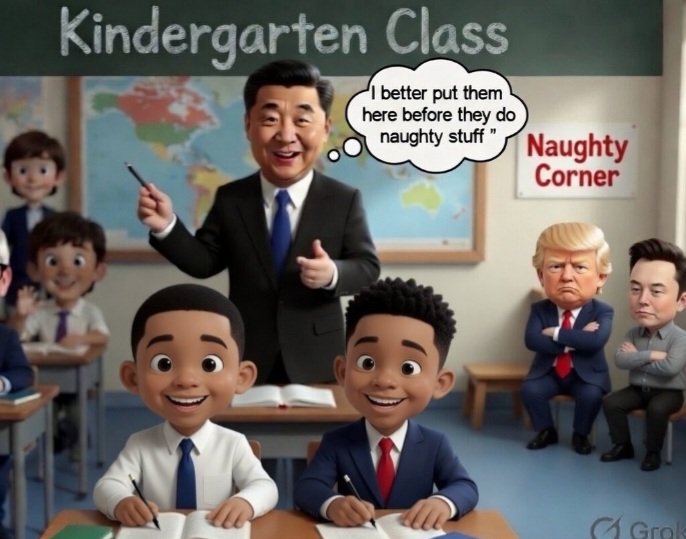
The kindergarten class promo by the popular Chinese state controlled media featuring Xi as a stick wielding teacher while Trump and Elon Musk consigned to the "Naughty corner" is doing the rounds on social media.
For India, watching from the sidelines amid the turbulence of the Iran war, the summit matters less for ceremonial snubs or airport protocol and more for one crucial question — will the world’s two largest economies finally cool the tariff war and return to business pragmatism?
US can't ignore two emerging Asian giants- India and China. Trump knows it now. It is more of "chip war" between US and China than trade in general and hence Taiwan is a hot chip war zone and Huang leading the NVIDIA is a bigger favorite than Elon Musk in Beijing.
Trump is a "ruthless capitalist"and Xi is a 'sinicized totalitarian' as many critics are out to commenting on them.
But both know it is MAS, Mutually Assured Survival that holds the key for future not MAD, Mutually Assured Destruction that will lead to "Doom, the Politics of Catastrophe".
The timing of the visit is striking. The global economy is already rattled by the expanding Middle East conflict, oil price volatility and supply-chain anxieties. Asia, heavily dependent on energy imports and export-driven manufacturing, stands particularly vulnerable.
In that backdrop, Trump arriving in Beijing with a delegation that included top 10 Billionaires, Jensen Huang, Elon Musk, Tim Cook and many others underscored one reality: despite years of decoupling rhetoric, America’s corporate giants still need China.
The reported US clearance allowing several Chinese firms to buy Nvidia chips further reinforced that strategic competition has not eliminated economic interdependence.
Washington may talk national security, but Silicon Valley continues to eye the vast Chinese market. Beijing, meanwhile, desperately needs advanced chips to sustain its AI ambitions and DeepfakesTechnology.
Chinese President Xi Jinping appeared keen to project calm confidence that Deng Xioping was known for. His message that “we should be partners, not rivals” was aimed not merely at Trump but at the wider world increasingly nervous about a fractured global order.
For India, however, the larger diplomatic theatre extends beyond US-China ties. Prime Minister Narendra Modi, Xi and Russian President Vladimir Putin have all engaged in calibrated diplomatic positioning before the Iran conflict spiralled further.
New Delhi has maintained a cautious balancing act — deepening strategic ties with Washington while preserving energy, defence and geopolitical space with Moscow and Tehran. But the formal agreement between New Delhi and Washington is yet to be signed.
Indian strategic affairs expert Brahma Chellaney captured the anxiety in many geopolitical circles when he observed that Trump’s “war of choice” with Iran risks draining American resources that would otherwise be needed for long-term competition with China.
His sharper warning — that “many countries agree China is winning” — reflects the growing perception that Beijing is gaining strategic patience while Washington appears overstretched across multiple theatres.
Ironically, while Trump seeks Beijing’s help in containing the Iran crisis, China has steadily expanded its footprint across West Asia through trade, energy diplomacy and infrastructure investments.
Tehran too sees Beijing as a more stable long-term partner than Washington.
The summit also exposes the limits of ideological confrontation. American conservatives continue attacking China over alleged religious repression and the Communist Party’s “sinicization” campaign, accusing Beijing of rewriting faith traditions and tightening state control over churches and clergy.
But Xi took Trump to the totalitarian Temple of Heaven in his bid to silence his critics in the US and outside.
Yet geopolitical compulsions are forcing engagement even amid deep distrust over Taiwan, trade, cyber espionage and technology theft.
Social media reactions mirrored the polarisation. Trump supporters hailed the “warmth” between the two leaders as proof that strong nations can compete while cooperating.
Critics mocked the absence of Xi at the airport reception, portraying it as a symbolic slight to an American president increasingly seen as needing China more than China needs America.
But beyond online noise lies a harder economic truth. Neither side can afford a prolonged trade rupture. American companies want access to Chinese consumers and rare earth supplies. China wants technology access, export stability and avoidance of strategic encirclement.
India, meanwhile, has its own long game. Even as the Trump-Xi summit dominated headlines, India quietly crossed a major nuclear milestone with the operationalisation of its 500 MWe Prototype Fast Breeder Reactor at Kalpakkam.
The achievement places India alongside Russia among the very few nations operating commercial-scale breeder reactor technology — a critical step toward unlocking the country’s vast thorium reserves.
The contrast is telling. While Washington and Beijing wrestle over tariffs, chips and geopolitical dominance, India is attempting to build long-term strategic autonomy through energy security, manufacturing expansion and multi-alignment diplomacy.
New Delhi’s core interest now is stability. A prolonged US-China confrontation combined with a widening Iran war could trigger energy shocks, disrupt trade routes and damage emerging economies.
But if Trump and Xi manage even a temporary détente on tariffs and technology restrictions, India could benefit from calmer markets, more predictable supply chains and breathing space to strengthen its own economic rise.
For now, the Beijing summit is less about friendship and more about necessity. The world’s two biggest powers may distrust each other deeply, but the costs of open confrontation have become too dangerous even for them to ignore.
But is good for world that the two super powers have come to the table to fight and solve trade and chip wars. It is hopes they including other do the same and the present Middle East War crisis ends at the earliest.
#TrumpXiSummit #USChinaRelations #IndiaGeopolitics #IranWar