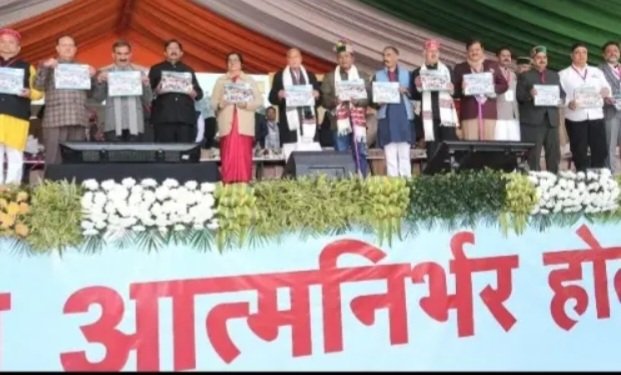
Shimla: The much-hyped hoardings proclaiming “Aatam Nirbhar Hota Himachal,” featuring Chief Minister Sukhvinder Singh Sukhu, splashed across the state capital and towns by the DPR department at a cost of crores over the years, are now under lens of economic experts.
As Himachal Pradesh completed 55 years of statehood this year, these claims sound increasingly hollow—even absurd—when weighed against its economic performance, especially in comparison with fellow Himalayan states.
Experts point out that while Himachal was never created on the strength of its revenue base, a close tracking of its fiscal trajectory today reveals a worrying disconnect between rhetoric and reality.
They argue the time has come to dissect the state’s economic performance more honestly, particularly as the Chief Minister has been repeatedly pitching a “self-reliant Himachal” for the past three years.
Himachal Pradesh has now many things to be worried about.
The hard economic data of its economic health is no longer whispering—it is screaming when we compare its performance with even smallest Himalayan states.
Fresh comparative figures from State Budget 2026–27 lay bare a troubling reality.
Himachal Pradesh, despite its size and legacy advantages, is steadily losing economic ground. It now struggles to keep pace with smaller hill states like Meghalaya and Mizoram.
With an estimated population of around 75 lakh, Himachal’s fiscal metrics paint a stark picture of stress.
If one goes by state’s revenue expenditure for 2025–26 (RE) presented by Chief Ministers of four Himalayan states in question, Himachal presents a dismal story.
Himachal’s revenue expenditure stands at ₹54,349 crore, but its revenue budget estimate for 2026–27 drops sharply to ₹46,938 crore. It is an indication of tightening finances rather than expansion.
Even more worrying is the committed expenditure—₹35,641 crore. It is eating up a massive chunk of Himachal’s budget, leaving little room for development.
Compare this with Meghalaya, a far smaller state with a population of roughly 35 lakh.
Its revenue budget rises to ₹21,812 crore with a healthier capital expenditure of ₹7,439 crore. Mizoram, smaller still, maintains stability with capital spending at ₹2,588 crore— it is remarkable given its limited base.
The real red flag for Himachal lies in capital expenditure—the engine of growth. Its GSDP stands at Rs 2, 54000 Crore.
However, from ₹10,229 crore in 2025–26 (RE), its capital expenditure crashes to a mere ₹3,090 crore in 2026–27 (BE).
This steep fall signals a near freeze on infrastructure expansion and development works.
In contrast, both Meghalaya and Mizoram show steadier capital investment patterns, underlining a more balanced fiscal approach.
Himachal’s Pradesh Chief Minister Sukhvinder Singh Sukhu’s repeated talk of self reliant Himachal sounds hollow in face of this economic reality.
Even Uttarakhand, often seen as a comparable Himalayan state, is operating at a different scale altogether.
With a GSDP far ahead and capital expenditure touching over ₹18,000 crore, Uttarakhand is clearly outpacing its neighbour.
The per capita lens sharpens the crisis further. With a larger population than Meghalaya and Mizoram, Himachal’s shrinking development spend translates into thinner resource allocation per citizen.
Rising salary, pension, and interest burdens are clearly choking growth-oriented expenditure with debt burden crossing Rs 1.10 Lakh Crore.
Against this backdrop, repeated assertions by Chief Minister Sukhvinder Singh Sukhu about making Himachal “self-reliant by 2028” are increasingly being questioned.
With falling capital investment, high committed liabilities, and limited fiscal space, the pitch appears more aspirational than grounded.
The last body blow came early this year when it's RDG was stopped by the Centre on the ground that Himachal has failed to fulfill its fiscal responsibility.
Critics argue the narrative risks sounding amateurish—more hype than a strategy backed by hard data of its performance.
Experts warn that the warning signs have been visible for years: heavy dependence on borrowings, weak revenue mobilisation, and mounting liabilities. The latest data suggests the situation has now reached a tipping point.
In plain terms, Himachal is no longer competing with bigger states—it is struggling to match even the smallest.
Unless structural reforms, aggressive revenue generation, and strict expenditure discipline are enforced, the hill state risks sliding deeper into a fiscal trap where slogans may dominate headlines, but growth remains elusive.
#HimachalPradesh #StateBudget2026 #EconomicCrisis #FiscalStress #MountainStates