CM releases Human Development Report-2025, says growth must be climate-resilient
1700 Lives Lost, ₹46,000 Crore Gone: Himachal’s Climate Bill Soars as Springs Dry and Fields Fade
Shimla, October 27:
Himachal’s development story now reads like a climate tragedy. In just four monsoon seasons, the hill state has lost 1,700 lives and suffered damages worth a staggering ₹46,000 crore — and the losses keep piling up.
The latest Himachal Pradesh Human Development Report 2025 lays it bare — from drying springs to dying farms, and from forest fires to fragile tourism, the state is fast sliding into a climate and livelihood crisis.
Two-thirds of Himachal’s traditional water sources have dried up, forcing villagers to migrate.
Forest fires, too, are spreading faster than ever — 2,580 incidents in 2024–25, against just 856 two years ago. The report bluntly says: climate change is widening inequalities and hitting the very sectors that fuel the state’s economy.
Tourism Booms, but on Thin Ice
Tourism and construction — the twin pillars of Himachal’s growth — are both feeling the heat. The construction sector employs 11.5% of workers, while tourism pumps 7.8% into the GSDP and gives jobs to over 14% of the workforce.
Tourist arrivals rose 13% in 2024, boosting livelihoods for women, migrants and informal workers. But erratic snowfall, flash floods and landslides are turning Himachal’s scenic charm into a risky bet. The 2025 monsoon alone cost the state ₹24,800 crore in property damage.
“Snow is now a rare guest, and without snow, tourism here will melt,” says a hotelier in Manali.
Fields Losing Out to Factories and Hotels
Agriculture — once Himachal’s pride — is losing ground fast. It still employs 54% of the state’s workforce, but adds only 14% to the Gross Value Added (GVA). Industries and services together take the bigger slice — 40% and 45% of GVA, respectively.
The manufacturing base — driven by pharma units and MSMEs — now makes up 27% of the state’s GVA. But on the flip side, diseases like dengue, diarrhoea, and typhoid are rising with the changing climate, adding a new layer of human vulnerability.
Kinnaur Tops Climate Adaptation, Solan Leads in Human Development
In climate adaptation, Kinnaur leads the pack, followed by Lahaul-Spiti, Chamba, and Kangra.
The UNDP has lauded Chief Minister Sukhvinder Singh Sukhu’s “climate-sensitive development model,” calling it a promising example for other mountain states.
In overall Human Development Index (HDI), Solan tops with a score of 0.880, while Kangra trails at 0.695. The state average stands at 0.783, showing impressive education levels but worrying income inequality.
| Rank | District | HDI |
|---|---|---|
| 1 | Solan | 0.880 |
| 2 | Lahaul-Spiti | 0.839 |
| 3 | Kinnaur | 0.813 |
| 4 | Shimla | 0.812 |
| 5 | Kullu | 0.772 |
| 6 | Mandi | 0.772 |
| 7 | Sirmaur | 0.768 |
| 8 | Hamirpur | 0.757 |
| 9 | Bilaspur | 0.756 |
| 10 | Chamba | 0.743 |
| 11 | Una | 0.723 |
| 12 | Kangra | 0.695 |
A State on the Edge
The numbers tell a tough story — Himachal’s economy is tilting toward sectors that depend on stable weather, but the weather itself is spinning out of control.
Unless the state strengthens its climate resilience, the gains of development may soon wash away with the next monsoon.
Himachal Pradesh may be shining on the development charts, but Chief Minister Sukhvinder Singh Sukhu admits the shadow of climate change is growing longer over the hills.
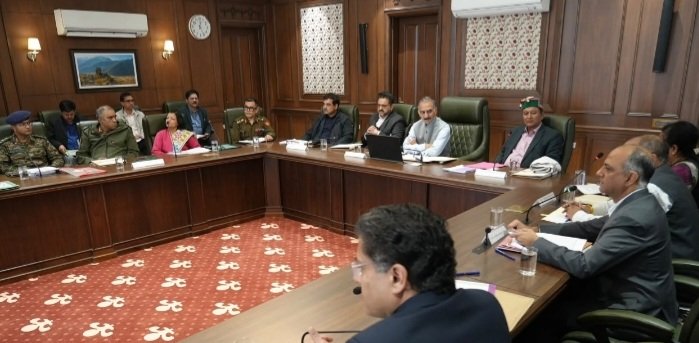
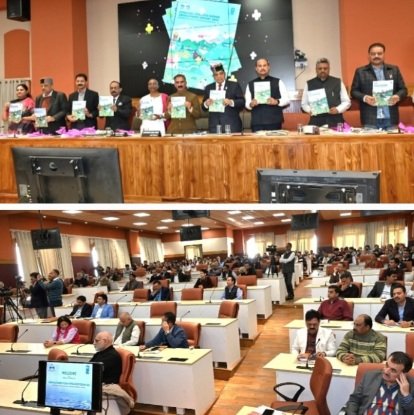
Releasing the Himachal Pradesh Human Development Report-2025 in Shimla on Monday, the Chief Minister said the State’s Human Development Index (HDI) stands at 0.78, significantly higher than the national average of 0.63 — a figure that he called “a matter of pride” for the hill state.
But the celebration was tinged with caution. “The mountains, rivers, forests and glaciers of Himachal are now victims of global warming,” Sukhu said, warning that the State’s progress could be undone if sustainable solutions were not adopted swiftly.
From literacy to life expectancy — progress with purpose
The report highlights Himachal’s impressive strides — a 99.3% literacy rate, making it India’s first fully literate state, and a jump from 21st to 5th position nationally in reading and writing skills within four years.
The infant mortality rate has fallen to 21 per 1,000 live births, and life expectancy has risen to 72 years, mirroring improvements in healthcare.
Poverty, too, has dropped below seven percent, a milestone Sukhu attributed to a focus on both physical and social infrastructure. “We’ve invested not just in roads and industries, but also in education, health, women empowerment and rural development,” he said.
Climate crisis hits home
Yet, the Chief Minister didn’t mince words on the climate front. This year’s monsoon, he said, had brought “unprecedented destruction” — landslides, floods, and cloudbursts that claimed lives and ravaged property. “The effects of climate change aren’t confined to one place — they’re global, and Himachal is paying the price,” he remarked.
He called for collective global action, saying the future “must be human-centric and climate-resilient” to safeguard coming generations.
Green push to offset warming
Sukhu cited the Rajiv Gandhi Self-Employment Start-up Scheme — with an outlay of ₹680 crore — as a step toward balancing growth with sustainability. The government is offering a 50% subsidy on e-taxis, and interest subsidies for solar projects ranging from 100 kW to 2 MW.
“Himachal has become the first hill state to adopt a strong EV policy,” he said, adding that the goal is to electrify public transport by 2030.
UNDP praises Himachal’s model
UNDP representative Dr. Angela Lusigi lauded the State for its green budgeting, climate-sensitive programmes, and focus on decentralized governance.
UNDP Senior Economist Amy Mishra presented the report’s findings, while Chief Secretary Sanjay Gupta and other top officials attended the release.
While the numbers in the report may flatter the Sukhu government. Himachal’s real test lies not in topping the charts, but in protecting its fragile ecology while sustaining growth.
The State may have scaled human development heights, but climate change is fast eroding the ground beneath its feet.
#HimachalDevelopment #ClimateCrisis #SukhuGovernment #UNDPReport