
NEW DELHI, JULY 18: In a dramatic pre-dawn operation that could reshape the ongoing student-led agitation in the national capital, Delhi Police on Saturday shifted climate activist and Ladakh reform campaigner Sonam Wangchuk from Jantar Mantar to Safdarjung Hospital after his 20-day hunger strike, triggering protests from fellow demonstrators and setting the stage for a confrontation over the proposed July 20 March to Parliament.
The police action, carried out in the early hours of Saturday, has intensified the political and public spotlight on the movement spearheaded by the Cocraoch Janata Party(CJP), which is demanding the resignation of Union Education Minister Dharmendra Pradhan and pressing a range of issues concerning NEET paper leaks and other students and issues of Ladakh.
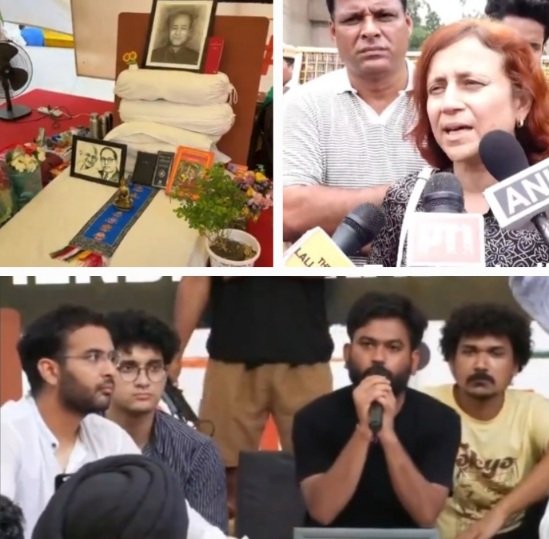
According to protesters present at the site, police personnel entered the protest venue around 3 a.m., reportedly restricting live streaming of events before tightening security around the area where Wangchuk usually emerged in the morning. Around 6 a.m., officers surrounded him with white bedsheets and shifted him to an ambulance, citing directions of the Delhi High Court and medical advice.
Delhi Police defended the action, saying Wangchuk's health had deteriorated after nearly three weeks without food.
The Deputy Commissioner of Police (New Delhi) said that as per the orders of the Delhi High Court and on expert medical advice, Wangchuk had been shifted to hospital for essential treatment due to his deteriorating health condition. Police also appealed to protesters to peacefully vacate Jantar Mantar.
However, Wangchuk's family and fellow protesters challenged the police's version.
His wife, Geetanjali Angmo, told supporters that Wangchuk was stable and that his vital parameters were normal before he was taken away. She declared that the July 20 Parliament March would proceed as scheduled. If Wangchuk is prevented from participating, she said, she would herself lead the march in his place to seek justice for "crores of students and the people of Ladakh."
Safdarjung Hospital presented a more measured medical assessment.
The hospital's Medical Superintendent said Wangchuk was admitted around 7.40 a.m. and was suffering from mild dehydration and weakness resulting from the prolonged fast. She said he was fully alert, all vital signs remained stable, blood tests showed mild dehydration, and doctors were providing appropriate treatment while continuously monitoring him.
The removal has sparked sharp political reactions.
Social activist Yogendra Yadav, who has been associated with the protest, termed the police action "illegal" and asserted that the students' movement would continue regardless of Wangchuk's hospitalization. He maintained that the March to Parliament would still take place.
Meanwhile, another protest leader, of CJP Abhijit Dipke announced an indefinite hunger strike beginning Saturday, declaring that the movement would continue and accusing the BJP government of making a "grave mistake" by removing protesters from Jantar Mantar.
The BJP, however, has not officially responded to Wangchuk's demand seeking the resignation of Education Minister Dharmendra Pradhan or clarified its position on the CJP agitation.
Union Minister and Lok Janshakti Party (Ram Vilas) leader Chirag Paswan praised Wangchuk's contribution to the nation but criticised opposition parties, alleging that Congress, AAP and other political groups were attempting to use Wangchuk for their political agenda instead of seeking public support through elections.
On social media, reactions remained sharply divided.
Supporters accused the government of suppressing a peaceful democratic protest and questioned the timing and manner of the police operation.
Others argued that the intervention was necessary to protect Wangchuk's life after an extended fast, describing the police action as a medical necessity rather than political suppression.
The episode marks another significant chapter in Wangchuk's growing public journey from engineer and education reformer to one of India's most recognised public campaigners.
Internationally known for his work on Ice Stupas, the SECMOL and HIAL, educational model, renewable energy innovations such as solar tents for the Indian Army, and climate adaptation in Ladakh, Magsaysay Awardee, Wangchuk has increasingly emerged as a national voice on environmental protection and constitutional safeguards for Ladakh.
His campaigns for Sixth Schedule status and statehood for Ladakh, including the Leh-to-Delhi march and his earlier preventive detention before being released, had already expanded his national profile. His decision to join the present hunger strike further elevated the visibility of the ongoing student movement.
Whether the government's strategy of avoiding direct political engagement with the agitation succeeds may now depend on what unfolds on July 20.
The proposed Parliament March had reportedly drawn interest from several opposition leaders, with reports suggesting that Rahul Gandhi and Tamil Nadu Chief Minister Vijay, were expected to meet Wangchuk around that time. It remains uncertain whether those plans will proceed in light of his hospitalization.
With Delhi Police asking protesters to vacate Jantar Mantar, Wangchuk under medical observation, and protest leaders insisting the march will continue under any circumstances, the focus has now shifted decisively to July 20.
Incidentally the Monsoon season of Parliament is starting on Monday that has added public anxiety to the march as Delhi Police that works under the Centre unlikely to allow this march.
Whether the Parliament March proceeds peacefully, is restricted by authorities, or becomes a larger political flashpoint will be closely watched across the country, making it the next defining moment in a movement that has steadily gathered national attention beyond the issues of Ladakh alone.
Will CJP agitation die or will it gain traction remains to be seen as much will depend how Congress, SP, AAP take it. Congress has already launched its sessions with the youth across the country. Others are waiting in the wings. The situation is fluid. But the Modi Government has chosen not to engage with CJP.